There is a number in this category that everyone quotes and nobody sits with.
The B2B buyer intent data market is estimated at roughly $4.49 billion in 2026, with projections putting it near $20.89 billion by 2035. Enormous capital, compounding fast. In the same body of analysis, 98% of marketers describe intent data as fundamental to demand generation, and 24% report exceptional ROI from it.
Read those two sentences together. Three out of four buyers of a product they consider fundamental describe the results as fine. Not bad. Fine. And the category is on track to quintuple.
The easy explanation is that the data is bad. It is certainly noisier than the marketing implies: about 52% of sales professionals report frequent false positives, and around 29% cite misattributed IP data as a core problem, which is what you would expect after remote work and VPNs took a hammer to IP-based identification. A graduate student researching a dissertation and a CTO shortlisting vendors leave a similar trail.
But bad data is not the main event, and blaming it lets everyone off the hook. Two other things are going on. One is a category-wide misunderstanding about what signals are for. The other is newer, structural, and nobody has priced it in yet.
A prioritization layer sold as a lead list
Here is the failure in its most common form.
You sign a contract with a major intent provider. Marketing exports the surge list every Monday. It goes to the SDR team as a queue. They work it for a week, bounce rates sit somewhere in the low double digits, and the pipeline contribution report at the end of the quarter is embarrassing enough that nobody presents it in full.
Nothing in that sequence was a data problem. The list was treated as a set of leads, and it was never a set of leads. Account-level intent tells you that somebody at Acme Corp read three articles about your category. It does not tell you which of Acme's four hundred employees did it, whether they have budget, or whether they are a buyer at all rather than an analyst writing a market map.
Signals are a prioritization layer. They reorder a list you already have. They do not generate one.
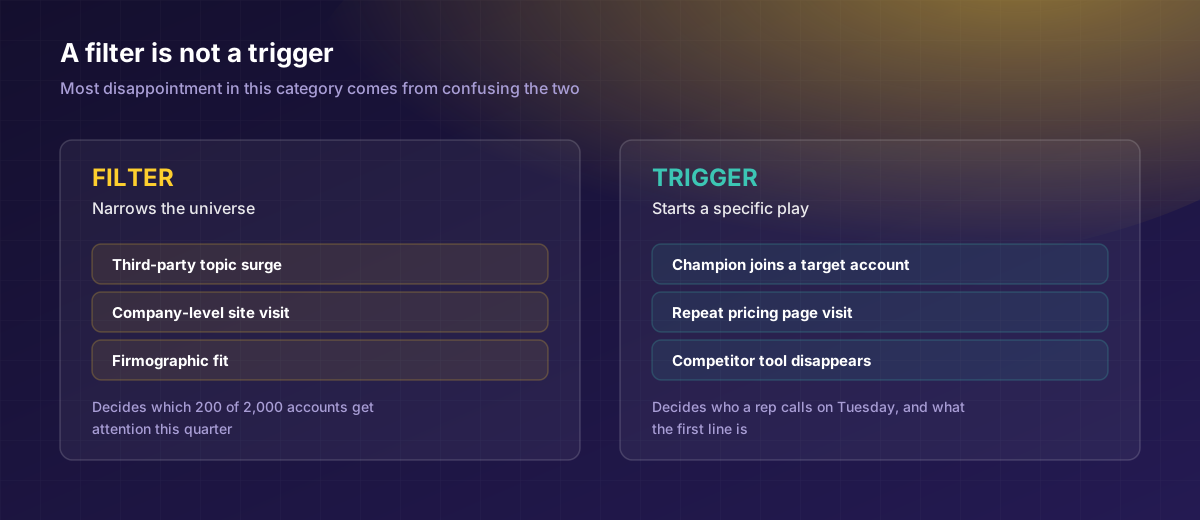
That distinction sounds pedantic until you look at what it changes operationally. If signals are a prioritization layer, then the account list comes first and the signal decides sequencing within it. Fit answers who could ever buy, which is the job of a properly weighted ICP scoring model for ABM. Signals answer who to call this week. Run it the other way and you get in-market companies who will never close, which is a specific and expensive kind of busy.
This is also why signal-based selling is genuinely the next step for account-based programs rather than a replacement for them. The most common failure in account-based marketing strategy is spending equal effort across unequal accounts. Signals are how you spend unequal effort correctly. But they need a target account list underneath them or they have nothing to prioritize, and that list has to be one your reps will actually work rather than one they quietly ignore.
And a signal without a play attached is not a signal. It is a report. If your system flags an account and the next step is a human deciding what to do, you have built a dashboard, and dashboards do not create pipeline. The three tiers and three motions in our ABM framework are the missing half for most teams here: a signal earns a tier, and the tier already has a defined play attached to it.
The half-life rule
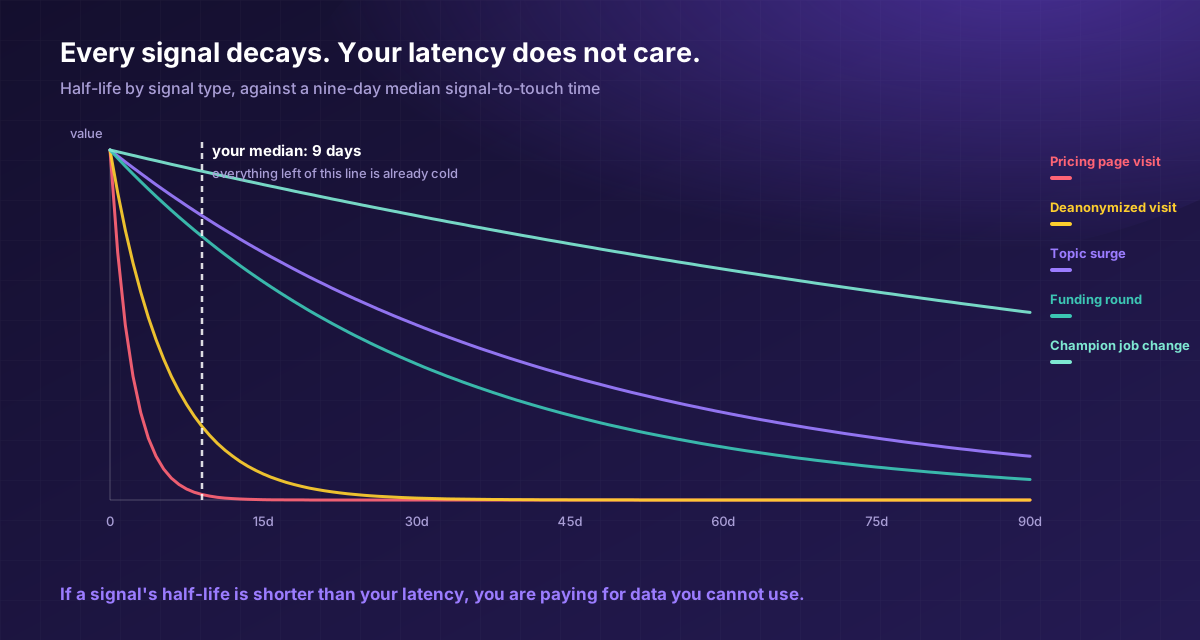
Every buying signal decays, and they decay at wildly different rates. This is broadly known. What almost nobody does is the arithmetic that follows from it.
Approximate decay behavior, synthesized from published patterns:
| Signal | Approximate half-life | Act within | The play it earns |
|---|---|---|---|
| Demo request, pricing page visit | Hours to 3 days | 4 hours | Direct rep outreach, referencing nothing |
| Deanonymized site visit | 2 to 7 days | 24 to 48 hours | Contextual sequence, role-matched |
| Third-party topic surge | About 30 days | 7 to 14 days | Light outbound plus nurture |
| Funding round | Sharp through 30 days, near baseline by 90 | 2 to 4 weeks | Use-of-funds thesis to the budget owner |
| Champion job change | 90 to 120 days | 30 days | Warm relationship play at the new company |
| Tech stack change | About 60 days | 60 days | Displacement or complement play |
Directional, drawn from published decay patterns and funding-signal analysis. Vendors' own figures differ. Calibrate against your own reply data before you build thresholds on them. We rank thirty of these in the buying signals that actually predict pipeline, including the eight that stopped working.
Now the arithmetic.
Measure your median time from signal detection to first human touch. Not your target. Your actual, measured median, including the weekend the alert fired on and the two days the account sat in a queue waiting for territory assignment. Most teams who have never measured this are somewhere between four and fourteen days.
Put that number next to the table.
Every signal whose half-life is shorter than your latency is money you are setting on fire. If your median is nine days, you are paying for pricing page visits you cannot act on, and you are paying for deanonymization that goes stale before anyone reads it. You are effectively buying funding announcements and job changes at a premium, bundled with a lot of data that expires in transit.
The standard advice at this point is to layer more sources for better composite coverage. That advice is backwards for most teams. The correct first move is to buy fewer signals and fix latency, because latency is the variable you control and coverage is the variable you rent. If you are weighing a platform purchase right now, our buyer's guide to the ABM platforms covers what each tier actually costs, 6sense vs Demandbase compares the two enterprise options head to head, and it is worth reading whether you need ABM software at all first, because most teams under $10M ARR are solving a routing problem with a procurement decision.
Two teams with identical data contracts and different latencies are not running the same motion. The one that touches in 24 hours is running signal-based selling. The one that touches in eleven days is running a slightly better-informed list pull, and paying signal-based prices for it.
Send us one quarter of signal alerts and the matching activity log. We will measure your real median signal-to-touch time, show you which of your current data contracts you are structurally unable to use, and hand you the routing fixes in priority order. Free, no pitch, and you keep the findings either way.
The coverage hole nobody priced in
This is the part of signal-based selling that changed in 2026, and it is not in most vendor decks for the obvious reason.
Intent data works by observing behavior on surfaces that can be observed. Publisher networks that carry a tracking pixel. Review sites. Content syndication. Your own website, if you have deployed identification. The entire model depends on the buyer conducting their research somewhere that a third party is watching.
Buyers have started conducting it somewhere nobody is watching.
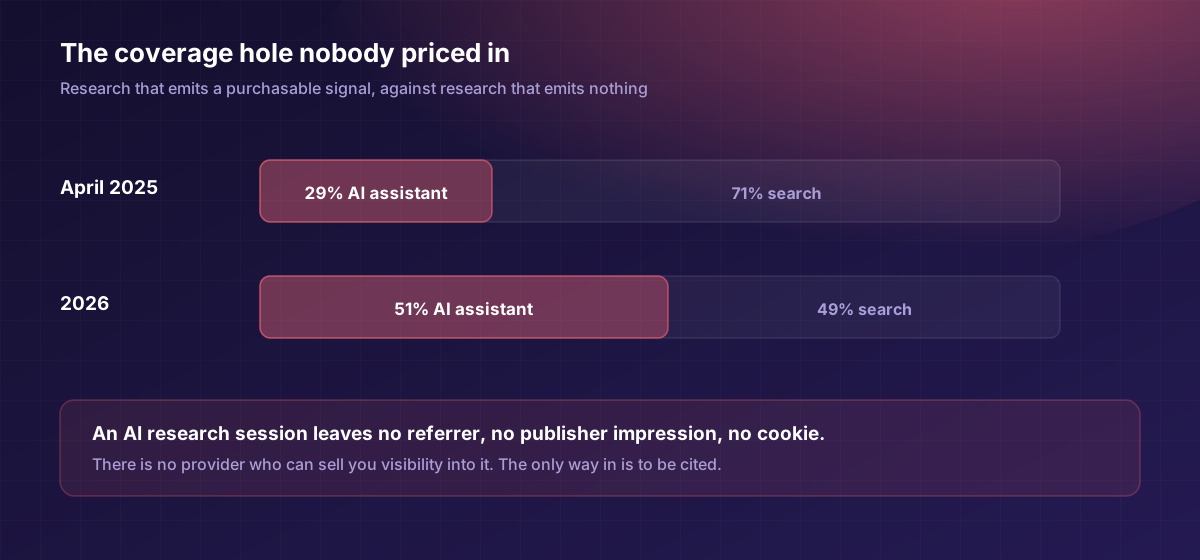
Research reported by G2, surveying over a thousand buyers, found that 51% of B2B software buyers now begin research in an AI assistant more often than in a search engine, up from 29% roughly a year earlier. Gartner's work over the same period shows 67% of B2B buyers preferring a seller-free experience, up from 61%.
An AI research session emits nothing. No referrer. No publisher network impression. No review site page view. No cookie to sync. A buyer can spend forty minutes inside an AI assistant assembling a shortlist, comparing your product to two competitors, forming a price expectation and a security objection, and produce precisely zero records in any intent data product on the market.
Set that beside two long-standing benchmarks. Forrester's work puts 70% to 80% of the buying journey complete before sales contact, and Gartner's finds buyers spending about 17% of total purchase time with vendors, split across all of them.
Combine the three and the picture is uncomfortable. The anonymous phase was already most of the journey. It is now migrating to a channel that produces no purchasable signal. Your signal coverage is shrinking every quarter while your signal spend goes up, and no line item on the invoice will tell you this is happening.
Two consequences follow, and the second one is the one worth sitting with.
First, you cannot buy your way out of it. There is no provider who can sell you visibility into an AI research session, because there is no observable event to sell. The only way to be present in that conversation is to be cited in it. Which means AI visibility stops being a traffic strategy and becomes a signal-generation strategy: it is now one of the few levers you have on the part of the funnel where the decision is actually being formed. We have written up how to get your brand cited by AI assistants and answer engines separately, and it belongs in the same budget conversation as your intent contract, not a different one. It is also the entire premise of our SEO, AEO and GEO practice.
Second, and less obvious: the signals you do still receive have changed character. If a buyer completes more of their evaluation invisibly and only becomes observable later, then the first signal you catch sits closer to the decision than the equivalent signal did three years ago. It is worth more. It also expires faster, because there is less runway between it and a shortlist that has already formed.
That is a double squeeze. Coverage falls, and the latency budget on whatever coverage remains falls with it. A nine-day response time was mediocre in 2023. In 2026 it is structurally too slow, and it will keep getting more so.
Which loops back to the half-life rule. The teams who will do well here are not the ones with the most sources. They are the ones who can move from detection to a relevant human touch inside a day, on a smaller number of signals they trust, while being visible in the research channel that emits nothing at all. Being visible there starts with being extractable, which is what answer engine optimisation is actually for.
Stacking beats volume
One more correction, and it is the cheapest of the three to implement.
A single signal is close to meaningless. Someone visited a pricing page. That could be a buyer, a competitor doing research, a candidate preparing for an interview, or a student. Standalone third-party topic surges correlate with actual buying behavior in the range of 5% to 15%, which is better than nothing and nowhere near good enough to route a rep's week.
Three signals from different sources inside the same seven-day window is a different object entirely. A pricing page visit, a competitor comparison on a review site, and a new VP hire in the relevant function is a pattern that noise does not produce often.
So rank, do not sum. Ten signals in a week is usually nine pings and one funding round, and a scoring model that adds them together will tell you that account is hot for the wrong reason. Weight by signal type, decay each one on its own curve, and require convergence across sources before an account earns a tier one play. The weighting mechanics are the same ones behind our account scoring model, applied to events rather than firmographics.
Then apply the multiplier almost every model omits. If a warm path exists to anyone in the buying group, an investor, a former colleague, an existing customer, multiply the score by 1.5 to 2. A large share of intent-sourced pipeline that never converts had a real signal attached and got routed cold, which is a routing failure being recorded as a data failure.
Two more things worth knowing before you build thresholds. Buying groups are not linear: around 74% revisit a buying step they thought they had finished, and groups that reach consensus close at roughly two and a half times the rate of divided ones. And irrelevance now carries a direct cost, with Gartner finding that 73% of B2B buyers actively avoid suppliers who send irrelevant outreach. A false positive is not a neutral event. It removes an account from your future.
What the system actually looks like
Stripped of vendor language, a working signal motion has five parts and only one of them is a purchase.
| Layer | What it does | Where teams get it wrong |
|---|---|---|
| Account list | Defines the eligible universe | Skipped entirely, so signals become the list |
| Detection | Captures events across first-party and third-party sources | Buying breadth before fixing latency |
| Scoring | Weights, decays and converges signals into a rank | Summing instead of ranking, no decay applied |
| Routing | Puts the right account in front of the right rep, fast | The step where most of the latency actually lives |
| Play | The specific motion each signal tier earns | Missing, so the output is a report and not a pipeline |
The routing row is where most of the damage is. Detection is usually adequate and scoring is usually adequate, and then an account sits in a queue for six days waiting for a territory assignment or a manager's review, and a system with a two-hour detection capability delivers a two-week response. Every hour you remove from routing is worth more than every dollar you add to detection.
This is unglamorous plumbing, which is exactly why it stays broken. It is also entirely automatable. We have published the intent-to-play workflow that handles the detection-to-routing path, two full demand gen systems built as n8n workflows, ten smaller automations a revenue team can steal outright, and the seven guards that stop those workflows breaking in production, because a routing system that fails silently is worse than no routing system at all. If you would rather not build it yourself, that is what our n8n workflow automation practice is for.
Three dependencies worth naming before you start. None of this survives a CRM where accounts are duplicated and lifecycle stages mean different things to different teams, so fix the CRM layer first if that describes you. The fastest signal in the world is worthless if the message lands in spam, which is a multi-domain sending infrastructure problem rather than a signal problem. And if you are considering handing the whole response layer to a tool, the build versus buy math on AI SDRs is worth reading first, because those tools are strongest at exactly the step signals do not need help with.
The number to run it on
Not signals detected. Not accounts surfaced. Not intent score distribution. Those are volume metrics and they all go up when you buy more data, which is why vendors like them.
Measure signal-to-touch latency: median hours from signal detection to a relevant human touch. Segment it by signal type, because a four-hour target for a demo request and a four-hour target for a tech stack change are not the same ambition. The scoring side of that has the same constraint: a model that recomputes weekly will route a three-day signal on day six, which is the same as not routing it.
It works as the primary metric for three reasons. You control it entirely, unlike coverage or data quality. It is measurable weekly without waiting a quarter for pipeline to resolve. And it is the one number that, when it improves, makes every other input in the system worth more without spending anything extra.
Run the audit once. Measure your real median, put it next to the half-life table, and see which of your data contracts you are structurally unable to use. For most teams that exercise produces an uncomfortable answer and a very clear first project, and the first project is almost never buying another source.
The evolution from account-based marketing to signal-based selling is not a change of philosophy. It is the same idea, which is that some accounts deserve more effort than others, with the addition of timing. The teams getting it right in 2026 are not the ones with the biggest signal stack. They are the ones who noticed that the buyer went somewhere they cannot watch, got faster on the signals they can still see, and started competing to be the answer in the room they were not invited to.
Bring your current signal stack and one quarter of alerts to a 30-minute call. We will show you where the latency actually sits, which contracts to cut, and what the first fix is worth, whether you hire us or not.
Frequently asked questions
Signal-based selling is a go-to-market motion that triggers outreach from observable events at an account, such as a funding round, a champion changing jobs, a hiring pattern, or a pricing page visit, rather than from a fixed calendar or a static list. The signal decides who gets worked this week and what the first line of the message is.
Intent data answers who appears to be researching your category. Buying signals answer what just happened at an account that changes its priorities. Intent narrows the universe, signals trigger the timing of the touch. Teams that treat them as synonyms usually end up with a subscription and no motion.
Because it is bought as a lead list and it is actually a prioritization layer. Around 98% of marketers call intent data fundamental to demand generation while only about 24% report exceptional ROI. Roughly 52% of sales professionals report frequent false positives, and about 29% cite misattributed IP data. The signals are noisier than the marketing suggests, and they are usually activated too slowly to matter.
The time it takes for a signal to lose half its predictive value. A pricing page visit is worth most within hours and is cold inside a week. Third-party topic surges lose about half their value in 30 days. Funding decays sharply through the first 90 days. Champion job changes stay useful for 90 to 120 days. If your time from signal to first human touch is longer than a signal's half-life, that signal cannot help you.
The working rule in 2026 is 24 to 48 hours from detection to first touch for behavioral signals, and around four hours for explicit ones such as a demo request or pricing page visit. Slower than that and you are contacting a moment that has already passed.
Substantially. Research reported by G2 found that 51% of B2B software buyers now begin research in an AI assistant more often than in a search engine, up from 29% a year earlier. Those sessions produce no referrer, no publisher network activity, and no third-party intent record, so they are invisible to every intent data provider. The share of buyer research that emits a purchasable signal is shrinking.