Almost every ranked list of buying signals in circulation was assembled by reading other ranked lists of buying signals.
You can tell because they all still include email opens. Apple's Mail Privacy Protection has been pre-loading tracking pixels through proxy servers since September 2021, and Litmus data from January 2026 puts Apple Mail at 51.52% of the global email client market. Add enterprise security gateways that open and detonate every message before a human sees it, and the open event has almost no relationship to human attention. It has been dead for years. It is still a scoring input in a remarkable number of marketing automation instances, because it is a default field and nobody turned it off.
That is the actual problem with signal lists. Not that they are wrong, but that they are stale in ways that are invisible until you audit them.
So this list is built on a different organizing idea, and it is worth stating up front because it explains why the order looks the way it does.
Why most signal lists are quietly out of date
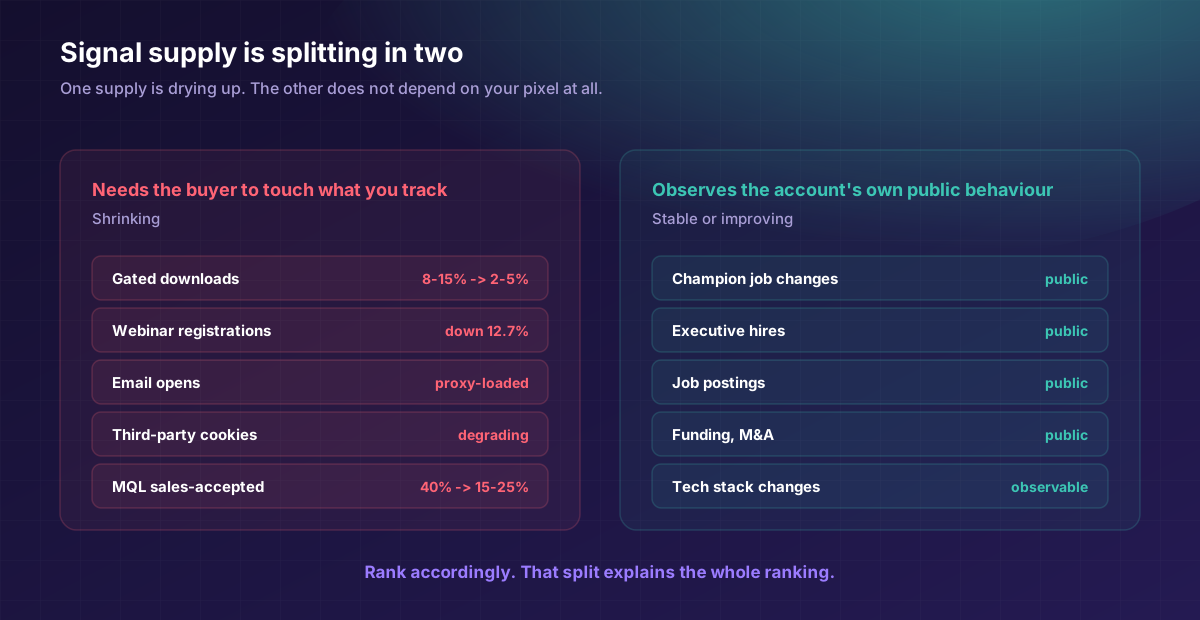
Buying signals come in two supplies, and the two are moving in opposite directions.
Signals that require the buyer to touch something you own or track are in structural decline. Form fills, downloads, email engagement, cookie-based site behavior. Gated content conversion rates have fallen from a range of roughly 8% to 15% in 2018 to about 2% to 5% in 2026, and sales-accepted rates on inbound marketing qualified leads over the same period dropped from around 40% to somewhere between 15% and 25%. Analysis of more than a hundred B2B marketing teams found webinar registrations down 12.7% overall, with the median company seeing a 42% drop and the bottom quartile down more than 70%. Email tracking is compromised. Third-party cookies have been degrading for years. And buyers are increasingly running the early evaluation inside AI assistants, which emit no trackable event at all.
Signals that observe an account's own public behavior are stable or improving. People still change jobs in public. Companies still post roles, announce funding, publish certifications, get acquired, swap out software, and say things on earnings calls. None of that depends on your pixel, your form, or a cookie surviving another browser update.
Rank accordingly. The top of this list is dominated by observable external events and by first-party signals with such high commitment that they survive the general decay. The bottom is full of signals that were never strong and are now getting weaker. If you want the strategic argument behind this shift in full, it is in our piece on signal-based selling as the 2026 evolution of ABM.
One honest caveat before the list. Rank is not universal. If you sell developer tooling, tech stack changes outrank executive hires. If you sell to regulated industries, compliance triggers move up several places. Use this as a starting weight, then recalibrate against your own closed-won data after a quarter. Anyone who tells you the ordering is fixed across categories is selling something.
How these are ranked
Five criteria, applied consistently. This matters more than the list itself, because it lets you rank a signal that is not on here.
| Criterion | The question it answers |
|---|---|
| Predictive strength | Does it correlate with closed-won revenue, not just with meetings booked |
| Specificity | Does it point at a person and a reason, or just at a company |
| Observability | Can you detect it reliably and cheaply, without heroics |
| Half-life | How long the window stays open after detection |
| Noise | How often it fires on someone who was never going to buy |
A signal that scores well on the first two and badly on the last is a trap, because it feels precise while being wrong. A signal that scores well on observability and badly on specificity is a filter, not a trigger. Most of the disappointment in this category comes from treating filters as triggers.
Tier 1: the nine worth building around
These are the signals that justify dropping what you are doing.
| # | Signal | Half-life | Act within | What it earns |
|---|---|---|---|---|
| 1 | Past champion joins a target account | 90 to 120 days | 30 days | Named rep, warm reintroduction, no pitch |
| 2 | Head-to-head comparison view on a review site | Days | 24 hours | Competitive displacement play |
| 3 | Repeat pricing page visit by a known ICP contact | Hours to 3 days | 4 hours | Direct rep call, not a sequence |
| 4 | Known competitor contract inside its renewal window | 60 to 90 days | 30 days before window | Structured displacement campaign |
| 5 | New executive hired into your buyer function | 90 to 120 days | First 30 days | New-in-role thesis, executive to executive |
| 6 | Champion departs an existing customer account | 30 to 60 days | 7 days | Two plays at once: churn defense and new pipeline |
| 7 | Deanonymized repeat visit to a bottom-funnel page | 2 to 7 days | 24 to 48 hours | Role-matched sequence referencing the topic |
| 8 | Job posting burst in the function you serve | 60 to 90 days | 2 weeks | Capability-gap thesis to the hiring manager's boss |
| 9 | Competitor tool disappears from the tech stack | About 60 days | 30 days | Replacement play, fast |
On number one. The champion job change signal is the strongest thing in B2B and it is not close. Analysis of 230,000 former champions reported an activity-to-opportunity conversion rate around 12%, against under 2% for cold outbound. Separate vendor research found that involving past contacts in an opportunity was associated with materially higher win rates, shorter cycles and larger deals. Treat those figures as vendor-sourced and directionally useful rather than independently audited, because they are. The mechanism is not in dispute though: this is the only signal that arrives with a relationship and a proven value story already attached.
Two operational notes that most teams miss. First, roughly 20% of your customers change jobs in a year, and only a small fraction reach back out on their own, so this is entirely an outbound motion. Second, track more than closed-won contacts. Open opportunity contacts and closed-lost contacts move too, and at their new company the budget and the timing may be completely different from the ones that killed the last deal.
On number two. Review site comparison views got materially more useful this year for a reason that has nothing to do with the signal itself. G2 announced an agreement to acquire Capterra, Software Advice and GetApp from Gartner in January 2026, with the deal closing in early February. Four research destinations became one data set. If you were previously piecing together partial coverage across separate marketplaces, that is now a single source, and the combined footprint has been described as producing substantially more signal volume.
What makes the comparison view specifically valuable is the semantics. Someone at that account has built a shortlist and you are on it. That is not research behavior, it is evaluation behavior, and it comes with the names of the competitors you are being weighed against. Very few signals hand you the objection and the timing in the same event. The same buyer-distance logic is how you should rank the questions you answer for People Also Ask and the other answer surfaces.
On number six. The departing champion is the most underused signal on this list because most teams only wire up half of it. When your champion leaves a customer account, two things happen simultaneously: your renewal just got riskier, and one of your strongest advocates just landed somewhere new. Route it to customer success and to sales at the same time, from the same trigger. Teams that only build the sales half of this play find out about the churn risk on the renewal call. This is one of the ten automations we think every revenue team should steal, and it takes an afternoon to build.
Tier 2: strong, with conditions
These work well when the condition attached to them is met, and produce noise when it is not.
| # | Signal | Half-life | Condition that makes it work |
|---|---|---|---|
| 10 | Job posting naming your category or a competitor | 60 days | The requirement text is specific, not boilerplate |
| 11 | Funding round, Series A or B | Sharp to 30 days, baseline by 90 | You reference use of funds, not congratulations |
| 12 | Compliance certification pursuit | 90 to 180 days | Your product touches the control they need |
| 13 | Merger or acquisition announced | 120 to 180 days | You sell consolidation, migration or integration |
| 14 | New CFO or COO appointed | 90 days | You have a cost or efficiency argument, not a feature one |
| 15 | Category page plus alternatives page in one session | Days | You can identify the account, not just the visit |
| 16 | Public product or roadmap announcement | 60 to 90 days | The announcement implies a capability they lack |
| 17 | Earnings call or annual report names an initiative you serve | 90 to 180 days | You quote their language back, not yours |
| 18 | Expansion into a new geography | 90 to 180 days | The new market carries different compliance or tooling needs |
| 19 | Headcount crosses a band threshold | 60 to 90 days | Your product has a real breakpoint at that size |
| 20 | New department starts using your product | 30 days | You have product usage data wired into the CRM |
On number eleven. Funding is the most over-rated signal in B2B, and it earns its place here only with the condition attached. The decay is steep: behavioral value drops sharply through the first 30 days and is close to firmographic baseline by day 90. More importantly, every vendor in the market sees the same funding announcement on the same morning. Your congratulations note is arriving in a pile of forty. The only version of this play that works is one that names what the money is for and speaks to the person who has to spend it, which usually means weeks two through twelve rather than week one.
On number ten. A job posting that mentions your category by name, or lists a competitor's product in the requirements, is a substantially better signal than a general hiring burst. It tells you what they use, what they are trying to do, and who will own it. Broader hiring data supports the direction: companies increasing job postings 30% or more in a quarter have been reported as meaningfully more likely to purchase new software. But the specific posting beats the aggregate trend every time, because the specific posting contains the pitch.
On number seventeen. Earnings call language is the highest-effort signal in tier two and the one that produces the best first lines. Public companies tell you their priorities for the next year, out loud, on a schedule, in language their own executives will recognize. Almost nobody mines it because it does not arrive as a webhook. If your ACV justifies the work, this is where it lives, and it is a natural fit for the account research workflow that turns a transcript into a usable brief without a human reading all forty pages.
Tier 3: real, but never alone
These are genuine signals. None of them should ever trigger an outbound touch on its own. They earn their keep as the second or third signal in a stack, and as tiebreakers when you are deciding which of two accounts gets the week.
| # | Signal | Half-life | Why it needs company |
|---|---|---|---|
| 21 | Third-party topic surge | About 30 days | Standalone correlation with buying is weak |
| 22 | Company-level site visit, no page depth | 7 days | Could be anyone at the company, including a candidate |
| 23 | ICP contact engages your social content | 14 to 30 days | Interest in a post is not interest in a purchase |
| 24 | Competitor outage or public incident | 14 to 30 days | Window is real but crowded and short |
| 25 | Marketing or analytics stack change | 60 days | Adjacent, not central, unless you integrate |
| 26 | Attendance at a category conference | 30 to 60 days | Attending is cheap, evaluating is not |
| 27 | Webinar attendance, not registration | 14 to 30 days | Only attendance carries information now |
| 28 | Community or forum post naming your problem | 7 to 14 days | Individual pain, no evidence of budget |
| 29 | Anonymous pricing page visit | 2 to 7 days | Timing is excellent, targeting is impossible |
| 30 | Adjacent event at a partner or customer of the account | 30 to 90 days | Two degrees of separation from any decision |
On number twenty-one. Third-party topic surge sits at the top of tier three and not higher, which will be unpopular with anyone who has just signed an intent contract. Standalone correlation with actual buying behavior is reported in the range of 5% to 15%, and around 52% of sales professionals report frequent false positives from intent tooling generally. This is not a criticism of the data. It is a criticism of how it is used. Topic surge is a superb instrument for deciding which two hundred of your two thousand accounts deserve attention this quarter. It is a poor instrument for deciding who to email on Tuesday. Filter, not trigger.
On number twenty-two, and the deanonymization question generally. This deserves more space than its rank suggests, because the category is widely misunderstood and the misunderstanding is expensive.
Company-level identification works. Realistic match rates land somewhere around 30% to 65% depending on traffic mix, with corporate office traffic at the top of that range and remote employees on residential connections at the bottom. Person-level identification, the thing most visitor-identification tools are actually marketed on, is far weaker: realistic figures sit around 5% to 20%, frequently US-only, and some vendors pad results with probable contacts that are inference rather than observation.
The practical consequence is that most teams buy the person-level tier, get a fraction of what they expected, and conclude visitor identification does not work. Company-level identification plus a good buying group map gets you most of the value at a fraction of the price and with far fewer false confidences. Combine that with the well-known figure that the overwhelming majority of B2B site visitors never convert, and the right posture is clear: identify the account, work the committee, and stop trying to guess the individual. If you are weighing a spend here, our honest answer on whether you need ABM software covers what the identification layer is really worth below $10M ARR.
The eight to delete from your scoring model
This is the part of the audit nobody runs. Each of these is still a default field or a common scoring input somewhere in the average B2B stack, and each of them is now actively misleading.
| Signal | What broke it | What to use instead |
|---|---|---|
| Email open | Apple MPP proxy loading, corporate security scanners | Reply rate, positive reply rate |
| Click-to-open rate | It is a function of opens, so it inherits the corruption | Reply rate and meetings booked |
| Email link click, standalone | Security gateways rewrite and click every URL before delivery | Click plus a corroborating site visit |
| Gated content download | Conversion fell to roughly 2% to 5%, and most fills are not buyers | Ungated reach plus bottom-funnel behavior |
| Webinar registration | Registration volumes down sharply, and registering is not attending | Attendance, poll responses, questions asked |
| IP-only company match, uncorroborated | Remote work and VPNs, with misattribution widely reported | IP match confirmed by a second signal |
| Page-view-count lead score | Counts volume, not intent, and rewards researchers | Specific page types weighted by depth |
| Time on site | A tab left open all afternoon scores highest | Return visits within a short window |
A few of these deserve a sentence more.
Email opens and clicks. The open is fully broken and there is no debate left to have. The click is more subtle and catches people out: enterprise security gateways rewrite links and follow them automatically to check for malware, which means a meaningful share of your click data is a scanner. A click is still worth more than an open. It is not worth what your scoring model currently gives it, and it should never fire a sequence on its own. If your reply rates look nothing like your open rates, the problem is usually deliverability and sending architecture rather than copy.
Gated content. The interesting part of the gating collapse is not the conversion rate. It is what it does to your signal supply. When gating worked, the form fill was a cheap, reliable, first-party signal that a real person at a real company wanted something. As gating stops working, that signal supply dries up, and teams that built their entire scoring model on form fills find themselves with a model and no inputs. There is a second-order effect worth noting too: a gated asset shows a form to an AI crawler, so it never becomes a citation, which costs you visibility in exactly the research channel that is growing fastest. We have written up how AI assistants choose which brands to cite separately, and it is the reasoning behind our SEO, AEO and GEO practice.
Webinar registration versus attendance. Keep webinars. Delete registration as a signal. The registration is now closer to a bookmark than a commitment, and the useful information is entirely in what someone does during the session: whether they showed, whether they answered a poll, whether they asked a question. Those are still strong. The calendar hold is not.
Send us your current lead scoring model and your last fifty closed-won deals. We will map which of the thirty signals above actually appear in your wins, flag the dead inputs still in your model, and give you a reweighted version you can implement yourself. Free, no pitch, and you keep the findings either way.
The rule that makes any of this work
You could implement every signal above perfectly and still produce nothing, because the ranking is not the hard part.
Compare each signal's half-life against your own median time from detection to a relevant human touch. Not your target. Your measured median, including the weekend the alert fired on and the four days the account waited for territory assignment. Most teams who have never measured this land somewhere between four and fourteen days.
Every signal in the tables above with a half-life shorter than your latency is a signal you cannot use. These half-lives are also the input to the recency dimension of an account score, which is where they stop being a reference table and start deciding which accounts get worked this week. If your median is nine days, the top three signals on this list are theoretically available to you and practically not. The reported figures are unforgiving on this point: follow-up inside the first hour has been associated with roughly three times the conversion of follow-up a day later, and most of the advantage on review site intent is reported as gone by 72 hours.
Which produces a conclusion most vendors will not offer you. The correct first move for almost every team is to buy fewer signals and fix routing. Breadth is purchasable in an afternoon. Latency requires someone to own the path from detection to a rep having something useful to say, and that path is where nearly all the delay actually lives. Three signals acted on inside a day beat twenty signals acted on inside a fortnight, every time, and the three-signal version is cheaper.
Routing is also the most automatable part of the whole system. We have published two full demand gen systems built as n8n workflows, the intent-to-play workflow that shortens the detection-to-touch path, and the seven guards that keep those workflows alive in production. If you would rather it were built and maintained for you, that is our n8n workflow automation practice. And none of it works on top of a messy CRM, so fix that layer first if duplicate accounts and undefined lifecycle stages sound familiar.
Then stack rather than sum. Ten signals in a week is usually nine pings and one funding round, and a model that adds them together will rank that account for the wrong reason. Weight by type, decay each one on its own curve, and require convergence from different sources before an account earns a tier one play. The weighted scoring mechanics are the same ones behind our ICP model. If a warm path exists to anyone in the buying group, weight it heavily, because a real signal routed cold is the most common way intent-sourced pipeline quietly fails.
Signals without a list underneath them are just a busy inbox. The target account list is what they prioritize, the ABM framework and 90-day roadmap is what turns a tier into a play, and the full account-based system is where all of it fits together.
Start with the audit rather than the shopping, and when you do get to the shopping, the platform buyer's guide covers what each tier really costs. Pull your last fifty closed-won deals, find the first observable event at each account, and see which of the thirty above actually appear. That distribution is your real ranking, and it is the only one that matters.
Book a 30-minute call. We will walk your current signal inputs against your last fifty wins, show you which ones are noise, and hand you the reweighted model. You leave with it whether you hire us or not.
Frequently asked questions
A buying signal is an observable event at an account that changes what the people there care about, and therefore changes whether your offer is relevant this week. A funding round, a new VP hired into the function you sell to, a competitor tool disappearing from their stack. It differs from intent data, which infers research activity rather than observing a discrete event.
A past champion joining a target account. Vendor research analyzing 230,000 former champions reported roughly a 12% activity-to-opportunity conversion rate against under 2% for cold outbound, and separate analysis found that involving past contacts in an opportunity was associated with substantially higher win rates. No other single signal comes with a pre-existing relationship attached.
Email opens, click-to-open rate, standalone email link clicks, gated content downloads, webinar registrations, IP-only company matching without corroboration, page-view-count lead scores, and time on site. Most were broken by Apple Mail Privacy Protection, corporate security scanners, remote work and VPNs, or the collapse in gated content conversion. Several are still default fields in major marketing automation platforms, which is why they persist.
Fewer than most teams track. Three to five signal types that map directly to your offer, monitored well and acted on inside their half-life, outperform twenty tracked loosely. Signal breadth is easy to buy and signal latency is hard to fix, which is why teams over-invest in the first.
Within four hours for explicit signals such as a demo request or a repeat pricing page visit. Within 24 to 48 hours for behavioral and event signals. Reporting on review site intent suggests most of the timing advantage is gone by 72 hours, and separate analysis found follow-up inside the first hour converted at roughly three times the rate of follow-up a day later.
No. Several of the highest-ranked signals are free to detect: job changes, executive hires, job postings, funding announcements, and public compliance or product news. A workflow tool, a data provider, and a CRM will run most of a signal motion. Buy a platform when your latency is already good and your problem is genuinely coverage.