Every ABM platform demo follows the same script. A dashboard lights up. An account you recognise glows red-hot. The rep says "imagine knowing this before your competitors do." And it works, because the thing being demoed is genuinely useful.
What the demo skips is the invoice.
We publish the State of ABM 2026-2027 report for the same reason. If you have already decided to buy and just want to know which one, we compare them in the 2026 ABM platform buyer's guide. We build ABM programs for a living, and we make money either way: we will implement 6sense for you as happily as we will build you a stack that avoids it. So here is the arithmetic nobody in the category will publish, including the part where buying the platform is the right call.
What the platforms actually cost
Before you price the platform, it is worth knowing which buying signals actually predict pipeline, because several of the strongest are free to detect. There is no public pricing for any major ABM platform. That is not an oversight, it is the business model, which is why we publish what we charge. But enough procurement data has leaked into benchmark databases to triangulate.
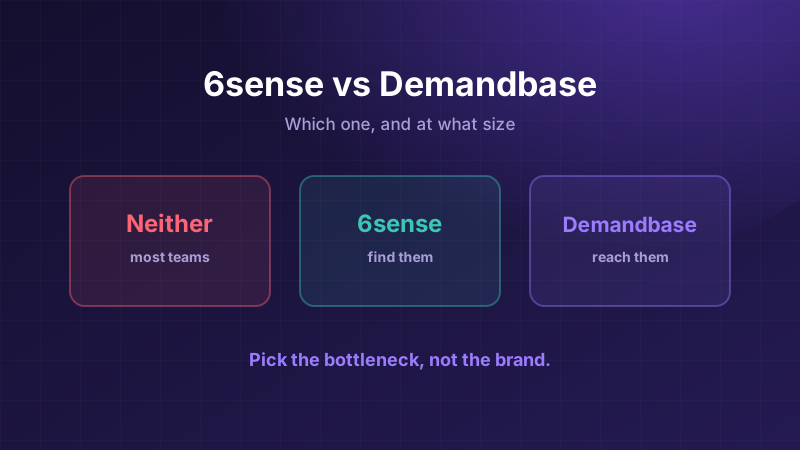
The most useful single number comes from Vendr, whose benchmark is built on 316 purchases across 204 handled deals: the median 6sense annual contract is $58,950, with an observed range from $10,621 to $154,859. Demandbase reportedly starts around $24,000 a year and runs to $300K or more for enterprise deployments, with onboarding fees that have been reported to exceed $29,000 before a single campaign runs. If those are the two you are weighing, 6sense vs Demandbase breaks down which bottleneck each one actually solves.
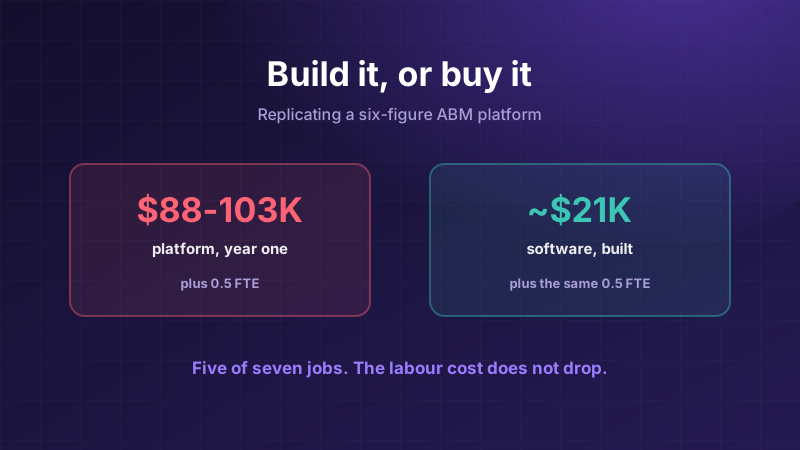
Then there is the part that is not the licence. No one publishes a year-one multiplier for this, so here is ours: budget 1.5 to 2 times the licence fee for what you will actually spend in year one. The rest is integration work and the roughly 0.5 FTE required to operate the thing.
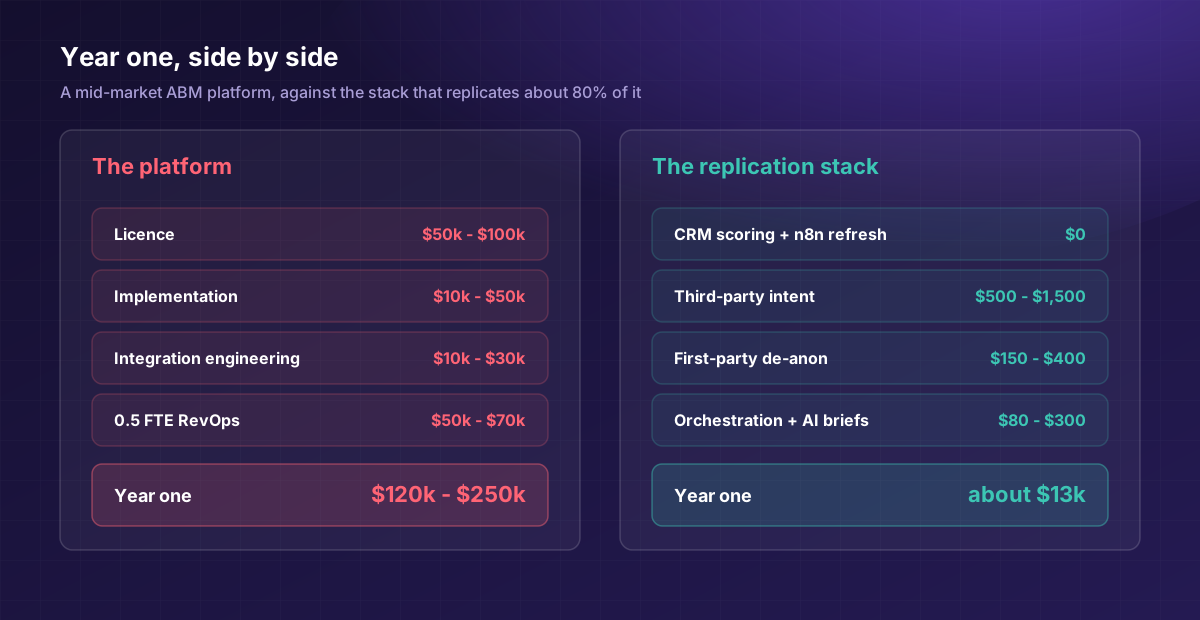
| Line item | Realistic year-one range |
|---|---|
| Platform licence (mid-market) | $50,000 - $100,000 |
| Implementation and onboarding | $10,000 - $50,000 |
| Integration engineering (CRM, MAP, sales engagement) | $10,000 - $30,000 |
| 0.5 FTE RevOps to operate it | $50,000 - $70,000 |
| Year-one total | $120,000 - $250,000 |
Sources: Vendr benchmark data; Demandbase and 6sense pricing analyses, 2026; practitioner-reported ranges. Every figure here is a range because none of these vendors publish rates. Verified July 2026.
Now hold that number next to your ARR. At $5M ARR, a $150,000 year-one commitment is 3% of revenue on a targeting layer, before you have paid for the ads, the content, or the humans who follow up. And most contracts are two-year minimums, so the decision you are making is not $150K. It is $300K.
The Replication Map
Here is the part that does not exist anywhere else on the internet: a feature-by-feature account of what an ABM platform does, what it costs to replicate each capability, and, honestly, how close the replication gets. If you decide to actually build it, the full teardown and the six workflows are here.
| Platform capability | How you replicate it | Monthly cost | How close you get |
|---|---|---|---|
| Account scoring and tiering | Scoring model in HubSpot or Salesforce, refreshed nightly by an n8n workflow | $0 (CRM you already own) | 95%. Your closed-won data beats their generic model. This is the one where DIY wins. |
| Third-party intent | G2 Buyer Intent piped into the CRM | $500 - $1,500 | 70%. You get the signal, not the predictive layer on top. |
| First-party intent (site visits) | RB2B, Vector or Warmly for de-anonymisation, into n8n, into the CRM | $150 - $400 | 90%. Genuinely comparable at your traffic volume. |
| Trigger events (funding, hiring, job change) | n8n watcher on public sources plus a data provider | $50 - $200 | 90%. These signals are public. You are paying for convenience, not access. |
| Account identification and de-anon | Same as above | (included) | 85%. Falls off with low traffic. See the Ceiling Test. |
| Multi-channel orchestration | n8n as the orchestration layer, firing plays into email, LinkedIn and CRM tasks | $50 (n8n self-hosted) | 75%. Works. Takes build time. |
| ABM advertising and B2B DSP | LinkedIn Matched Audiences from a CRM-synced list | Your ad budget | 60%. This is the real gap. See below. |
| Account intelligence briefs | AI agent in n8n researching each Tier 1 account | $30 - $100 in API costs | 85%. Ours produce a brief in 90 seconds. |
| Sales alerts and enablement | n8n into Slack, with the play attached | $0 | 95%. Faster than most platforms, actually. |
| Reporting and attribution | CRM dashboards plus a weekly n8n digest | $0 | 80%. Less pretty. Same numbers. |
| Total | about $780 - $2,250/mo | about 80% of the platform |
The monthly costs here are what we pay or have been quoted for our own builds rather than vendor list prices, and they exclude your own time. The replication percentages are our assessment, not a measured benchmark.
Round it: about $1,100 a month at the midpoint, against $10,000 to $20,000 a month all-in for the platform. That is the claim on our ABM service page, and now you can check our working.
The 20% you cannot replicate (and should not pretend you can)
This is where every "just build it yourself" post stops being honest. Four things you genuinely give up:
1. The predictive model. 6sense's predictive layer is trained on data from thousands of companies. Your scoring model is trained on your closed-won history. If you have 40 closed-won deals, your model is weak and theirs is not. Below roughly 100 closed-won accounts, their model beats yours. That is a real, specific, quantifiable reason to buy.
2. Anonymous account identification at scale. De-anonymisation tools resolve a percentage of your traffic, and so do the platforms. Test the match rate on your own traffic before you assume the platform resolves more, because at 50,000 or more monthly visitors a small percentage gap is a lot of accounts.
3. The B2B DSP. LinkedIn Matched Audiences reaches your accounts on LinkedIn. A DSP reaches them across the open web. If display is central to your motion, this is not replicable and you should stop reading.
4. The audit trail. When your board asks why you targeted those accounts, "our model said so" from a vendor with a logo carries a political weight that "our n8n workflow said so" does not. This is not a technical argument. It is a real one anyway.
The Ceiling Test
Five questions. Three or more yeses and you should buy the platform. Fewer than three and you are buying a dashboard.
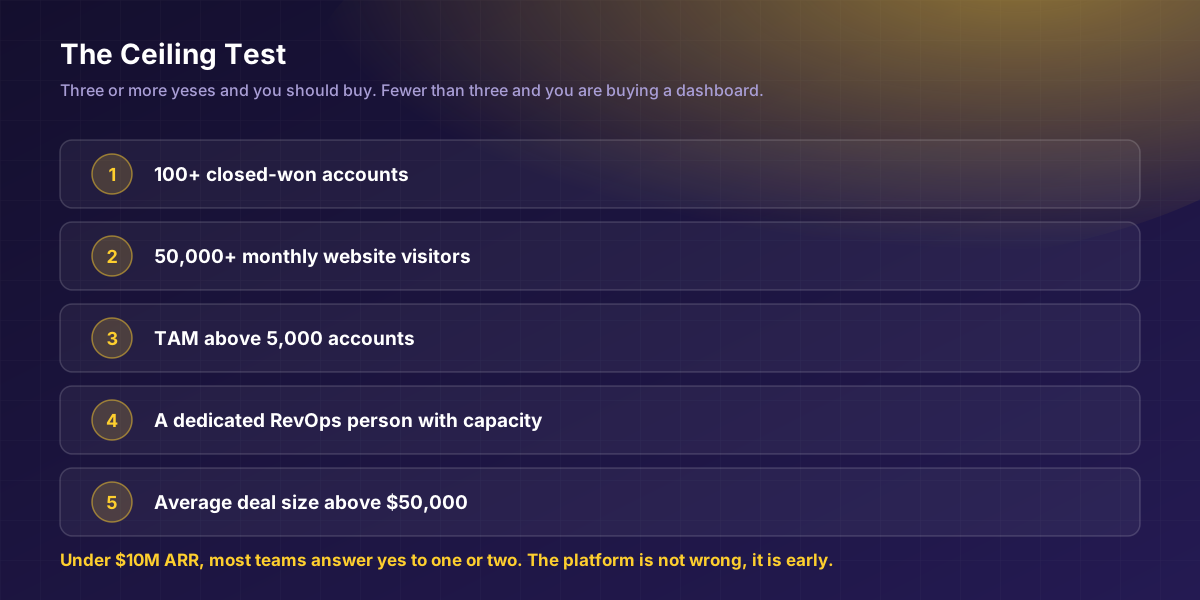
- Do you have 100 or more closed-won accounts? Below this, there is not enough history to train a predictive model, theirs or yours. But theirs borrows from everyone else's data, and yours cannot.
- Do you have 50,000 or more monthly website visitors? At this volume even a small gap in match rate is a lot of accounts, so test a DIY tool and the platform on your own traffic. Under this, the gap barely shows.
- Is your TAM above 5,000 accounts? Under that, a human can review your entire target list quarterly. You do not need a model to tell you which 300 accounts matter, you can just read them.
- Do you have a dedicated RevOps person with capacity? Not "an ops person who is busy." Half of a real one. Without this, the platform decays into an expensive alert nobody actions.
- Is your average deal size above $50,000? Below that, the platform cost per closed deal stops making sense at almost any volume.
Under $10M ARR, most teams answer yes to one or two. Platform or not, the binding constraint is the same: a target account list your team can actually work. If that is you, the platform is not wrong, it is early. Buy it in eighteen months when it is the constraint, not now when the constraint is that nobody is following up.
The break-even, worked
Take a $6M ARR company, $40K average deal, 25% win rate. A mid-market 6sense deployment at $150K year-one all-in.
To break even on gross profit at an 80% margin, the platform must generate roughly $187K in new ARR, about 4.7 additional closed deals, which at a 25% win rate means 19 additional qualified opportunities that you would not otherwise have created. In year one. While you are still implementing it.
Now ask your rep to commit to 19 incremental opportunities in writing. The answer to that question tells you more than the demo does.
What we actually recommend
Not "never buy." The honest sequence:
Phase 1 (months 0 to 6): prove the motion. CRM scoring, first-party intent, an n8n signal watcher, LinkedIn Matched Audiences. Around $1,100 a month. If ABM does not work here, it will not work at $150K, you will just find out more expensively. This is the same sequence we lay out in the 90-day ABM roadmap.
Phase 2 (months 6 to 18): find the ceiling. Run the Ceiling Test quarterly. You will usually hit a specific wall: anonymous traffic you cannot resolve, or a target list too big to review by hand. Name the wall.
Phase 3: buy the wall, not the platform. Sometimes that is 6sense. Often it is just a standalone intent feed such as Bombora, piped into the stack you already built. Buy the capability that is actually binding.
The teams that regret their ABM platform almost never regret the software. They regret buying a targeting layer when their real problem was that nobody followed up within five minutes, their CRM was full of duplicates, and their emails were landing in spam. An intelligence layer amplifies whatever motion you already have. If that motion leaks, you have just bought a bigger hose.
Name three accounts from your dream list and we will sketch the plays we would run for each, free: the trigger worth acting on, the buying-committee roles to reach, the angle and the first three touches, plus a short note on whether a platform would earn its keep at your size. If the honest answer is that you should buy the platform, we will tell you that too.
Frequently asked questions
No. ABM is an operating model, not a product category. You need a way to select accounts, a way to detect when they are in-market, a way to reach them, and a way to measure it. Software makes those faster, it does not make them exist.
There is no public pricing. Vendr's benchmark puts the median 6sense contract at $58,950 a year across 316 purchases, with a range of roughly $10.6K to $155K. Demandbase reportedly starts near $24K a year. Budget 1.5 to 2 times the licence for year-one total cost once implementation and operating headcount are counted.
CRM-based account scoring, a first-party de-anonymisation tool, an intent source, and LinkedIn Matched Audiences, orchestrated with n8n. Roughly $780 to $2,250 a month depending on your intent source.
When you can answer yes to three of the five Ceiling Test questions: 100 or more closed-won accounts, 50,000 or more monthly visitors, a TAM above 5,000 accounts, dedicated RevOps capacity, and an average deal size above $50,000.
They occupy similar price bands and solve slightly different problems: 6sense leans predictive intent, Demandbase leans advertising and orchestration. At mid-market the more useful question is usually whether you need either one yet.