The AI SDR category has a problem it does not like discussing.
In March 2025, TechCrunch reported that 11x, then one of the category's loudest brands, was displaying customer logos it had no right to use. A ZoomInfo spokesperson told the publication: "We did not give them permission to use our logo in any manner, and we are not a customer," adding that during a one-month pilot "11x's product performed significantly worse than our SDR employees." Airtable also said it was not a customer and had not given permission. Current and former employees told TechCrunch the company counted one-year contracts at full annual value even after customers exercised a three-month break clause and stopped paying, and one described losing "70-80% of customers that came through the door."
11x disputes the characterisation. It says it uses contracted ARR when reporting to its board, that its retention rate is 79%, and that its highest churn was in its initial late-2023 cohorts. We have not independently verified any of this, and we are repeating it because of what it says about the category rather than about one company.
Because that is not a story about one vendor behaving badly. Plenty of AI SDR companies are honest. It is a story about a category-wide expectation gap, and the gap has a structural cause that nobody in the category will name, because naming it shrinks the addressable market.
Here it is.
The three jobs an SDR actually does
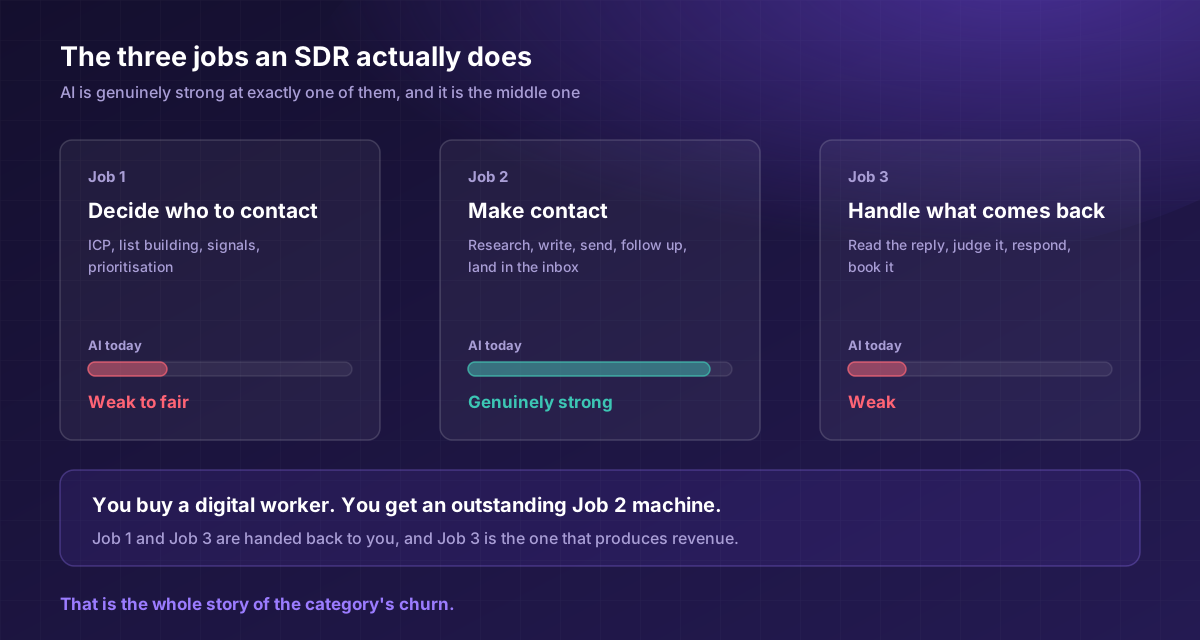
Strip the role to its parts and there are three:
Job 1: decide who to contact. ICP definition, list building, signal monitoring, prioritisation. Deciding that this account, this week, is worth a touch.
Job 2: make contact. Research the account, write something specific, send it, follow up, land in the inbox.
Job 3: handle what comes back. Read a reply that says "we are already using a competitor but our contract is up in March," understand it, decide whether it is a real opportunity, respond in a way that does not blow it, book the meeting.
Now map AI SDR tools onto that.
| Job 1: who | Job 2: contact | Job 3: replies | |
|---|---|---|---|
| AI SDR tools today | Weak to fair | Genuinely strong | Weak |
| Where the marketing is aimed | Yes | Yes | Yes |
| Where the value actually is | Yes |
In our experience, current AI SDR tools are strongest at high-volume initial outreach. They do not reliably handle replies, qualify prospects, or navigate a real sales conversation. Anyone claiming otherwise is overselling what the technology currently does.
That is the whole story of the churn. You buy a "digital worker." You get an outstanding Job 2 machine. Job 1 is still your problem, and the tool will happily contact the wrong accounts at superhuman scale. Job 3 is still your problem, and it is the one that produces revenue. Three months in you notice you are paying enterprise money for the easiest third of the role, and you do not renew.
What they cost
List prices where vendors publish them, mid-2026. Annual billing discounts of 15-20% are common across the category.
| Tool | Monthly | Annual at monthly rates | Contract | Data included? |
|---|---|---|---|---|
| Salesforge (Agent Frank) | about $599 | about $7,200 | Quarterly or annual | Yes, 2,000+ contacts a month |
| AiSDR (Explore) | about $900 | about $10,800 | Quarterly minimum | Yes |
| Regie.ai (Pro) | $49 | about $590 | Monthly or annual, cancel anytime | Yes, credits cover enrichment |
| AiSDR (Scale) | about $2,500 | about $30,000 | Quarterly minimum | Yes |
| Artisan (Ava) | quoted | not published | not published | Yes, 250M+ contacts |
| Qualified (Piper), inbound only | quoted | not published | not published | Not applicable |
| 11x (Alice) | quoted | not published | Some enterprise deals: 12 months, 3-month opt-out | not published |
Sources: the vendors' own pricing pages, linked in the table where they publish one. Several of them quote rather than publish. Last checked September 2026: re-check before you rely on any figure here.
Note the pattern at the bottom of the table. Three of the seven rows carry no published price at all. Read the data column before you compare monthly numbers, because sourcing contacts separately is a real extra cost.
And Qualified is in a different business entirely: Piper works your existing website traffic. It harvests demand you already created. It is not cold outbound and should not be compared to tools that are.
The number everyone quotes, and why it is rigged
The category's favourite comparison is cost per meeting, and on that measure AI SDRs come out cheaper than in-house reps. Those comparisons get quoted everywhere, and they are also doing a lot of work in the wrong direction.
The in-house number is defensible. A fully loaded US SDR costs roughly $154,000 in year one, about 1.8 times on-target earnings once you count overhead, tooling, recruiting, turnover re-ramp, and a slice of management. Ramp averages 3.2 months to first qualified meeting and 5.5 months to full quota. Annual turnover runs 34-40% with median tenure around 1.5 years. So year one buys you roughly eight or nine productive months, and then the clock resets sooner than you would like.
The rigging is in the word "meeting." An AI SDR's meeting and a human SDR's meeting are not the same object. The human's meeting has been through Job 1 and Job 3: someone decided the account mattered, and someone handled the objection that nearly killed it. The AI's meeting has been through Job 2. Comparing them on cost is like comparing the cost of a CV to the cost of a hire.
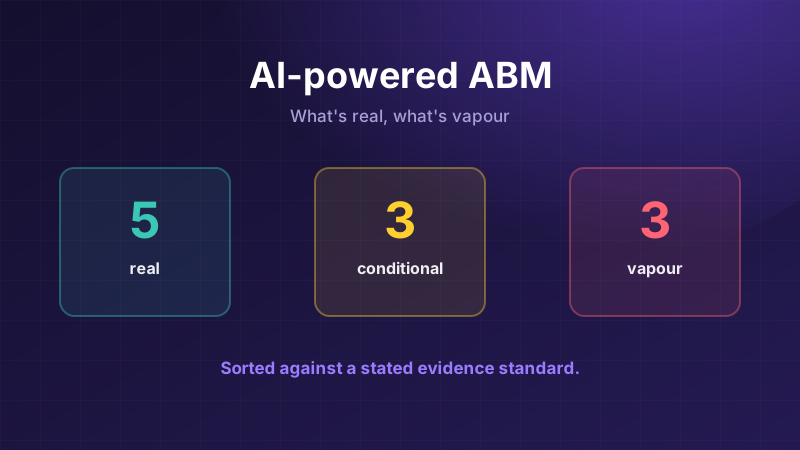
Ask for cost per qualified opportunity, not cost per meeting. Watch the ratio collapse. That single substitution is the most useful thing in this article, and it generalises: we set out the full evidence standard for AI claims in what is real and what is vapour.
What building it actually looks like
We have built this. Not as a thought experiment, as a working system. Here is the honest inventory.
The stack, and what it costs us to run:
| Component | Purpose | Monthly cost |
|---|---|---|
| n8n (self-hosted) | Orchestration layer | $20 - $50 (the server) |
| Data provider (Apollo, Clay or similar) | Contacts and enrichment | $150 - $800 |
| Sending infrastructure (domains, mailboxes, warm-up) | Deliverability | $200 - $500 |
| LLM API calls | Research and drafting | $50 - $300 |
| De-anonymisation (RB2B or similar) | First-party signal | $150 - $400 |
| Total | $570 - $2,050/mo |
The build: 60 to 120 hours for a competent operator to get to production. That is the number nobody publishes. At what an agency charges it is real money; done internally it is a quarter of someone's attention for six weeks.
What you get that you cannot buy:
- Job 1 gets solved. Your signal logic, your scoring model, your triggers. This is the part the tools are weakest at, and it is the part that decides whether outbound works at all.
- Job 3 gets a human in the loop. Our system drafts the reply and a rep approves it in one click. The AI does the reading and the typing, the human does the judgement. That is the split that actually works today.
- It composes. The same workflow that watches for a funding round can trigger an ABM play, update the CRM, and alert the rep. A point tool cannot reach into the rest of your motion.
- No cancellation drama. Cancellation terms in this category are worth reading closely before you sign. Your own workflows do not have any.
What you give up, honestly:
- Speed. A tool is live this week. A build is live in six.
- Maintenance. APIs change. Something breaks. Somebody owns that or it rots. In our experience it is the most common reason DIY builds fail, and it is why we wrote up why n8n workflows break in production.
- A throat to choke. Real.
The decision, in one table
| If this is you | Do this | Why |
|---|---|---|
| Testing whether outbound works at all | Buy, cheapest monthly, no annual lock | You are buying learning speed, not a system. |
| Need pipeline in 3 weeks, board meeting in 6 | Buy | Build time is a real cost. Pay to skip it. |
| TAM over 10,000, ACV under $25K, simple cycle | Buy | Pure numbers game. Job 2 is genuinely most of the value here. |
| Under 500 target accounts | Build, or do not automate at all | At this size the tool contacts your entire TAM in a fortnight, and then what? |
| ACV over $50K, complex committee | Build | Job 3 is where these deals live, and no tool does Job 3. |
| Data residency or compliance constraints | Build | Self-hosted is the only option that clears this. |
| Already running n8n | Build | Marginal cost is an evening. You have paid the setup tax already. |
| You will still be doing outbound in 12 months | Build | Break-even lands in month 6 at mid-market pricing. |
The break-even, worked
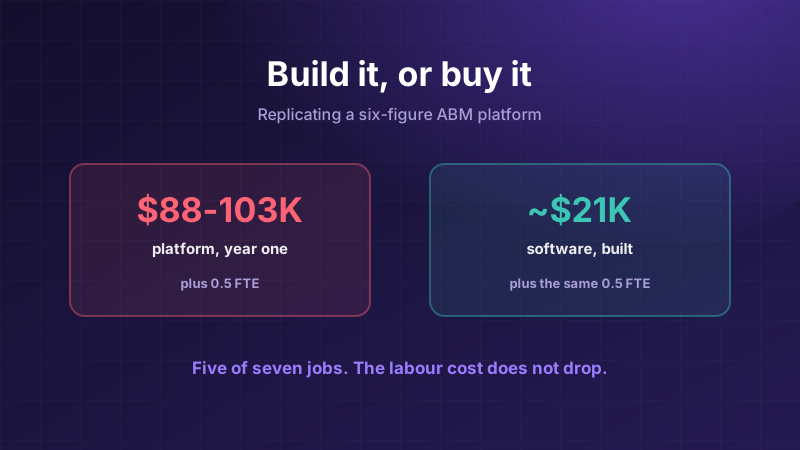
Against a mid-market tool at $2,500 a month, with transparent pricing and no annual lock:
- Buy: $30,000 a year.
- Build: about $1,300 a month running cost, so $15,600 a year, plus a one-time build of 90 hours.
- At an internal blended cost of $75 an hour, the build is about $6,750. Total year one: $22,350.
- Break-even: month 6. Year two, the build costs half as much.

But here is the part that decides it: the build's advantage is not the $8,000. It is that your version does Job 1 with your logic and Job 3 with your rep's judgement. The bought version does Job 2 brilliantly and hands the other two back to you, which is exactly what the churn numbers in this category describe. If you would rather not spend your own team's hours on the build, that is the work we do: custom AI workflows we build and hand over, running in your own n8n, with documentation.
The thing that actually determines whether either works
Neither. It is your data.
Every system in this category degrades as its data drifts, including ours. Without someone owning CRM hygiene, output quality falls no matter which logo is on the invoice.
An AI SDR pointed at a dirty CRM is a machine for damaging your domain reputation at scale. If your CRM has duplicates, dead fields and no lifecycle definitions, buy neither. Fix that first, then automate. Otherwise you are not choosing between build and buy, you are choosing how expensively to fail.
Send us one manual process from your outbound, the tools it touches and roughly how often it runs. In a free Workflow Teardown you get a diagram of how we would automate it, build notes and a fixed quote, and we will tell you if you would be better off just buying a tool.
Frequently asked questions
Software that automates outbound prospecting: sourcing contacts, researching accounts, drafting personalised emails, and running follow-up sequences. It automates the outreach portion of the SDR role, not the targeting judgement or the reply handling.
Published list prices run from under $100 a month for single-seat plans to about $2,500 for mid-market ones, and several tools do not publish a price at all. Mid-market options sit between $900 and $2,500. Check whether contact data is included, because a separate provider is a real extra cost.
At high-volume initial outreach, yes, genuinely well. At reply handling, qualification and complex conversations, no. In TechCrunch's March 2025 investigation, an employee at one well-funded vendor described losing 70-80% of customers, while the company itself put retention at 79%. Either figure is what you would expect when a tool that does one job well is sold as a replacement for all three.
Running costs are roughly $570 to $2,050 a month against $900 to $2,500 for a mid-market tool, plus a 60 to 120 hour build. Break-even lands in month 6 versus mid-market pricing. It is cheaper if you will run outbound for more than a year and someone owns maintenance.
Not currently. It replaces the outreach execution. Account selection and reply handling still need a person, and those are the two jobs closest to revenue.
Cost per qualified opportunity, not per meeting. Whether contact data is included. What happens at the break clause. Current customer references you contact directly rather than case studies. And an independent inbox-placement benchmark.