This is written for revenue leaders running an outbound or account-based motion at 1,000 accounts or more, who have hit the ceiling where adding volume stops adding pipeline.
A note on the number before anything else. The 200 in the title is a worked model, not a case study. It is what the arithmetic produces when our own conversion assumptions, anchored to a published 2026 reply-rate benchmark, run through a scored universe of 13,700 accounts. One rate below is a published benchmark and the rest are our assumptions, and the point of showing the whole chain is that you can swap in your own rates and find your own ceiling. Nobody should take a headline SQL number on trust, including this one.
Stop reading if your target universe is under 500 accounts. You have a research problem, not a prioritisation problem, and a good analyst with a spreadsheet will outperform any scoring model at that size.
The number, and the denominator
A monthly SQL count reads like a brag. On its own it is close to meaningless, because two companies can report the same number while measuring completely different things. So here are the definitions before the arithmetic.
SQL, as defined here: a discovery meeting that was booked, held, and passed an explicit qualification gate against budget authority, timeline and stated problem fit. Not a booked meeting. Not a positive reply. Not a form fill. Held and qualified.
Denominator: a combined scored universe of roughly 13,700 fit-gated accounts, worked monthly. Each individual programme sits between 1,000 and 3,000 accounts, which is the band where scoring starts to earn its keep and below which it does not.

| Stage | Monthly figure | Rate applied |
|---|---|---|
| Scored account universe | 13,700 accounts | Fit-gated, not raw TAM |
| Accounts crossing the activation threshold | 985 | 7.2% of universe activates in-month |
| Buying-committee contacts engaged | 4,040 | 4.1 contacts per activated account |
| Email touches delivered | 16,200 | 4 per contact, across the month |
| Replies | 956 | 5.9% reply rate |
| Positive replies | 296 | 31% of replies |
| Meetings booked, all channels | 338 | 178 from email, 160 from LinkedIn, phone and paid |
| Meetings held | 267 | 79% show rate |
| SQLs | 200 | 75% of held meetings pass qualification |
Two rates in that table are above average and worth defending.
The 5.9% reply rate is the first. Instantly's 2026 benchmark report, drawn from billions of analysed emails, puts the overall average at 3.43%, with the top quartile of campaigns at 5.5% or higher and the top decile clearing 10.7%. So 5.9% is not exotic. It is just inside top-quartile performance, which is what a tightly selected, signal-triggered list should produce and what a cold list will not.
The 75% meeting-to-SQL rate is the other, and it is a selection effect rather than a sales-skill effect. When an account was chosen because three people inside it were already researching the category, the qualification call is a formality more often than not. The show rate of 79% is our own assumption rather than a published benchmark, so check it against your own calendar.
What the same 200 costs without scoring
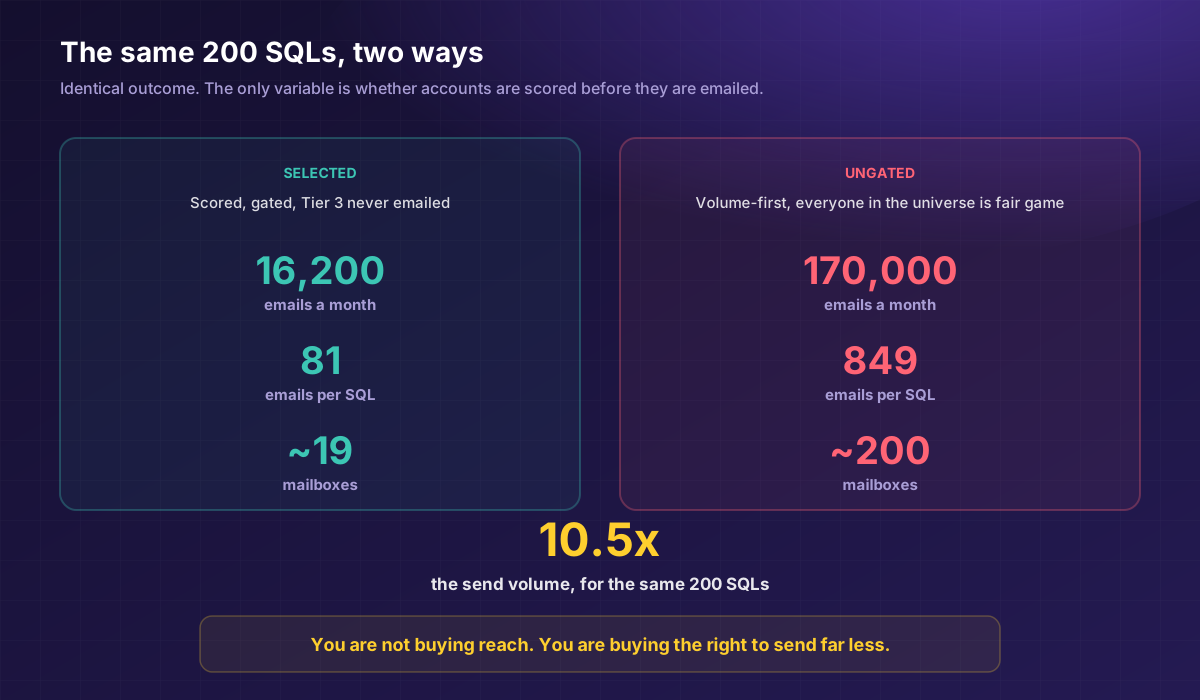
This is the part that makes the case. Run the identical target through an ungated, volume-first motion and the input requirement changes by an order of magnitude.
| Scored and gated | Ungated volume | |
|---|---|---|
| Reply rate | 5.9% | 3.4% |
| Positive share of replies | 31% | 20% |
| Positive reply to meeting booked | 60% | 45% |
| Show rate | 79% | 70% |
| Meeting held to SQL | 75% | 55% |
| Emails required per month | ~16,200 | ~170,000 |
| Emails per SQL | 81 | 849 |
| Mailboxes at 40 sends a day | ~19 | ~200 |
Ten and a half times the send volume for the same outcome. And the right-hand column is not merely expensive. It is close to operationally impossible to run cleanly in 2026, for reasons in the next section.
That gap is the entire case for programmatic ABM. You are not buying reach. You are buying the right to send far less.
Why the old programmatic ABM playbook broke
Three things changed between 2023 and 2026, and together they inverted the economics of volume.
Reply rates fell and stayed down. Average cold email reply rates have fallen over the past several years, and nothing about buyer behaviour caused that on its own. Supply did.
Inbox providers turned guidance into enforcement. Google and Yahoo introduced bulk sender requirements for anyone sending more than 5,000 messages a day to personal accounts: SPF, DKIM and DMARC, one-click unsubscribe, and spam complaints held under 0.3%. Microsoft matched them and began rejecting non-compliant bulk mail on 5 May 2025, returning 550 5.7.515. By late 2025 the posture across all three had hardened from filtering to outright rejection, so non-compliant mail does not land in a junk folder, it is refused. Microsoft shares complaint data only through feedback programmes you have to request access to, so without enrolling you are flying blind on a provider that blocks at the domain level.
AI agents flooded the channel and quality followed volume down. AI-assisted and autonomous sending drove per-rep volume up several times over, and average positive reply rates fell as it did. Downstream quality moved the same way. AI-booked meetings convert to qualified opportunity at a materially lower rate than human-booked ones, which surfaces as account executives sitting in meetings with people who were never going to buy. We went through that trade in detail in AI SDR tools versus building your own.
Put those three together and the conclusion is uncomfortable for anyone selling volume. Sending capacity is now abundant, cheap and mildly toxic. Selection is the only scarce input left.
RFE account scoring
Where it comes from
RFM originated in database marketing as a way to rank customers on how recently, how often and how much they transact. Analytics tooling later documented an RFE variant that swaps Monetary for Engagement in businesses without purchase history to draw on.
What did not exist was an account-level version built for B2B buying committees rather than individual consumers. RFE account scoring, the account-level and buying-committee adaptation described here, was coined by Sid Rane at Omnitics.
The distinction matters because the consumer version scores one person's own behaviour. The B2B version has to score the aggregate behaviour of a group who mostly do not know the others are looking. Forrester's State of Business Buying 2026 puts the typical buying decision at 13 internal stakeholders plus nine external influencers. A model that cannot tell one hyperactive intern from three coordinating executives is not a scoring model. It is a noise amplifier.
Why Monetary is not in it
Monetary works in retail because the customer has already bought and you hold the history. Run the same dimension against a net-new B2B account and there is nothing underneath it, so a third of the model becomes dead weight. Worse, teams substitute employee count, which turns a behavioural score into a proxy for company size and points sales at large logos that were never going to be profitable.
RFE keeps Recency and Frequency, drops Monetary, and splits Engagement into Channel, where the account came from, and Activity, what it actually did. Those are the two dimensions most models underweight. The full scoring tables, the routing bands and the deployment steps for HubSpot and Salesforce are in the RFE Account Scoring Playbook, which is the model itself rather than a summary of it.
The one thing RFE deliberately excludes
Firmographic fit is not a scoring dimension. It is a binary gate applied before scoring begins.
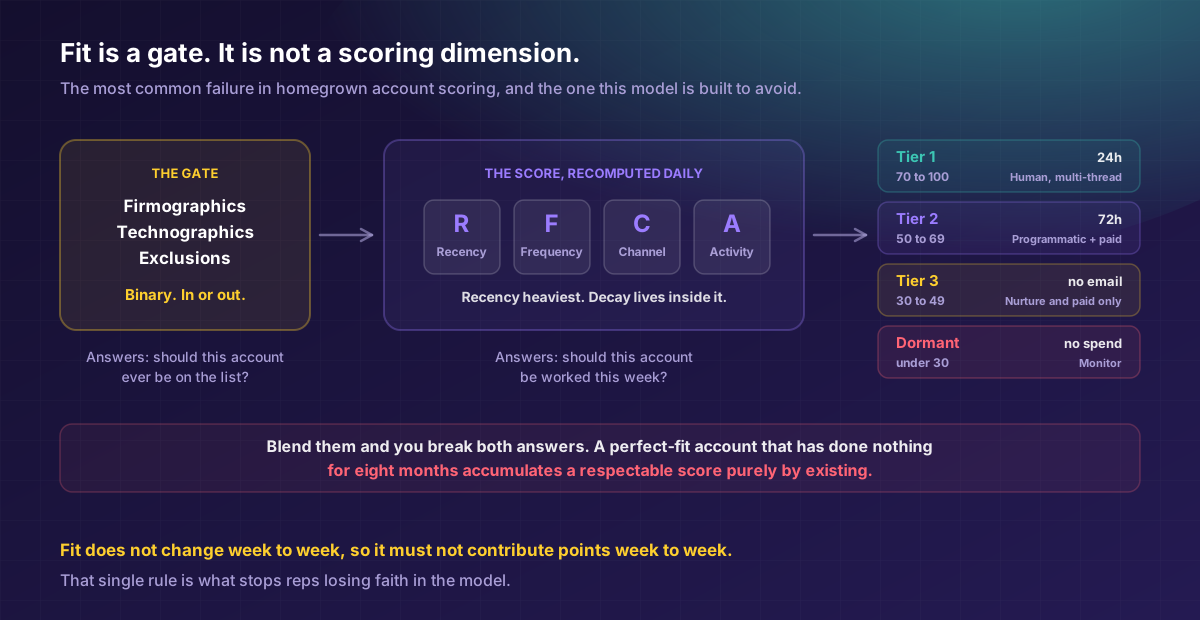
This is the failure we see most often in homegrown account scoring and it is worth being blunt about. When fit is a weighted component it contributes points permanently and unconditionally, because fit does not change week to week. A perfect-fit account that has done nothing for eight months accumulates a respectable composite score purely by existing. Reps work it, find nothing, and lose faith in the model. Account scoring built only on firmographic criteria produces lists that are technically correct and operationally inert, where every account looks like it fits and none is prioritised by anything except size.
Fit answers "should this account ever be on the list". RFE answers "should this account be worked this week". Different questions, and blending them destroys both answers. Building the gate itself is a separate job, and we set it out in the ICP that builds your account list.
Recency, and why one decay curve is not enough
Recency is the heaviest-weighted component because it is both the most predictive and the most perishable. But a raw day count is worthless, because signals do not age at the same speed. A leadership change is still live in three months. A repeat pricing page visit is stale within days.
So recency decays on a per-signal half-life rather than a single global curve, with the decay living inside the Recency component so a score never goes negative. Getting those half-lives right is most of the work, and we published the full ranking, thirty signals with their half-lives and the window to act inside each, in the buying signals that actually predict pipeline. That list is the input to this dimension. Eight of those signals should come out of most scoring models entirely.
The operational consequence is the part teams miss: the score has to recompute daily. A model that recomputes weekly will route a three-day-half-life signal on day six, which is the same as not routing it.
Frequency counts people, not clicks
Frequency is distinct signal events across distinct people inside the account, in a rolling thirty-day window. The critical design choice is that it counts people.
One person triggering six events scores lower than three people triggering four, because the second pattern is a committee forming and the first is usually a student, a competitor, or someone building a slide.
| Score | Pattern | Read |
|---|---|---|
| 0 to 2 | One signal, one person | Noise until proven otherwise |
| 3 to 4 | Two or three signals, one person | A researcher, not a buyer. Do not route to sales |
| 5 to 6 | Three or more signals, two people | Something is forming |
| 7 to 8 | Four or more signals, three people | Active evaluation |
| 9 to 10 | Five or more signals, three-plus people including an economic buyer | In-market now |
There is a multiplier on top: when three or more distinct personas have generated signal inside the window, the composite is lifted, capped at 100. Programmes that reach three or more stakeholders per account produce materially stronger win rates than those reaching one, so the model should be built to chase committees rather than individuals. This is the single highest-value adjustment in it.
Thresholds, and what each one triggers
A score with no attached action is decoration. Every band maps to a play and a routing SLA.
| Band | Tier | Play | Routing SLA |
|---|---|---|---|
| 70 to 100 | Tier 1 | Human-led multi-thread, custom point of view, executive touch, three-plus personas | 24 hours |
| 50 to 69 | Tier 2 | Programmatic sequence with committee multi-thread, paid retargeting layered on | 72 hours |
| 30 to 49 | Tier 3 | Nurture and paid retargeting only. No outbound touch | None |
| Below 30 | Dormant | Monitor. No spend, no touch | None |
The Tier 3 rule is the one teams argue about, and it is the one that protects the whole system. Accounts scoring 30 to 49 receive no outbound email, until they score higher.
Selection discipline is a deliverability strategy
This is the connection most ABM writing misses, and it is why the previous paragraph matters more than it looks.
At 16,200 sends a month, roughly 740 a business day, you need around 19 mailboxes at a conservative 40 sends each. That is a modest build, and the modesty is the point. The ungated version of the same programme needs closer to 200 mailboxes and 7,700 sends a day, which puts you well past the 5,000-a-day threshold the major providers use to classify a bulk sender, and into the volume band where reputation problems start.
The non-negotiables underneath it:
- SPF, DKIM and DMARC on every sending domain. A large share of B2B senders still have not implemented all three correctly, and unauthenticated domains see materially worse delivery.
- Three to four weeks of warm-up before any new domain enters production. That is the minimum, not a best practice.
- Bounce rate under 2 to 3%. Above that, deliverability degrades before you notice.
- Complaint rate held under 0.1%. The published ceiling is 0.3%. Run at a third of it, because measurement is daily and one bad Tuesday can cost a domain.
- Enrolment in Microsoft's feedback programmes, because it does not surface user-reported spam rates by default.
The multi-domain build this implies is its own discipline, and we documented ours in the multi-domain cold email setup.
Where the human still has to sit
The tempting read is that this can run autonomously. SaaStr, six months into running five AI SDRs, reports they need heavy human oversight, so the realistic model is hybrid rather than full replacement.
The split that works is AI for research, enrichment and first-draft personalisation, humans for the conversation, the disqualification call and the relationship. Applied here, automation owns the gate, the signal capture, the scoring and Tier 2 execution. Humans own Tier 1 entirely, own every disqualification decision, and own the weekly model review.
Give a machine your Tier 1 accounts and you trade your best-scoring accounts for a worse conversation, which is an expensive way to save a salary. The research-and-enrichment half is genuinely automatable, and the workflow architecture for it is in the n8n demand gen playbook.
The blind spot this framework cannot cover
RFE scores signals your stack can observe. That is its power and its ceiling.
A growing share of B2B shortlist formation now happens inside AI assistants, in sessions that produce no site visit, no content download, no third-party topic surge and frequently no referrer. An account can move from problem awareness to a three-vendor shortlist without generating a single event your scoring model can see. By the time they visit your pricing page, the shortlist is set and you are either on it or you are not.
The stakes are documented. Forrester's Buyers' Journey Survey, 2024 found that 92% of B2B buyers had a shortlist when they began, and 41% had a single vendor in mind. 6sense's own buyer research puts the pre-contact favourite winning roughly four out of five deals.
No ABM platform solves this and neither does RFE. Being present when the assistant assembles the shortlist is an answer engine and generative engine optimisation problem: structured, machine-quotable content, third-party presence in the sources assistants cite, and original data worth citing. We treat it as the front half of the same system, because a scoring model that only ever sees accounts who already know you exist will always be working a shorter list than it should be. The mechanics are in winning the answer box, People Also Ask and voice, and the shortlist half is generative engine optimisation.
Sequencing the build
Three things have to be true before the scoring model is worth switching on, and they are worth doing in this order.
- Gate and instrument first. Define the fit gate and cut the universe to it. Stand up signal capture and first-party resolution. Start warming sending infrastructure on day one, because it is the longest lead time in the build. Agree the SQL definition in writing with sales, because if that definition moves later, every number in your reporting becomes retrospectively meaningless.
- Score in shadow mode before you route anything. Run the model against the last two quarters of closed-won and closed-lost accounts and check whether it would have surfaced the wins before they happened. Adjust against your own outcome data rather than anyone else's published weights, including these.
- Activate, then review weekly. Thirty minutes, sales and marketing, same list, promotions and demotions logged. It is the component nobody wants and everybody needs.
Expect no meaningful SQL volume before day 45, and meaningful pipeline impact at six to nine months. Anyone promising quarter-one pipeline from a standing start is selling something. If you want the full readiness checklist and the pilot structure that gives you a clear yes or no, it is in the ABM framework checklist and 90-day roadmap.
When programmatic ABM is the wrong answer
The honest disqualifiers. If two or more apply, do not run this.
| Condition | Why it disqualifies |
|---|---|
| Fewer than 500 fit-qualified accounts | No prioritisation problem to solve. A researcher with a spreadsheet beats any model |
| ACV below $15,000 | Committee-level orchestration costs more than the deal returns. Run volume demand gen instead |
| No sales capacity to receive routed accounts | Scoring manufactures work. Surfacing 900 in-market accounts a month to a team already at capacity changes nothing except morale |
| Under 5,000 monthly visitors from ICP-shaped companies | First-party signal will be too thin, so you will be scoring almost entirely on third-party intent, the weakest input |
| No owner with 0.5 FTE for the model | Scoring models decay, and an uncalibrated model is worse than no model because people trust it |
| Sales and marketing disagree on the SQL definition | Fix this first. A one-week conversation that determines whether any of the rest is measurable |
A scoring model that has not been recalibrated against actual outcomes in twelve months is not necessarily wrong, but it is not validated either. Weights, thresholds and tier boundaries are judgement calls dressed as arithmetic. Revisit them quarterly.
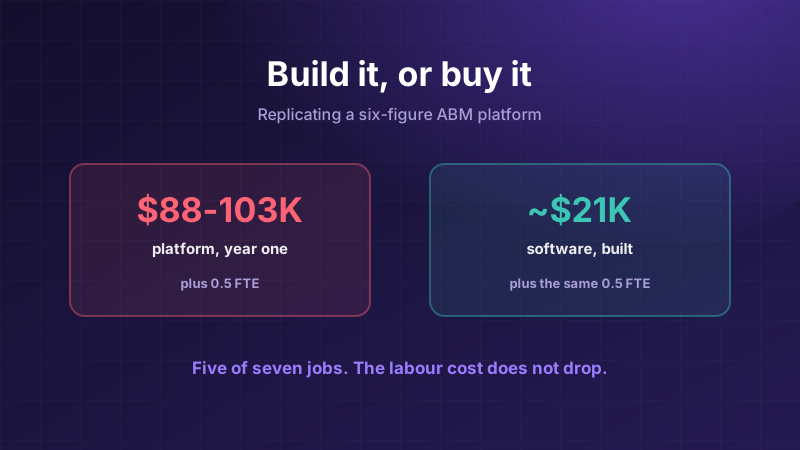
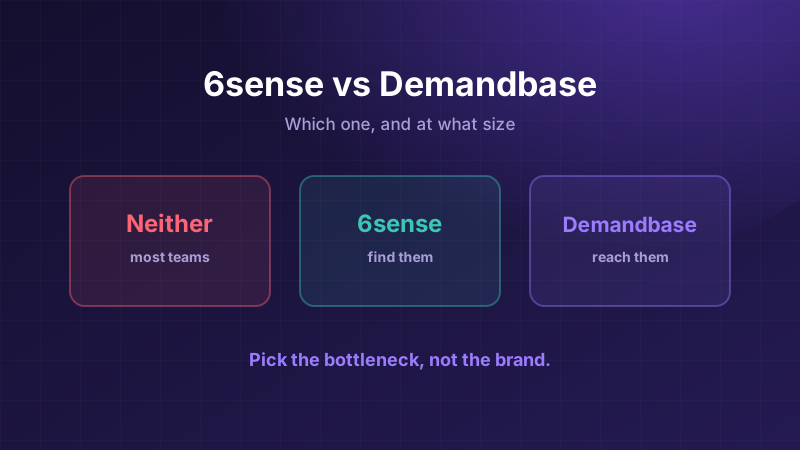
If you are still deciding whether any of this needs a platform underneath it, the honest comparison is in the ABM platforms buyer's guide, the head-to-head is 6sense versus Demandbase, and the third option, building the scoring and orchestration layer yourself, is priced in replicating a six-figure ABM platform. And if you would rather not build it alone, we publish what an ABM programme costs without a platform. That published price covers up to 500 accounts in two tiers, so a programmatic universe of the size modelled here is scoped separately.
Where we land
The number in the title is arithmetic, not a trophy. Rerun it with your own reply rate, your own show rate and your own qualification bar and you will get a different number, which will be the useful one.
What survives the rescaling is the ratio. Eighty-one emails per SQL against 849 is not a marginal efficiency, it is the difference between a programme that can run inside 2026 deliverability rules and one that cannot. Every account you decline to work is capacity, reputation and rep attention you keep for the accounts that are actually in market.
At Omnitics we build the gate, the signal layer and the scoring model first, then turn on sending, because doing it the other way round is how programmes end up with 200 mailboxes and a complaint rate problem. That is what our account-based marketing practice actually does.
Name three of your Tier 1 accounts and we will sketch the plays we would run for each, free: the trigger worth acting on, the buying-committee roles to reach, the angle and the first three touches. You keep it whether you hire us or not.
Frequently asked questions
Programmatic ABM, also called one-to-many ABM, applies account-level personalisation across hundreds or thousands of target accounts using technology rather than manual effort. It sits alongside one-to-one ABM, which covers roughly 10 to 50 accounts with bespoke plans, and one-to-few, which covers clusters of 50 to 200. Programmatic is the tier where account scoring becomes essential, because human triage stops working past a few hundred accounts.
For most single companies, no. At published 2026 benchmarks of four to eight SQLs per SDR per month, median six, 200 implies somewhere between 25 and 50 rep-equivalents. The figure in this article is a modelled portfolio-level output across a combined scored universe of roughly 13,700 accounts, not a single company's result. The value is the arithmetic underneath it, which you can rerun with your own conversion rates to find your own ceiling.
Recency, Frequency and Engagement, with Engagement split into Channel, meaning where the account came from, and Activity, meaning what it actually did. RFM originated in database marketing, and analytics tooling later documented an RFE variant that swaps Monetary for Engagement where there is no purchase history to draw on. RFE account scoring, the account-level and buying-committee adaptation for B2B described here, was coined by Sid Rane at Omnitics.
Because in a net-new B2B account there is nothing underneath it. Monetary works in retail, where the customer has already bought and you hold the purchase history. Against an account that has never transacted with you, a monetary score is a proxy for company size wearing a disguise, and using it points sales at large logos rather than active buyers. Dropping it removes a third of the model that was not measuring anything.
Three differences. Firmographic fit is a binary gate rather than a weighted component, which stops well-fitting but inactive accounts from accumulating scores by existing. Frequency counts distinct people rather than distinct events, so committee formation outranks individual enthusiasm. And recency decays on per-signal half-lives rather than one global curve, because a funding announcement and a pricing page visit do not age at the same rate.
As a rule, three or more distinct signals from two or more distinct people, inside the shortest relevant half-life window. One person generating five events is usually a researcher, a competitor or someone building a slide. Routing that account to sales is how you teach reps to ignore your scoring model.
No, though above a certain scale it helps. The model runs on a CRM, a signal source, an enrichment layer and a sequencing tool, which most teams already own. Platforms earn their cost somewhere past 1,000 accounts with real ad budget attached and a dedicated RevOps owner. Below that, a layered stack usually beats a suite at a fraction of the price.
Send less. SPF, DKIM and DMARC authentication, the three to four weeks of domain warm-up we treat as a floor, and list hygiene are table stakes. The structural protection is the tier rule: accounts below the activation band receive no outbound email at all. The published spam complaint ceiling across Google, Yahoo and Microsoft is 0.3%, and a well-run programme holds under 0.1%. Every account you decline to email is headroom you keep.
First SQLs around day 45 to 60 from a standing start, assuming sending infrastructure warm-up begins on day one. Meaningful pipeline impact at six to nine months and full return at nine to twelve. Account-based programmes do not produce visible top-of-funnel volume in the first 60 to 90 days regardless of what you buy.
Under 500 fit-qualified accounts, where a good analyst with a spreadsheet beats any model. Below roughly $15,000 ACV, where committee-level orchestration costs more than the deal returns. When sales has no capacity to receive routed accounts. When first-party signal is too thin to score on. And when sales and marketing have not agreed a written SQL definition, which is a one-week conversation that determines whether any of it is measurable.