This is written for the person who has been told to evaluate ABM platforms and has two demos booked. You are probably a VP of Marketing, a Head of Demand Gen or a RevOps lead at a B2B company somewhere between $5M and $150M in revenue.
Stop reading if you are under 30 employees, your ACV is below $20,000, or your sales team is three people. Nothing here will change your answer, which is no. Read our ABM platforms buyer's guide instead, particularly the section on running account-based motions without a platform.
Keep reading if you have a target account list of 300 or more, an ACV above $25,000, sales cycles longer than 60 days, and at least half a person's worth of ops capacity to give the platform. That is roughly where the maths starts working.
The short answer
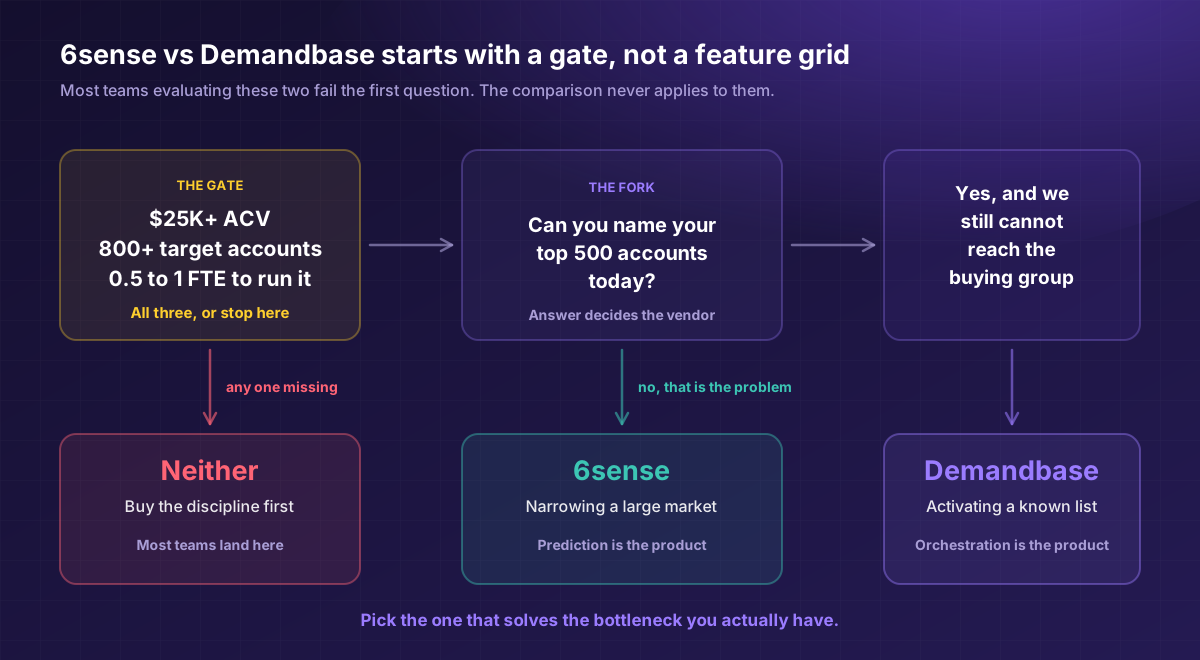
Below roughly $25,000 ACV, under 200 target accounts, or without a dedicated ops person, the answer is neither. Both platforms are priced and built for teams that already have a defined account list, a sales org large enough to work signals, and someone whose job it is to run the thing.
Above that line, the choice is mostly determined by which problem you actually have. 6sense is the better buy when your bottleneck is narrowing: a large addressable market and no reliable way to know which accounts are in play. Demandbase is the better buy when your bottleneck is activating: you already know the accounts and need coordinated media, personalisation and sales plays against them.
Median contract values are close enough that price is not the deciding factor. What separates them financially is what stacks on top: Demandbase's onboarding fee and media minimums, versus 6sense's credit model and advertising tiers.
And one thing neither platform solves, which we come back to at the end: they help you work a shortlist. They do not help you get onto one. In 2026 those are two different budgets.
What changed in 2026, and why older comparisons mislead
Plenty of 6sense versus Demandbase comparisons online are feature grids that predate the changes below. Four things have shifted materially, and each one changes the buying decision.
1. The category you are buying into was redefined
In Q1 2026, Forrester published its Wave on Revenue Marketing Platforms for B2B. Not an ABM Wave. It scored the ten most significant providers, and the Leader group included 6sense and Demandbase alongside Salesforce, Adobe and HubSpot. Demandbase took the highest Strategy score of the ten.
That is the most under-discussed fact in this comparison. Your marketing automation vendor is now scored in the same evaluation as your ABM vendor.
What this means practically: before you shortlist either, check what your existing enterprise marketing automation or CRM contract already entitles you to. In 2024 the answer was mostly nothing. In 2026, if you are on Adobe's B2B stack, Salesforce's marketing stack, or a high-tier HubSpot contract, the overlap is real and worth an hour with your account team before you spend $70,000 elsewhere.
2. Both shipped MCP servers, which changes what you are buying
Demandbase launched its MCP server in April 2026. 6sense opened its own MCP server in beta on 14 July 2026, with general availability planned for the following month, exposing account insights, predictive buying stages, 6QA status and keyword intent as callable context for any MCP-compatible agent.
The strategic read: both companies have concluded that the dashboard is not where the work happens anymore. They are repositioning from destination to intelligence layer.
Three practical consequences:
- Seat maths changes. If signals reach your reps inside the tools they already use, you may need fewer full platform seats than the opening quote assumes. Seats are where both vendors upsell hardest. Ask explicitly how MCP access is licensed versus named user seats, and get the answer in the contract, not the demo.
- The adoption failure mode changes. The classic ABM platform failure, where nobody logs in, becomes less relevant. The new failure mode is agents confidently acting on stale or thin data. That makes data freshness and match rate a harder commercial question than it used to be.
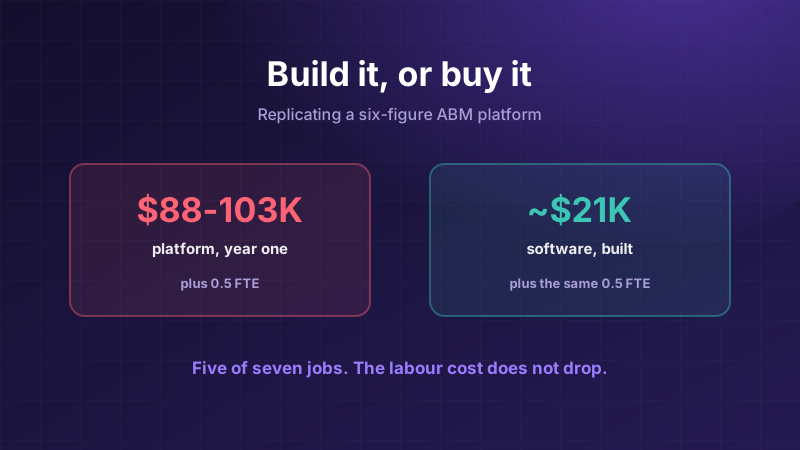
- The build-it-yourself option got stronger. If the product is increasingly an API you call, the gap between a six-figure platform and a signal layer wired into your own orchestration narrows. Not to zero, but it narrows. We covered where that line sits in do you need ABM software.
3. Both are shipping agents faster than customers can absorb them
Demandbase's agent suite now spans campaign outcomes, account engagement, filtering and action, plus an onboarding agent that generates starter intent keywords and a recommended account list from a website URL. What the suite covers today is worth confirming in writing rather than in the demo.
6sense opened its assistant to Revenue Marketing customers in May 2026 and used its summer release to push intelligence into agents, APIs and ad workflows, including turning engaged accounts from ad campaigns into named, CRM-ready contacts.
4. Intent data is table stakes, so the differentiation moved to activation
In the November 2025 Gartner Magic Quadrant for Account-Based Marketing Platforms, the Leaders were 6sense, Demandbase and ZoomInfo Marketing. It was 6sense's fifth consecutive year as a Leader, ranked highest for Ability to Execute, while Demandbase took the highest score for Completeness of Vision. Both have also been named Leaders in Forrester's intent data evaluation, alongside several specialist providers.
When that many vendors are Leaders in the same intent evaluation, intent quality is no longer a differentiator you can win a business case with. The question has moved to what happens after the signal fires, which is the argument we made in signal-based selling.
The size question: six variables that actually decide it
"What size company should buy this?" is usually answered with an employee count, which is close to useless. Employee count is a proxy. These six are the actual drivers. Work through them honestly before either demo.
1. Average contract value. Below roughly $20,000 to $25,000 ACV, a $60,000 to $100,000 all-in commitment rarely pays back. You need volume economics, not account economics. Above $50,000 ACV, a single influenced deal can justify the year.
2. Target account list size. Under roughly 200 accounts you do not have a prioritisation problem, you have a research problem, and a good analyst with a spreadsheet will beat a predictive model. Predictive scoring earns its keep somewhere around 1,000 accounts and up, where human triage genuinely breaks down. If you are not there yet, the work is building a target account list sales will not ignore.
3. Sales capacity to act on signals. This is the one nobody models. Intent data manufactures work. If ten reps are already at quota capacity, surfacing 400 in-market accounts changes nothing except morale. Rough rule: one rep or BDR per 100 to 150 prioritised accounts before the signal has anywhere to go.
4. Ops capacity to run it. Budget 0.5 to 1 FTE. Both platforms need ongoing list hygiene, model tuning, keyword maintenance, CRM field mapping and reporting. If that person does not exist and is not being hired, the platform will degrade into an expensive intent dashboard within two quarters.
5. Website traffic volume. Account identification works by resolving visits. Thin traffic means thin first-party signal, and you become almost entirely dependent on third-party intent, which is the weaker half of both products. Under roughly 5,000 monthly visitors from target-account-shaped companies, expect identification value to disappoint.
6. What you already own. See the Forrester point above. Check your marketing automation and CRM entitlements first.
Size bands and the honest verdict for each
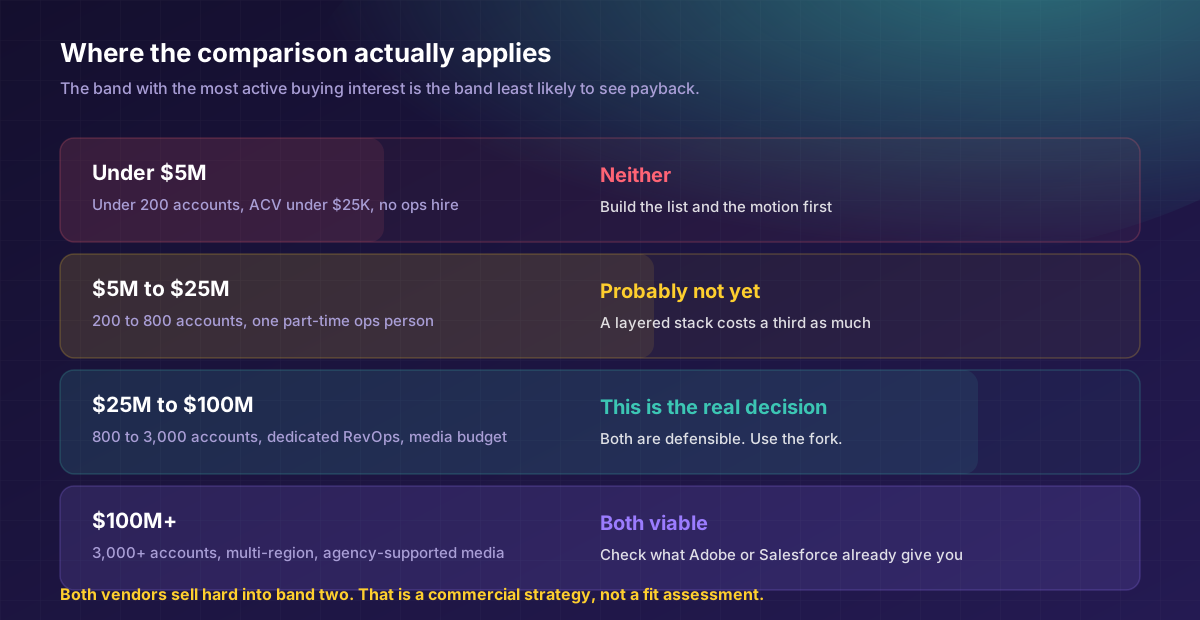
| Band | Profile | Verdict |
|---|---|---|
| Under $5M revenue | Under 50 employees, under 200 accounts, ACV below $25K, no ops hire | Neither. Build the account list and the outbound motion first. Revisit in 12 to 18 months. |
| $5M to $25M revenue | 50 to 200 employees, 200 to 800 accounts, ACV $25K+, one part-time ops person | Probably neither yet. If you must, buy the smallest possible configuration. A layered stack usually beats a platform at this size and costs a third as much. |
| $25M to $100M revenue | 200 to 1,000 employees, 800 to 3,000 accounts, dedicated RevOps, real media budget | This is where the real decision lives. Both are defensible. Use the decision rules below. |
| $100M+ revenue | Enterprise, multi-product or multi-region, 3,000+ accounts, agency-supported media | Both viable. Choose on stack gravity and media strategy, and seriously evaluate what Adobe or Salesforce already give you. |
Note the awkward implication of the second row: the band with the most active buying interest is the band least likely to see payback. Both vendors sell aggressively into mid-market. That is a commercial strategy, not a fit assessment. Your maths still has to work.
If it is a real choice: where the two genuinely differ
For companies in bands three and four, here are the five dimensions where the platforms actually diverge. Everything else is close enough to be noise.
Unit of analysis: prediction versus orchestration
6sense's centre of gravity is the predictive model. Buying-stage classification and qualified-account status are the product, and the pitch is that the model tells you which accounts are in-market before they identify themselves.
Demandbase's centre of gravity is the account journey and coordinated activation across it: media, site personalisation, sales plays and lifecycle orchestration against a list you have defined.
Decision rule: if you cannot confidently name your top 500 accounts today, that is a 6sense problem. If you can name them and cannot reliably reach the buying group, that is a Demandbase problem.
Identification method
Demandbase built proprietary company-identification intelligence and reports stronger enterprise match rates. 6sense leans more on its predictive layer and third-party signal. Both degrade badly on the same things: companies under 50 employees, distributed teams on residential connections, and VPN traffic. Treat any vendor-quoted match rate as a claim to test against your own list, not a specification.
Decision rule: if your ICP skews enterprise with office-based staff, Demandbase's identification advantage is real. If your ICP skews mid-market or remote-first, neither will impress you, and you should weight predictive modelling over identification. Get both vendors to run identification against your actual ICP and report the percentage they can resolve.
Advertising
Demandbase's native B2B demand-side platform is its oldest asset and remains its clearest technical advantage. If display and programmatic account advertising is central to your motion, that maturity matters. It also carries cost: media spend is a separate line item on top of platform fees, with meaningful campaigns requiring committed monthly minimums.
6sense advertising is credible and increasingly tied to lead output, converting engaged accounts from ad campaigns into named contacts routed to a rep or a sequence.
Decision rule: media-led ABM with a real six-figure ad budget favours Demandbase. Advertising as a support channel for a sales-led motion favours 6sense, whose ads-to-pipeline loop is now tighter.
Stack gravity
6sense integrates most naturally with a sales-engagement-centred stack. Demandbase has deeper history with Adobe's marketing tooling, a legacy of its Engagio acquisition.
Decision rule: this predicts adoption better than any feature. Buy the one that lands inside the tools your team already opens every morning. Both now have MCP connections into major sales tools, which softens but does not eliminate the difference.
Implementation and time to value
Neither vendor publishes an implementation timeline, and the week counts circulating in comparison posts disagree with each other. Ask both for a dated go-live plan for your own instance, and note that Demandbase's acquisition-built architecture still shows in uneven experience across modules.
Decision rule: if your fiscal year gives you two quarters to prove value, get the go-live date into the contract rather than the deck.
What they actually cost
Neither publishes list pricing. The figures below are third-party procurement data, not vendor-published list prices. Treat them as a negotiating baseline, not a quote.
| 6sense | Demandbase | |
|---|---|---|
| Median annual contract (Vendr) | $62,440 across 381 purchases | $68,591 across 185 purchases |
| Reported deal range | Roughly $35,000 to $130,000+ | $24,000 to $164,265 |
| Enterprise deployments | Six figures once modules, seats and media are added | Six figures once modules, seats and media are added |
| Standard term | 12 to 24 months, 24 common | 12 months minimum, 2 to 3 years common |
| Onboarding | Negotiable, waivers reported | Separately invoiced line item |
| Seats | Licensed per user beyond included count | Licensed per user beyond included count |
| Media | Advertising tiered separately by spend | Platform fee separate from media, with monthly minimums |
| Free entry | Free plan with a small monthly credit allowance | None |
Implementation commonly adds $25,000 to $50,000 on top for either vendor, which is why first-year totals for mid-market deployments often clear $100,000.
Five things to get in writing before you sign, whichever you pick:
- A 12-month first term. Both will resist. Both have agreed to it.
- A seat cap, and the price of seat eleven. Seat expansion is the primary upsell path for both.
- Intent volume and ad terms explicitly defined. "Unlimited" rarely is. Get overage rates for credits and data volume into the contract.
- Data export rights on termination. You should own your intent and engagement history if you leave.
- A capped renewal escalator. Ask in year one. You will not get it in year three.
The part most comparisons skip: vendor durability
You are signing a two to three year commitment to a private company. Both are stable operating businesses. Both have also been through the same funding-environment correction as the rest of martech.
6sense is the larger of the two, having scaled revenue from $5M to more than $250M under Jason Zintak, who handed the CEO role to Chris Ball in September 2025 and continues as Chairman. A CEO transition mid-contract is not a red flag on its own, but it is a fair thing to ask about roadmap continuity.
Demandbase is smaller, led by Gabe Rogol, and took a $175M credit facility from Vista Credit Partners in February 2023 on top of its equity funding. Debt financing is normal at this stage and is not a distress signal by itself.
What to do with this: ask both vendors the same two questions. What is your net revenue retention? What is your commitment to the specific modules I am buying, over my contract term? You will get vague answers. The quality of the vagueness is itself information, and it is a fair question when you are being asked for a multi-year commitment.
The blind spot both platforms share
Here is the thing that should genuinely affect your budget, and it is in neither pitch deck.
Both platforms exist to detect buyers researching anonymously. Their core mechanism is resolving website visits and observing content consumption across publisher networks. That mechanism was designed for a world where anonymous research meant browsing.
It increasingly does not. Forrester's Buyers' Journey Survey found in 2024 that 89% of B2B buyers had adopted generative AI, naming it a top source of self-guided information at every phase of the buying process. The 2025 wave of the same survey put that at 94%, and recorded the more consequential shift: generative AI and conversational search now rank as more meaningful information sources than vendor websites, product experts or sales conversations.
When a buyer asks an AI assistant to compare vendors in your category, there is no IP address to resolve, no publisher page view to score, and often no click through to your site at all. The research happened. You have no signal that it happened. Neither platform can sell you one.
And the shortlist is where the deal is decided. 6sense's own 2025 buyer research, across roughly 4,000 B2B buyers, found the winning vendor was already on the buyer's Day One list 95% of the time, and that the pre-contact favourite wins about four out of five deals.
This is not an argument against buying a platform. It is an argument against treating the platform budget as your whole answer. If your name is not appearing in the comparisons and category answers that AI assistants synthesise, a better intent model just tells you more precisely how you are losing. That is a different discipline, and we wrote the playbook for it in generative engine optimisation.
Forrester's 2026 B2B predictions add the next turn of the screw: at least one in five B2B sellers will be compelled to respond to AI-powered buyer agents during the year. When the researcher is an agent, structured, machine-readable, publicly available information about your product becomes the entry ticket. Worth being precise about which structure actually gets read, because most of the AI-era files being sold as the answer are never requested. Marketing copy persuades humans. Agents need specifics they can parse, which is a formatting discipline with its own rules: we set out the spec in winning the answer box, People Also Ask and voice.
A 60-day evaluation process that produces a real decision
- Week 1, audit before you demo. Pull your current entitlements from your marketing automation and CRM contracts. Count your addressable account list. Calculate ACV, cycle length and reps available per 100 accounts. If the maths fails here, cancel the demos.
- Week 2, write the failure condition first. One sentence: this platform will have failed if, by a given date, we have not achieved a specific outcome. Circulate it. If nobody can agree on the sentence, you are not ready to buy.
- Weeks 3 and 4, run identical demos. Same account list, same three keywords, same question set. Ask each vendor to show you your accounts, not their sandbox. Ask directly what percentage of your target list they can currently identify.
- Week 5, reference calls with a rule. Ask for two customers of similar size in your band, plus one customer who downgraded or reduced scope at renewal. The third call is the interesting one. If a vendor cannot produce it, note that.
- Week 6, pilot the free entry points. 6sense's free plan is enough to sanity-check data quality on accounts you already know. Demandbase has no free tier, so ask for a scoped paid pilot instead.
- Weeks 7 and 8, model total cost. Licence, onboarding, seats, media minimums, credit overages and 0.5 to 1 FTE. Compare that number against the same budget deployed as a layered stack, and against what we charge for the same work.
- Week 9, negotiate structure, not just price. Term length, seat cap, overage rates, export rights, renewal cap. A discount on a bad structure is not a saving.
When the answer is neither
Be honest about these four situations, because a platform will amplify each of them rather than fix them.
- Your conversion layer is the actual problem. Both platforms are intelligence layers. They send more of the right accounts into a landing page and a sales process that already underperform. If your demo-to-opportunity rate is broken, fix that first, or the platform will only make the leak more expensive.
- Marketing and sales do not agree on the account list. ABM software does not create alignment. It surfaces the absence of it, quarterly, in a dashboard nobody wants to present.
- You need contacts, not accounts. Both tell you which companies are researching. Turning that into named humans with verified contact details is a separate capability and often a separate spend. Pressure-test it in the demo.
- You are buying it to look serious. It happens. It costs $70,000 a year and produces a quarterly slide.
If two or more of those describe you, the work is upstream of the purchase. Start with which buying signals are actually worth acting on and build the motion the platform would have automated.
Where we land
If you are in the band where this is a genuine decision, the honest summary is short. Pick 6sense when you need to find the accounts. Pick Demandbase when you need to reach the ones you have already found. Pick neither if your list, your sales capacity or your conversion layer is not ready to absorb what either one produces.
And whichever you pick, do not let the platform budget absorb the visibility budget. The account that is in-market and never hears your name is not a signal problem. It is a presence problem, and it is decided long before your intent model wakes up.
At Omnitics we build the account list, the signal layer and the outbound motion first, then tell you when a platform licence is genuinely the next constraint. Often it is not yet. That is what our account-based marketing practice actually does.
Name three target accounts and we will sketch the plays we would run for each, free: the trigger worth acting on, the buying-committee roles to reach, the angle and the first three touches, plus a short note on whether either platform would earn its keep at your size. If the honest answer is neither, we will say that.
Frequently asked questions
Neither is better in general. 6sense is stronger at predicting which accounts are in-market from a large addressable universe. Demandbase is stronger at coordinated activation, particularly advertising, against an account list you have already defined. If you cannot name your top 500 accounts today, that is a 6sense problem. If you can name them and cannot reach the buying group, that is a Demandbase problem.
Neither publishes list pricing. Vendr marketplace data puts Demandbase's median annual contract at $68,591 across 185 purchases and 6sense's at $62,440 across 381 purchases, with individual Demandbase deals reported from $24,000 to $164,265. Enterprise deployments for both reach $100,000 to $300,000 or more once modules, seats and media are included.
Practically: 800 or more target accounts, ACV above $25,000, sales cycles over 60 days, at least one rep per 100 to 150 prioritised accounts, and half an FTE of ops capacity. Below that, a layered stack of enrichment, signal and sequencing tools typically delivers more for less.
Median contracts are close enough that price rarely decides it. The difference shows up in add-ons: Demandbase carries a separately invoiced onboarding fee and demand-side platform media minimums, while 6sense's costs concentrate in data credits, seat expansion and advertising tiers. Model total cost, not licence cost.
Not sustainably. Both require ongoing list management, model tuning, keyword maintenance and CRM field mapping. Budget 0.5 to 1 FTE, or expect the platform to decay into an expensive intent dashboard within two quarters.
Yes. Both expose their intelligence through Model Context Protocol servers. Demandbase launched its MCP server in April 2026. 6sense opened its MCP server in beta on 14 July 2026, making account insights, predictive buying stages, 6QA status and keyword intent callable from MCP-compatible agents, with general availability planned for August 2026.
No. ABM platforms detect and engage accounts that are already researching. Being named when a buyer asks an AI assistant to compare vendors is a content, structured-data and third-party-citation problem, which is a separate discipline and a separate budget.
Neither vendor publishes an implementation timeline, and the week counts circulating in comparison posts disagree with each other. Ask both for a dated go-live plan for your own instance. Both need longer to reach useful model accuracy, generally one to two quarters.
6sense offers a free plan with a small monthly credit allowance, useful for sanity-checking data quality on accounts you already know but not for running a workflow. Demandbase has no free tier or free trial, so evaluation requires a sales conversation. Ask for a scoped paid pilot instead.
It broadened. Forrester's Q1 2026 evaluation of the space was titled Revenue Marketing Platforms for B2B rather than ABM, scored ten vendors, and placed 6sense and Demandbase in the Leader group alongside Salesforce, Adobe and HubSpot. Your existing marketing automation vendor may now overlap with what you are shopping for.