Every target account list gets the same funeral.
It is built over three weeks. It is presented in a quarterly planning session with a slide showing the tiers. Everyone in the room agrees. It goes into the CRM behind a custom field, a dashboard gets built on top of it, and someone posts a message in the revenue channel with a rocket emoji.
Six weeks later you pull the activity report and find that reps are working accounts that are not on it.
Once the list exists, timing decides what gets worked first, which is where signal-based selling picks up. The usual diagnosis is that the list was wrong. Occasionally it is. Far more often the list was fine and the process that produced it was never going to survive contact with a quota.
The evidence here is not subtle. Supered's State of Sales Enablement 2026 found that 89% of sales teams have their process written down, while the average rate at which reps actually follow that process sits at about 36%. More than fifty points of daylight between what a company decided and what its people do. In that study the adoption gap outweighed territory design, compensation structure, and methodology choice as a predictor of quota attainment.
A target account list is a sales process in list form. It inherits the same adoption problem, and it inherits it worse, because a list is a set of instructions about where a rep spends the one thing they cannot get more of.
So the question is not how to build an accurate list. Accuracy is table stakes and most teams get reasonably close. The question is how to build one that a rep will still be working in month four.
The list is not ignored because it is wrong
Start with what a rep knows that your list builder does not.
They know the deal that died at that account fourteen months ago and why. They know the VP who left. They know that the security review at that logo takes seven months and eats a quarter of a rep's year. They know which parent company just imposed a vendor consolidation freeze. None of this is in your data provider. Some of it is not in your CRM either, because the rep who learned it has since moved on.
Now consider what happens when a list arrives fully formed. The rep scans it, finds one account they know is a waste of time, and quietly concludes the other ninety-nine were selected with the same care. One visible error discredits an unknown number of invisible correct ones. This is not irrational. It is how anyone evaluates a source they cannot audit.
The second failure is slower and more common. LeanData's execution research names it directly: the most frequent ownership failure in account-based programs is that nobody owns the target account list after launch. The list ships, the project closes, the working group dissolves, and eight months later it is a historical document that a dashboard is still treating as current.
Neither of these is fixed by better data. Both are fixed by changing who builds the list and what happens to it after it ships.
Size the list by capacity, not by filter
Here is the most common way a target account list gets its size, and it is almost universal.
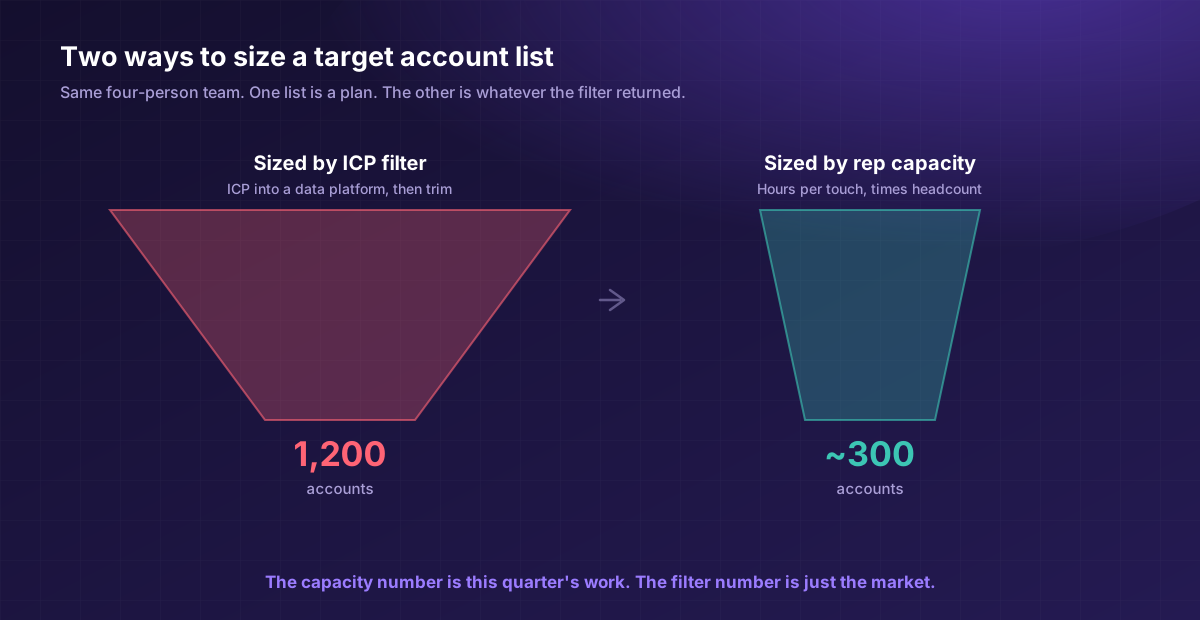
You define the ICP. You put the criteria into a data platform. It returns 4,000 companies. Somebody says four thousand feels like a lot, so you add a headcount floor and a region filter and get to 1,200. That number appears on the slide and becomes the target account list.
Nothing in that sequence involved the sales team's capacity. It is also the moment most teams start shopping for an ABM platform to solve what is really a sizing problem. If you are already deep in that evaluation, 6sense vs Demandbase covers which of the two fits which constraint. The list is sized by whatever the filter happened to return, which is a function of your data provider's coverage and your patience for adding criteria. It is not a plan.
The capacity approach runs the other way. Start with the hours a rep actually has, work out what a tier-appropriate touch costs in hours, and derive the number of accounts from there. Winning by Design's account capacity model works this way, and the industry benchmarks that get quoted most often turn out to be capacity numbers in disguise. The frequently cited figure of 88 accounts per sales development rep, and the median of around 50 accounts per account owner reported by Engagio, are not statements about market size. They are statements about how much a person can hold.
A working set of planning assumptions:
| Tier | Motion | Annual hours per account | Accounts one rep can carry |
|---|---|---|---|
| Tier 1 | One-to-one, named, custom | 20 to 40 | 10 to 20 |
| Tier 2 | One-to-few, clustered by trigger or segment | 6 to 12 | 40 to 80 |
| Tier 3 | Programmatic, one-to-many | 1 to 3 | 200 to 400 |
Planning ranges, not measured constants. Calibrate against your own logged activity before you commit a headcount plan to them.
Multiply by your actual headcount. That total is your ceiling, and it is usually a fraction of what the filter returned. A four-person sales team does not have a 1,200-account list. It has, at the outside, a 300-account list with a small tier one, and pretending otherwise is how you end up with 900 accounts nobody has ever touched sitting in a CRM field, quietly poisoning every coverage report you run.
The uncomfortable version of this: if the capacity math says your list should be 200 accounts and your board deck says the TAM is 40,000, those two numbers are not in conflict. One is the market. The other is this quarter's work. Confusing them is how account-based programs turn back into spray and pray with better labeling.
The veto round
This is the intervention that changes adoption more than anything else we run, and it costs a single ninety-minute meeting.
Before the list goes live, give every rep a rejection budget. A fixed share of their assigned accounts, say 20%, that they may strike from their own list. Not a suggestion box. An actual right, exercised in a working session, with the outcome binding.
Three rules make it work.
Every rejection needs a reason code. Not free text. A short closed list: wrong size, no reachable entry point, competitor locked, dead relationship, wrong buying motion, timing. If a rep cannot fit their objection into a code, it goes to a seventh bucket called other, and other gets read out loud.
Rejected accounts go to a holding pool, not the bin. They come back into scoring next quarter with the rejection logged against them. A competitor-locked account with a contract ending in March is a Q1 account, not a dead one.
The budget is a ceiling, not a quota. Reps who want to keep everything keep everything. In practice most use half of it.
What this buys you is consent. The 80% a rep keeps is a set they chose, not a set they received, and the difference in how it gets worked is not subtle. This is old behavioral ground and it holds up in the field: people work harder on things they had a hand in shaping, even when their hand was small and mostly involved saying no.
But the reason codes are the real prize, and this is the part most teams miss.
Aggregate them and you have a free diagnostic on your own targeting. Read them like this:
| If rejections cluster on | Your actual problem is | The fix |
|---|---|---|
| No reachable entry point | Contact data, not account selection | Buying group coverage before you add more accounts |
| Wrong size or wrong motion | Your ICP filter | Retune the profile, not the list |
| Competitor locked | Timing intelligence | Track contract cycles as a scoring input |
| Dead relationship | CRM history is not reaching the list builder | Wire closed-lost reasons into scoring |
| Spread evenly across all codes | The list is probably fine | Adoption is a management problem, not a data one |
That last row matters. If rejections come back scattered with no pattern, your list was decent and your problem is elsewhere. That is a genuinely useful thing to learn in ninety minutes, and you cannot learn it any other way.
Fit and reachability are two different scores
Most account scoring models produce one number. Firmographic fit, technographic fit, maybe an intent overlay, rolled into a single score between zero and one hundred. Sort descending, draw a line, ship the list.
The problem is that this single number silently mixes two questions that have nothing to do with each other. Should we sell to this account, and can we reach it this year?
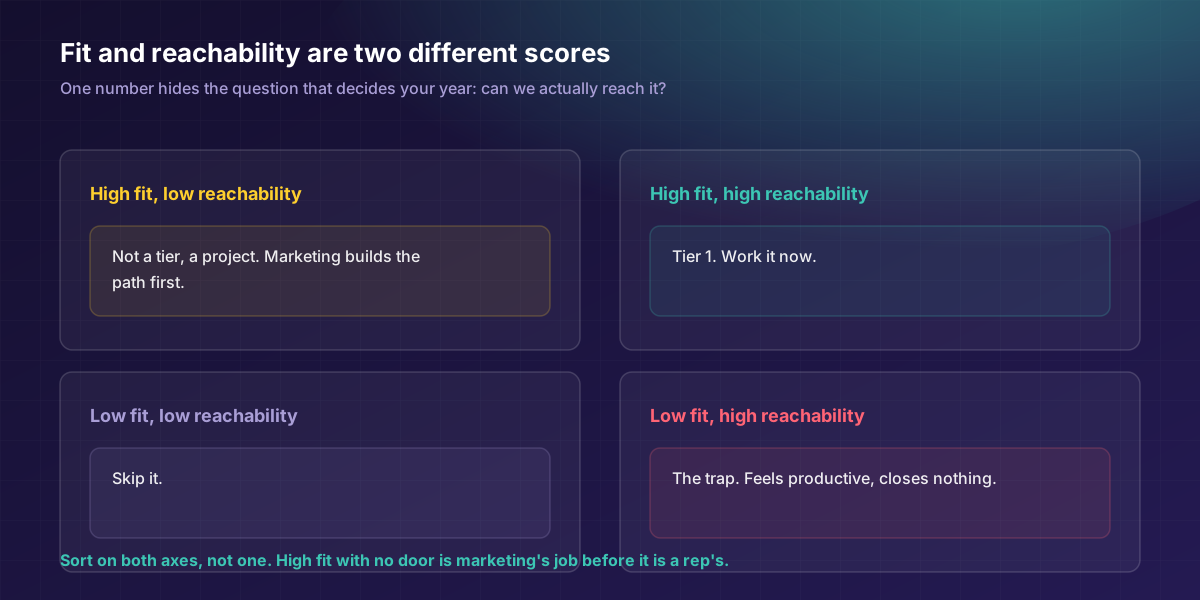
An account can score 94 on fit and be completely unworkable. There may be no verified contacts in the buying group. There may be no warm path of any kind into an organization that ignores cold outreach as policy. There may be a competitor contract with eighteen months left. There may be a procurement rule that blocks vendors under a certain size. Each of these is fatal, none of them is a fit problem, and a single blended score hides all of them.
Split the score. Keep fit as fit, and add a separate reachability score with three components:
The same principle goes further once the list is live: fit works better as a binary gate than as a weighted component, because fit does not change week to week and should not contribute points week to week.
Coverage. Do we have verified contacts for the roles that will actually decide this? Not one contact. The roles. Estimates of buying group size vary widely by source and by how you count, with Gartner's frequently cited range at six to ten people and Forrester counting thirteen for enterprise deals. The disagreement is not a problem for your purposes. The floor is what matters, and the floor is more than one.
Path. Is there a warm route in? An investor, a former colleague, a customer with a relationship, an advisor. Accounts with a warm path convert at materially higher rates than accounts without one, which is why some scoring models apply a multiplier of 1.5 to 2 times when a warm relationship exists. Most models skip this input entirely, then wonder why the high-scoring accounts underperformed.
Timing. Do we know anything about their contract cycle, budget calendar, or renewal date? If not, say so rather than assuming the window is open.
Now sort on both. High fit and high reachability is tier one. High fit and low reachability is not a tier one account, it is a project: the work is to build a path, and that is marketing's job before it is ever a rep's. Low fit and high reachability is the trap that eats junior teams, because it feels productive and closes nothing.
Publishing that two-axis view alongside the list does something else useful. It tells reps you understand that their year has constraints, which is the fastest way to be taken seriously by people who have been handed optimistic lists before. If you want the full scoring approach, we have written up the ICP work that feeds it.
The list rots, and nobody owns it
A target account list is a perishable good and almost nobody treats it as one.
Champions leave. Roughly 30 to 40 percent of B2B champions change jobs every eighteen months, which means a meaningful share of the relationship map underneath your list is wrong within a year of building it. Companies get acquired. Funding changes the budget picture. A competitor's contract ends. A tier three account hires the exact role that makes them a tier one account, and your list has no idea.
Two things fix this, and neither is a tool.
Name one owner. A person, not a team, usually in revenue operations. Their job is not to rebuild the list. It is to make sure the list is never quietly wrong, which is a different and smaller job. Ownership fails when it is assigned to a function rather than a human, because a function cannot be asked in a meeting whether it did the thing.
Set two cadences, not one. A quarterly rescore and retier, which is the scheduled work. And an event-driven update, which is the unscheduled work: funding, acquisition, leadership change, champion move. The second one is where automation earns its place, because a person will not reliably notice a Series B on account 173. A workflow will, and it can move the account between tiers and tell the owner why. That is the kind of thing we build in n8n, and it is one of the few genuinely unglamorous automations that pays for itself in a quarter.
And a hygiene point that outranks both: none of this survives a CRM where accounts are duplicated and lifecycle stages mean different things to different teams. A target account list sitting on top of dirty account records is a list of guesses with a dashboard attached. Fix that layer first.
What the finished artifact looks like
A target account list that gets used is not a spreadsheet of company names. It has a specific shape.
| Element | What it contains | Why it survives contact with a rep |
|---|---|---|
| Account and tier | Named, with the motion attached | A rep can tell what is expected of them per account |
| Fit score with visible inputs | The score and the three or four factors that drove it | Auditable. A rep who disagrees can argue with the inputs |
| Reachability score | Coverage, path, timing | Sets honest expectations about effort |
| Buying group map | The roles to reach, and which ones you have contacts for | Prevents single-threading, which is the most common way these deals die |
| Why now | The trigger or the absence of one | A rep opening a sequence needs a first line, and this is it |
| Rejection history | What was vetoed, by whom, when, why | Stops the same argument recurring every quarter |
| Owner and last review date | A name and a date | Makes decay visible instead of silent |
The last two rows are the ones teams leave out, and they are the ones that make the difference between a list and a living system.
The one number that tells you it worked
Not pipeline. Pipeline is the outcome and it arrives too late to steer with.
Measure list coverage: the share of accounts on the list with at least one logged, meaningful rep activity in the last 30 days. Meaningful means a call, a sequence, a meeting, a real touch. Not an automated email open. Not a page view.
Below 60% and the list is decorative. Your reps have a shadow list they actually work, and your dashboards are reporting on a fiction. Between 60% and 80% is a healthy program with normal slippage. Above 80% sustained, and either you have an unusually disciplined team or your list is too small, which is a better problem than the alternative.
Coverage is a leading indicator, it is available weekly, and it is almost impossible to game in a way that does not also produce real activity. Run it in your weekly revenue meeting for one quarter and watch how quickly the conversation changes from whether the list is right to whether the list is being worked, which was the real question the entire time.
The point of all of this is not a better spreadsheet. It is that account selection stops being a marketing deliverable that sales receives, and starts being a shared decision that both sides are on the hook for. Everything above is machinery for making that shift concrete rather than aspirational. If you want the surrounding program, the 2026 ABM playbook covers what happens after the list is agreed.
Bring your dream-account list to a 30-minute call and we will pressure-test it against capacity, run the reachability split on your top tier, and sketch the plays we would run. You leave with a plan either way.
Frequently asked questions
A target account list is the defined set of companies a revenue team has deliberately chosen to pursue, usually tiered by fit and potential value. It is the company-level equivalent of a prospect list, and it is the artifact that turns an ideal customer profile from a description into a working queue.
Size it by rep capacity rather than by how many companies survive your filter. A useful planning range is 10 to 20 one-to-one accounts per account executive, 40 to 80 one-to-few accounts, and 200 to 400 programmatic accounts per rep. Multiply by headcount, and that total is your ceiling. Most lists are two to three times larger than the team can actually work.
Usually because they had no hand in building it. Reps hold local knowledge that never reaches the list builder, such as the deal that died there last year or the competitor contract with eighteen months left. When a list arrives fully formed and contains one account a rep knows is wrong, they treat the rest as unverified too. Adoption is the failure mode far more often than accuracy.
Quarterly for scoring and tiering, with event-driven updates in between for funding rounds, acquisitions, leadership changes, and champion job moves. Roughly 30 to 40 percent of B2B champions change roles every eighteen months, so a list left untouched for a year is substantially fiction.
One named person, usually in revenue operations. The most common ownership failure in account-based programs is that nobody owns the list once it ships, so it decays quietly while everyone assumes someone else is maintaining it.
The ideal customer profile is the rule that describes which companies fit. The target account list is the specific, named, finite set of companies you are working right now. The ICP can match fifty thousand companies. The list should match your team's capacity.