This is written for the person who owns organic growth at a B2B company and has been handed "we need to be in AI answers" as an objective. You are probably a Head of Demand Gen, a content lead or a founder doing both jobs.
Stop reading if your site has fewer than thirty indexed pages, no author attribution and nothing published in the last quarter. AEO is a layer you add on top of a functioning content operation, not a substitute for having one.
Keep reading if you publish regularly, rank for something, and cannot work out why that ranking has stopped producing traffic or pipeline.
The short answer
Answer Engine Optimisation is the practice of writing and structuring content so a machine can lift a correct, self-contained answer out of it and attribute that answer to you. That is the whole idea. Everything else is implementation detail.
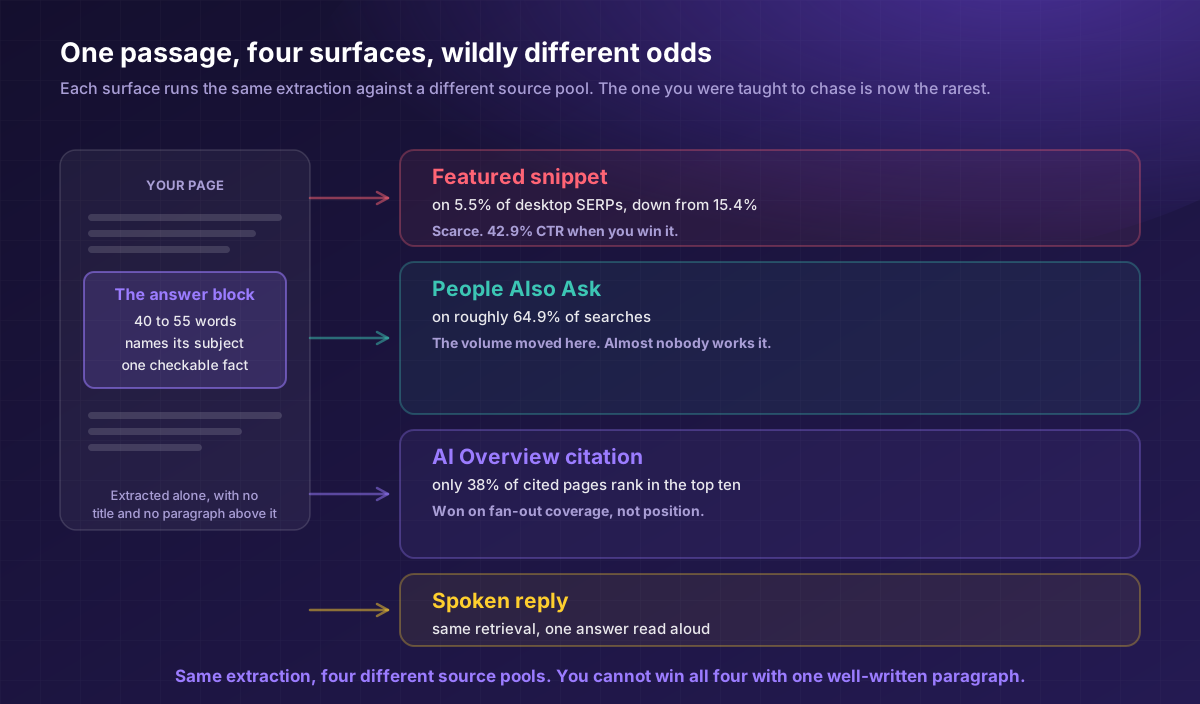
What changed is where the extraction happens. In 2019 the placement that mattered was the featured snippet, and the tactic was simple: find a question, answer it in forty words, win the box. In 2026 the same extraction runs across at least four surfaces at once, and they no longer share a source pool. The featured snippet, the People Also Ask box, the AI Overview and the spoken assistant reply all pull passages, but they pull them differently, and the box you were taught to chase is now the smallest of the four.
The practical consequence: you cannot win this by writing better forty-word paragraphs on your top ten keywords. You win it by covering a topic densely enough that you appear across the sub-queries an engine generates on its own, and by writing every section so it survives being ripped out of context.
What changed in 2026, and why most AEO advice is stale
Four things moved this year. Each one invalidates a piece of standard advice you will still find on page one for "answer engine optimisation".
1. The answer box got scarce
Featured snippets did not become less valuable. They became rarer. Ahrefs tracked desktop snippet presence dropping from 15.41% of SERPs to 5.53%, a 64% decline, as Google routed more informational queries into AI Overviews.
Where snippets do survive, they remain the highest-value organic placement on the page. First Page Sage puts click-through for a first-position featured snippet at 42.9%, the best of any organic result.
So the snippet is now a scarce, high-yield placement rather than a volume play. That changes how you should budget attention toward it: chase snippets on the handful of queries where the buyer is close to a decision, and stop auditing your whole keyword set for snippet opportunities.
2. People Also Ask got bigger, and started composing its own answers
While the snippet contracted, PAA expanded. Semrush puts People Also Ask boxes on around 64.9% of searches, which makes it the most common answer surface in search and the least deliberately worked in B2B.
The more interesting shift is what is inside the box. Google began inserting its own generated answers into PAA in late 2024. An analysis of 8.4 million English PAA results put the generated share at 12.6%. By October 2025 it was measured at 38%, up from 17.8% a few months earlier.
Be precise about what that does and does not mean. At 38%, most PAA answers were still extracted from pages, so the passage you wrote could still be lifted verbatim. But the generated share more than doubled in months, and on the questions where Google could not find a page that fully answers the query, which are exactly the specific questions a B2B buyer asks, composition is already the norm rather than the exception.
The tactical read: stop trying to match the phrasing of an existing PAA answer. That was always a weak tactic and it is now a shrinking one. What gets you into the box is being one of the sources the composer draws on, and being the link it attaches underneath. That is a comprehension problem, not a copywriting problem.
PAA is also the cheapest thing on this list to work, because almost nobody in B2B works it deliberately. Most teams treat the box as a keyword research artefact, a place to harvest question ideas. It is a placement.
3. Google retired FAQ rich results
On 7 May 2026, FAQ rich results stopped appearing in Google Search. The Search Console FAQ report and Rich Results Test support were dropped in June 2026, and Search Console API support ends in August 2026. All three dates are in Google's own FAQPage documentation.
The industry produced two overcorrections within about a week: "schema is dead" and "FAQ schema matters more than ever for AI". Neither holds.
Here is the accurate version. FAQPage remains a valid Schema.org type. The markup will not error, will not trigger a manual action and will not hurt rankings if you leave it in place. Bing and the various retrieval crawlers still parse it. What ended is the visible Google feature, which is the part marketers actually cared about.
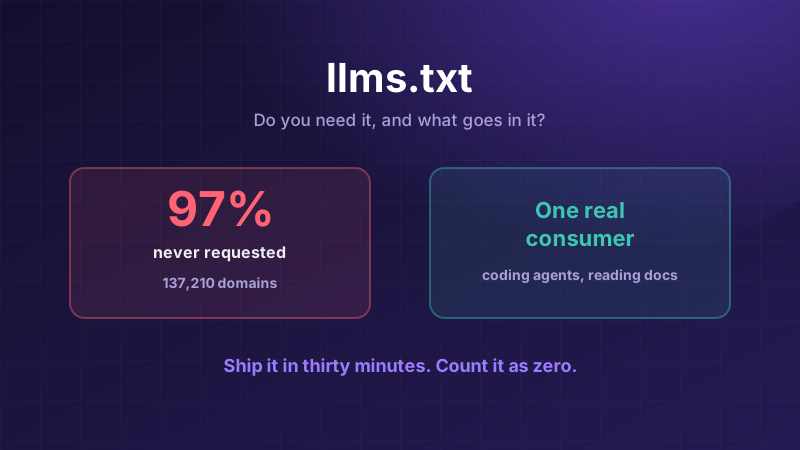
Google's own guidance on AI features is unusually direct about this. It says you do not need to create new machine-readable files, AI text files or markup to appear in AI Overviews and AI Mode, and that there is no special schema.org structured data you need to add. The one thing it does recommend is making your structured data match the visible text on the page. The most popular file that guidance quietly rules out is llms.txt, and the request logs agree with Google: we went through the evidence in llms.txt: do you need it, and what goes in it.
The honest lesson, and I include our own content in this: the schema was never doing the work. The clear answer on the page was doing the work. The markup made it easier to parse. Removing the rich result simply removed the part that flattered us into thinking otherwise.
4. Ranking and citation came apart
This is the one that should reset your reporting.
Ahrefs analysed 863,000 keyword SERPs and four million AI Overview URLs and found that 38% of cited pages also appeared in the top ten for the same query, down from 76% in a July 2025 run that looked only at the top three citations in each overview. Counting SERP features as positions, the remainder splits almost evenly: 31.2% at positions 11 to 100, and 31.0% beyond position 100. BrightEdge, using its own parser, reported a lower figure: 16.7% of citations from top ten results, in a study running to September 2025.
The gap between those numbers is a measurement difference, not a contradiction. The two studies use different parsers, different samples and different windows, and BrightEdge's reading is six months older than Ahrefs'. Read them as a range rather than a trend.
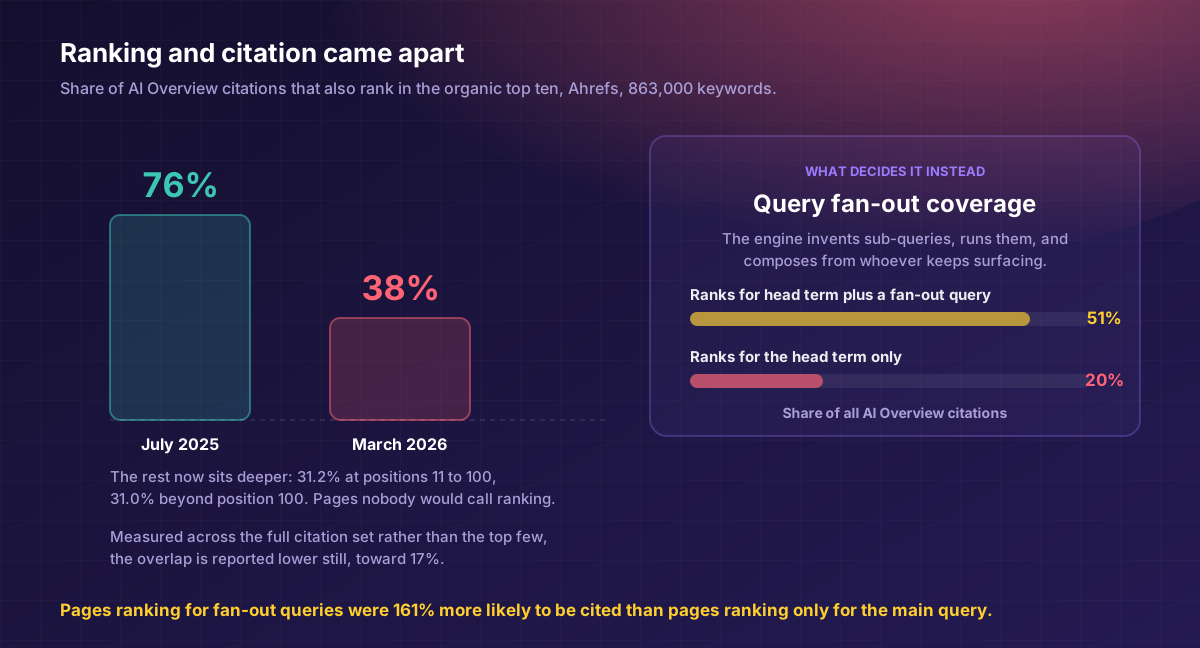
The mechanism is query fan-out. The engine takes one typed question, decomposes it into a set of sub-queries, runs those, and composes an answer from the sources that keep surfacing across the set. An analysis of 10,000 keywords with roughly 33,000 fan-out queries extracted found that pages ranking for fan-out queries were 161% more likely to be cited than pages ranking only for the main query. Pages ranking for both the head term and at least one fan-out accounted for 51% of citations. Pages ranking only for the head term accounted for just under 20%.
Position still matters. It is now one input among several rather than the input.
The strategic translation is short: a page that ranks first for your money keyword and fortieth for the twelve questions surrounding it will lose citation slots to a page that answers those twelve questions well and ranks for none of them.
What AEO actually is, and where it stops
The three acronyms get used interchangeably, usually by people selling all three. Here is the division we use internally, because it changes what you build.
| Optimising for | Winning looks like | Primary lever | |
|---|---|---|---|
| SEO | A ranked list of documents | A blue link in the top ten | Relevance, authority, technical health |
| AEO | An extracted answer on a search surface | Your passage inside the snippet, PAA box or overview, with your name on it | Passage-level structure and factual specificity |
| GEO | A synthesised recommendation inside an assistant | Being named when a buyer asks who the options are | Third-party corroboration, entity presence, original data |
AEO sits between the other two and shares mechanics with both. It depends on SEO because you generally have to be in the candidate pool to be extracted from it. It feeds GEO because the same passage-level clarity that wins a PAA slot makes you easier to quote inside an assistant answer.
Where AEO stops is the part worth being blunt about. AEO gets your answer into the response. It does not get your company onto the shortlist. Those are different jobs, and we wrote the second one up separately in our guide to generative engine optimisation.
The distinction matters commercially. Winning the answer box for "what is intent data" is a brand-awareness outcome. Being named when someone asks which vendors to evaluate is a pipeline outcome. Teams routinely fund the first and expect the second.
The answer block: a format spec, not a writing tip
Every guide tells you to "answer the question directly". That is true and useless. Here is the specification we write to, and the reasoning behind each rule.
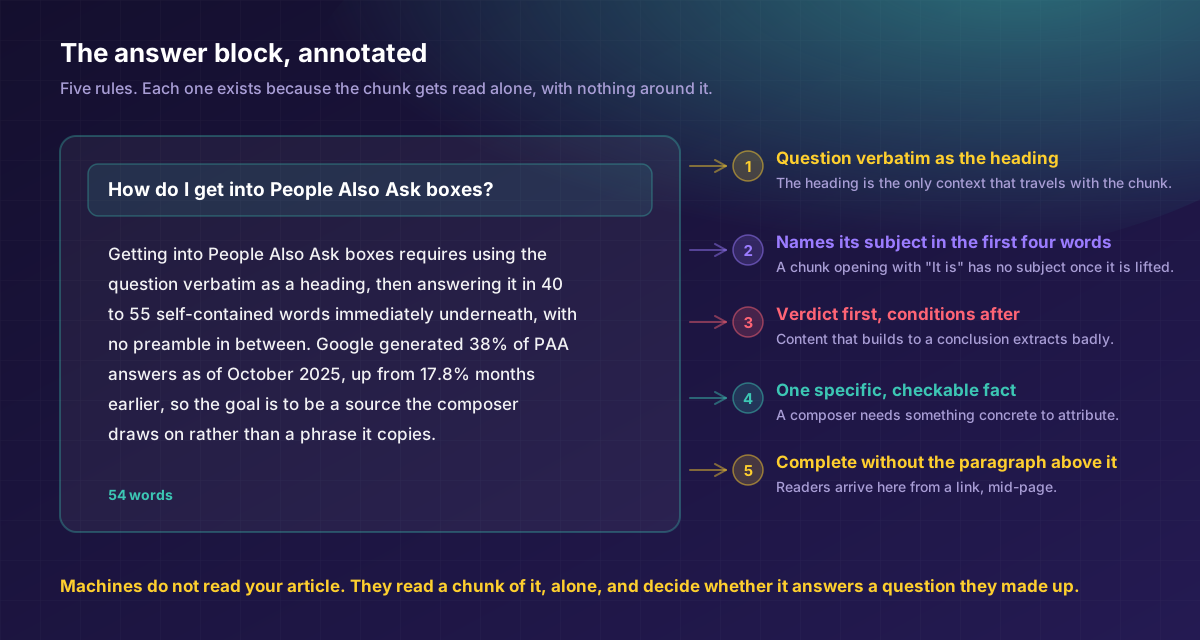
Lead with a standalone claim of 40 to 55 words. Long enough to be complete, short enough to be lifted whole. The rule is not aesthetic. Extraction systems need a contiguous span that reads as an answer without the sentence before it.
Repeat the entity, never pronoun it. Write "Answer Engine Optimisation is" rather than "It is". A chunk that begins with a pronoun has no subject once it is separated from your H2, and it will lose to a chunk that names its subject.
Front-load the verdict, then qualify. Put the answer in sentence one and the conditions in sentences two and three. Content that builds toward a conclusion is well-written and badly extracted.
Make sections self-contained. Each H2 should survive being read alone. That means restating context you already established, which will feel repetitive to you and will not feel repetitive to a reader arriving mid-page from a PAA link.
Include at least one specific, checkable fact per section. A number, a date, a named source, a price, a threshold. Specificity is the strongest quotability signal there is, because a system composing an answer needs something concrete to attribute.
Match the format to the query type. This is where most teams lose slots they were otherwise entitled to.
| Query shape | Extracted format | What to write |
|---|---|---|
| What is X | Paragraph | A definition sentence, then a distinguishing sentence, then a boundary sentence |
| How to X | Numbered list | Sequential steps under an H2 that repeats the task, one action per step |
| X vs Y | Table or paragraph | A comparison table with identical row labels, plus a one-sentence verdict above it |
| Best X for Y | List | Named options with a one-line qualification each, not a ranked essay |
| How much does X cost | Paragraph with numbers | A figure, a range, and the variable that moves it |
| Is X worth it | Paragraph | A direct yes, no or conditional in the first clause |
Write for the fan-out, not the keyword. Before drafting, list the twelve to twenty questions an engine would generate from your head term. Answer each one under its own heading in the same piece, or across a tightly linked cluster. This is the single highest-leverage change available to most B2B content teams right now, and it is the one that maps directly to the citation data above.
Update the date and mean it. Freshness signals feed source selection. A dateModified that moves while the content does not is a short-term trick that erodes trust with both readers and crawlers.
People Also Ask: the surface most B2B teams leave on the table
Work PAA as a placement, in this order.
Harvest properly. Take your ten highest-intent commercial queries. Expand every PAA box, which regenerates new questions as you click, and record three to four levels deep. In our own harvests that produces sixty to a hundred and twenty questions per seed. Deduplicate by meaning rather than by string, because "how much does ABM software cost" and "is ABM software expensive" are one question wearing two coats.
Sort by buyer distance, not volume. Many PAA questions have no measurable volume in keyword tools, which is part of why they are available. Rank them by how close the asker is to a purchase decision. A question containing a competitor name, a price, an alternative or an implementation detail is worth ten definitional questions. If you have already built a signal hierarchy for outbound, the logic is the same one we use for ranking buying signals.
Answer each in place, with the question as the heading. Use the question verbatim as an H2 or H3, then the 40 to 55 word answer block directly underneath, then any elaboration. No preamble between the heading and the answer.
Cluster rather than sprawl. Twenty questions on one topic belong in one substantial piece plus two or three supporting pieces, not twenty thin pages. Thin question pages were a viable tactic in 2021. In 2026 they read as exactly what they are, and they dilute the topic authority that fan-out coverage depends on.
Track appearance monthly. Many rank trackers report PAA presence per keyword. If yours does not, a monthly manual check on twenty questions takes an hour and is enough to see movement.
One warning worth stating plainly. Most PAA answers are now composed rather than quoted, which means the box will sometimes paraphrase you inaccurately. That is a real risk and there is no lever that fully prevents it. The mitigation is to make the correct version of your claim the clearest, most repeated and most corroborated version available, so the composition has less room to drift.
Voice: what is true, and what is folklore
Voice deserves a section in an AEO piece, and it deserves a shorter one than it usually gets.
Start with why the statistics are unusable. Depending on which report you open, global voice search adoption is 20.5%, 27% or 31% of queries, and each figure is presented with equal confidence. All three trace back to marketing statistics roundups rather than a primary panel you can inspect. The often-quoted "one billion voice searches a month" has no reproducible methodology behind it. The "41% of voice results come from featured snippets" number predates AI Overviews entirely, which is a problem given featured snippets have since become scarce.
Anyone building a business case on these figures is building on sand, and any agency quoting them at you without caveat is telling you something about their research standards.
Now the part that is true and actionable.
Voice is a delivery format, not a retrieval system. Siri, Gemini, Alexa and ChatGPT's voice mode all do roughly the same thing when they answer from the web: parse intent, retrieve from an index, extract a passage, speak it. The retrieval is the same retrieval. There is no separate voice index to optimise for, which is why "voice search optimisation" as a discrete service line has always been slightly oversold.
It imposes one real constraint: singularity. A screen shows ten results. A speaker reads one. Everything about the answer-block spec above matters more when there is no second place, and being cited becomes closer to binary.
Sentence length and pronounceability start to count. Short sentences survive text-to-speech intact. Tables, nested lists, parenthetical asides and acronym soup do not. If your answer block cannot be read aloud without confusing a listener, it is a weaker candidate for spoken retrieval.
Speakable schema is not the answer. Google's documentation still labels it beta, as it has since 2018, and still limits it to users in the US with Google Home devices set to English. Seven years without expansion is information. If you are not a news publisher, implement it if it costs you nothing and expect nothing back.
For B2B specifically, be honest about the volume. In B2B, voice barely registers. Nobody is asking a smart speaker to compare mid-market ABM platforms. What is genuinely growing is conversational assistant use on desktop and mobile, where the input happens to be spoken, and that is a GEO problem rather than a voice problem.
The practical position: optimise your answers so they read well aloud, because that constraint improves them for every surface. Do not fund voice as a channel.
Schema in 2026: what to keep, and what to stop pretending about
After the FAQ deprecation, here is where structured data actually stands for a B2B site.
Keep and invest in:
- Organization, with sameAs links to your verified profiles. This is entity-building work and it feeds knowledge graph association, which affects whether an assistant recognises you as a distinct thing that exists.
- Article with complete author, datePublished, dateModified and publisher. Authorship and freshness are inputs to source selection.
- Person for your authors, linked from Article and to their real professional profiles. Experience and expertise stop being abstractions when there is a machine-readable person behind the claim.
- Product, Review, Event and BreadcrumbList where genuinely applicable. These retain rich result support.
Keep but stop counting:
- FAQPage. Harmless to leave in place, and no longer producing anything visible on Google. Leave existing markup, do not build new processes around it, and remove it where it is stale or hidden from users. For the record, this post ships FAQPage markup, because the advice above is to keep it rather than to strip it.
Do not build a strategy on:
- Speakable, for the reasons above.
- HowTo, which was deprecated in 2023 and lost desktop rich results that September.
The governing rule from Google's own guidance is simple and often ignored: structured data should match what is visible on the page. Markup describing content a human cannot see is the one version of this that can actively hurt you.
Measuring AEO when there is no click
US zero-click reached 68.01% for the first four months of 2026, up from 60.45% in 2024, according to SparkToro working from Similarweb clickstream data. Only 232 of every 1,000 US Google searches now reach the open web. A session-based scorecard will report a successful AEO programme as a failure.
Change what you count.
Impressions and impression-to-click divergence in Search Console. Impressions climbing while clicks stay flat is the signature of answer-surface presence. That is the pattern you want to see, not the one you escalate about.
Answer-surface presence, tracked as a percentage. Of your top fifty buyer questions, on how many does your domain appear in a snippet, a PAA answer or an AI Overview citation? Baseline it, then track monthly. This is the closest thing to a real AEO KPI.
Citation share against named competitors. Same question set, run through the major assistants on a fixed schedule, counting how often each brand is named. Manual at first, automatable once the question set stabilises, and a straightforward n8n workflow if you already run one.
AI referrers as first-class sources in GA4. Configure the major assistant domains as recognised referral sources. Traffic from them is low volume and unusually high intent. Seer Interactive's tracking found click-through on AI Overview queries bottomed at 1.3% in December 2025 and recovered to 2.4% by February 2026, still below the click-through on searches with no overview. Expect fewer, better visits rather than a rebound to old volumes.
Branded search volume. The lagging indicator that tells you whether being the answer is translating into being remembered. If answer-surface presence rises for six months and branded search does not move, your content is informing people without introducing you, which usually means your answers are correct and your positioning is invisible.
A 30-day AEO sprint
If you are starting from nothing, this is the sequence that produces evidence fastest.
- Days 1 to 3, build the question set. Fifty buyer questions across the funnel, harvested from PAA expansion, your sales team's inbox and your own assistants. Not keywords. Questions, phrased as a buyer would phrase them.
- Days 4 to 6, baseline. For each question, record whether a snippet, PAA box or AI Overview appears, and who is cited. Run the same set through two assistants and record who gets named. This spreadsheet is your programme.
- Days 7 to 10, audit your existing pages against the answer-block spec. In our audits, a good share of existing content already ranks somewhere and simply buries the answer under three paragraphs of preamble. Fixing those is faster and higher-yield than writing anything new.
- Days 11 to 18, restructure the top ten. Answer blocks under every heading, questions as headings, one checkable fact per section, format matched to query type. No new content in this window.
- Days 19 to 24, build one fan-out cluster. Pick your single highest-value commercial topic. Map the twenty sub-questions. Cover all twenty across one substantial piece and two or three supporting pieces, interlinked. If you want the mechanics of building a cluster rather than a pile of posts, our AI workflow guide covers the research and drafting half of it.
- Days 25 to 27, fix the schema layer. Organization with sameAs, Article with full authorship, Person for authors. Export whatever historical FAQ data you still have, because Search Console API support for it was due to end in August 2026.
- Days 28 to 30, wire the measurement. AI referrers in GA4, the answer-surface tracker, the citation-share check on a monthly recurrence.
Re-baseline at day sixty and day ninety. We plan for movement on PAA first, within four to six weeks, while snippet and overview citation take longer, usually a quarter, and depend on how much authority the domain already carries.
When AEO is the wrong priority
Four situations where this work will not pay, and you should hear it now rather than in month five.
- You are not in the candidate pool yet. If nothing on the site ranks in the top fifty for anything commercial, extraction has nothing to extract from. Fundamental SEO and indexing come first. AEO is a multiplier on existing visibility, and a multiplier applied to zero is still zero.
- Your category is not searched, it is asked. Some B2B categories generate very little traditional search volume because buyers go straight to peers, communities and assistants. In that case the money is in GEO and third-party presence, not in snippet formatting.
- The problem is conversion, not visibility. If you already appear on twenty answer surfaces and the resulting traffic does not convert, more answer surfaces will produce more of the same. Fix the offer.
- You need pipeline this quarter. AEO compounds, it does not sprint. If the number is due in ninety days, the honest answer is outbound and paid, with AEO running underneath as the thing that makes next year cheaper. That is a different build, and it starts with cold email infrastructure that actually delivers.
Where we land
The short version of a long piece. The answer box is a scarce placement now, worth pursuing on your dozen highest-intent queries and not worth an audit across your whole keyword set. People Also Ask is where the volume moved and where almost nobody in B2B is deliberately competing. Voice is a constraint on how you write, not a channel to fund. And the structural shift underneath all three is that ranking and being cited have become separate achievements, decided largely by whether you cover the questions surrounding your topic rather than the topic itself.
The trap in all of this is treating AEO as a formatting exercise. Format gets you extracted. It does not get you chosen.
When a buyer moves from "what is X" to "who should I buy X from", the answer surfaces stop summarising and start recommending, and recommendation runs on corroboration you do not control: third-party mentions, review presence, original data other people cite, and whether a model has seen your name in the same sentence as your category often enough to believe you belong there. It is the same gap we described when comparing the major ABM platforms, where a better intent model tells you more precisely how you are losing if the buyer never had you on the list. Being the best-formatted page in a category nobody associates you with is a solvable problem, but it is not solved by more headings.
At Omnitics we run the answer-surface layer and the shortlist layer as one programme, because separating them is how teams end up perfectly quotable and never recommended. That is what our SEO, AEO and GEO practice actually does.
Send us your site, three competitors and three questions your buyers ask. We will run your questions and a set of buyer prompts across ChatGPT, Perplexity, Google's AI answers and Gemini, and send you a free AI Visibility Snapshot: whether you are named, who is cited instead of you, and the top three fixes. If the honest answer is that you need basic SEO first, we will say that.
Frequently asked questions
Answer Engine Optimisation, also spelled Answer Engine Optimization, is the practice of structuring content so search and AI systems can extract a complete, correct answer from it and attribute that answer to your brand. It targets featured snippets, People Also Ask boxes, AI Overviews and spoken assistant replies rather than blue-link rankings alone.
Yes, though they overlap. SEO optimises a document to rank in a list. AEO optimises a passage to be extracted as an answer. SEO usually gets you into the candidate pool, and AEO decides whether the engine lifts your paragraph rather than a competitor's once you are there.
Yes, but selectively. Ahrefs tracked desktop snippet presence falling from 15.41% to 5.53% of SERPs, a 64% decline, while First Page Sage puts first-position snippet click-through at 42.9%, the highest of any organic result. The placement is now scarce and high yield, so target it on high-intent commercial queries rather than across a whole keyword set.
Google removed the FAQ rich result, not the schema type. FAQ rich results stopped appearing on 7 May 2026, Search Console reporting and Rich Results Test support ended in June 2026, and Search Console API support ends in August 2026. FAQPage remains a valid Schema.org type and the markup is harmless to leave in place, which is Google's own position on unused structured data.
Use the question verbatim as a heading, then answer it in 40 to 55 self-contained words immediately underneath, with no preamble in between. Most PAA answers are now composed by Google rather than lifted word for word, so the goal is to be a source the composer draws on, which depends on clarity, specificity and covering the surrounding questions on the same page.
Less reliably than it did. Ahrefs found the share of AI Overview citations that also rank in the organic top ten fell from 76% in July 2025 to 38% by March 2026, with the remainder split almost evenly between positions 11 to 100 and beyond position 100. Ranking still helps and no longer decides.
Query fan-out is when a search or AI system decomposes one typed question into multiple related sub-queries, runs them, and builds its answer from sources that appear consistently across the set. One analysis of 10,000 keywords found pages ranking for fan-out queries were 161% more likely to be cited than pages ranking only for the head term.
As a channel, very little. As a constraint, quite a lot. Voice assistants use the same retrieval as text search and simply read one answer aloud, so writing answers in short, pronounceable sentences improves your candidacy on every surface. Published voice adoption figures vary widely and we could not trace any of them to a panel you can inspect, so treat any voice-specific business case with scepticism.
Only if it costs you nothing. Google's documentation still labels speakable as beta and still limits it to users in the US with Google Home devices set to English. It has carried that label since 2018. Non-news B2B sites should not build a strategy around it.
Track answer-surface presence across a fixed set of buyer questions, citation share against named competitors, Search Console impressions relative to clicks, AI referral traffic in GA4, and branded search volume. With US zero-click at 68.01% in early 2026 and only 232 of every 1,000 searches reaching the open web, a session-only scorecard will misreport a working programme as a failing one.
We plan for People Also Ask movement within four to six weeks of restructuring existing content. Featured snippet and AI Overview citation generally take a quarter or more and depend heavily on existing domain authority. Restructuring pages that already rank produces results faster than publishing new content.