This guide is written for B2B marketing and revenue leaders who are actively evaluating account-based marketing software and want a straight answer about whether they need it.
It will be useful to you if three things are true. Your average contract value sits above roughly $25,000. Your typical deal involves a buying committee of more than three people. And you have, or can build, a named account list you are willing to be held accountable to.
If your ACV is below that, if you sell to a single decision-maker, or if you cannot yet name the 200 companies you most want as customers, an ABM platform will not fix that. Close the tab and go build a target account list your team will actually work. Everything in this guide assumes you have one.
What actually changed in the ABM category in 2026
Four shifts matter for anyone signing a contract this year.
Buyers now build shortlists inside AI tools, not search engines. G2's 2026 research found that just over half of B2B software buyers begin their research in an AI chatbot more often than in Google, and that AI chatbots are now the single biggest influence on which vendors make a shortlist. Forrester's Buyers' Journey Survey put the share of B2B buyers using AI in their buying process at 94% in 2025, up five points on the year before. Meanwhile the shortlist itself has shrunk to roughly two and a half vendors, and 6sense's buyer research found that the vendor who wins the deal was already on the buyer's day-one list the overwhelming majority of the time.
The first line is whether an answer surface names you at all, which is a content and structure problem rather than a platform one. We cover it in AEO: winning the answer box, People Also Ask and voice.
The implication for ABM is uncomfortable and under-discussed. Account-based marketing is designed to influence accounts you have identified. But the shortlist that decides your fate is now often formed before any signal reaches your platform, inside a conversation you cannot see, based on content you may not have published. That is the same coverage hole we mapped in signal-based selling, and the only way into that conversation is being cited by the AI assistants themselves.
The category consolidated, and half the internet has not noticed. Terminus, for years the default mid-market answer to enterprise suites, merged into DemandScience in November 2024 and the Terminus brand was folded into the parent company. Plenty of "best ABM platforms" roundups still list Terminus as a standalone self-serve advertising platform. It is not one. If you are evaluating what used to be Terminus, you are evaluating DemandScience's product family, and you should ask directly about migration paths and packaging before signing anything multi-year.
Generic third-party intent data is being repriced. For most of the last decade, "we have intent data" was enough to justify a six-figure contract. In 2026 buyers are openly questioning whether a generic topic-level intent feed converts at a rate that justifies the monthly spend. The interesting movement is toward first-party signals, your own site, your own product, your own community, and toward contact-level rather than account-level resolution. Knowing that someone at a target company researched your category is much less useful than knowing who. We rank thirty of these inputs in the buying signals that actually predict pipeline.
AI agents moved from demo to default. Demandbase ships Agentbase, HubSpot ships Breeze, Salesforce ships Agentforce, and Common Room has built its positioning around a research-and-personalisation agent layer. The genuinely new development is pricing: in April 2026 HubSpot moved two Breeze agents to outcome-based pricing, charging per resolved conversation and per lead recommended for outreach. Expect more of this, and expect it to make total cost harder to forecast, not easier.
Five questions to answer before you look at a single vendor
Most buying guides open with logos. That is backwards. The following five questions will eliminate more bad purchases than any feature comparison.
1. How many named accounts are you actually working?
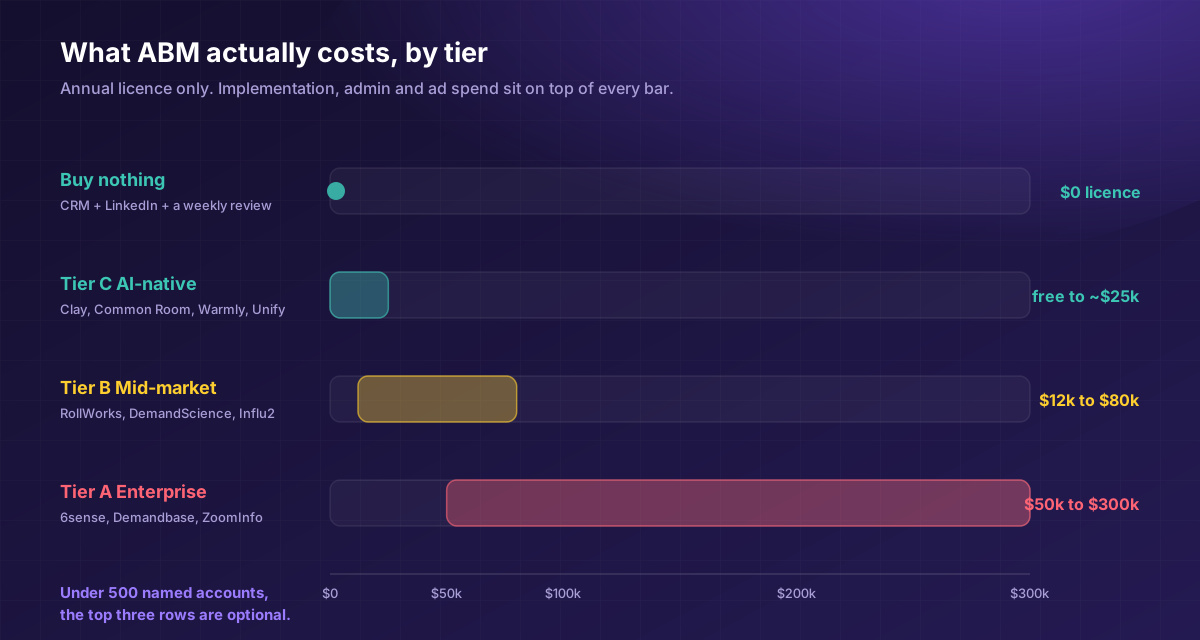
Under about 500, the coordination problem an ABM platform solves does not exist yet. You can hold 500 accounts in a spreadsheet and a CRM. Between 500 and 2,000, a platform starts earning its keep. Above 2,000 with a real sales team attached, manual coordination becomes the bottleneck and software wins.
2. Who will own and administer it?
This is the question that decides whether your purchase becomes shelfware. Enterprise ABM platforms are not self-driving. They need someone who owns list hygiene, field mapping, segment logic and reporting, typically a RevOps person, often close to half their time. If you cannot name that person today, you are not buying software. You are buying a job description you have not funded.
3. Is your CRM data good enough to feed it?
Every platform in this guide ingests whatever your CRM contains and inherits its flaws. B2B contact data goes stale quickly through job changes and restructuring, and CRMs without deduplication governance steadily accumulate duplicates. Feed that into predictive scoring, ad targeting and personalisation and you get confidently wrong answers at scale. Data quality is not a differentiator in ABM. It is a prerequisite, which is why we fix the CRM layer before anything else.
4. Is your real constraint finding accounts, or reaching them?
These are different problems with different answers. If you cannot tell which accounts are in-market, your constraint is signal, and the intent-heavy platforms are worth their premium. If you already know exactly who you want and cannot coordinate a consistent multi-channel touch pattern against them, your constraint is orchestration, and you will overpay badly for an intent layer you do not need. Most teams have not asked themselves which one they are.
5. Do you have tier-specific content ready to run?
ABM without differentiated content for each tier is just personalised cold email with a bigger budget. At minimum you need one substantial mid-funnel asset per ICP segment before launch. If you do not have it, the platform will faithfully distribute nothing.
If you answered "no" or "not yet" to three or more of these, the honest recommendation is the buy-nothing stack further down.
The platforms, grouped by the job they do
Ranked lists age badly and rankings are mostly arbitrary. What follows is grouped by the motion each tool actually serves. Every entry uses the same four lines, including the one most guides leave out.
Tier A: enterprise suites
6sense
- Best at: Predictive buying-stage modelling. Its account scoring is the most granular in the category, and it was recognised as a Leader in Forrester's Q1 2026 Wave for revenue marketing platforms.
- Fits: Enterprise teams with large account universes, a dedicated RevOps function and existing ABM maturity.
- Real cost: Vendr transaction data puts the median contract around $58,000 per year across several hundred purchases, with the range running from roughly $10,000 to over $150,000. Multi-year commitments are standard, and a free sales-intelligence tier exists but is not a meaningful substitute for the platform.
- Do not buy it if: Your constraint is orchestration rather than identification. You will pay a premium for the intent layer and use a fraction of it.
Demandbase
- Best at: Unified account intelligence plus B2B advertising. It operates a B2B-native demand-side platform, which is a genuine differentiator if your ABM strategy is advertising-led, and it holds current Gartner Magic Quadrant Leader status for ABM platforms.
- Fits: Enterprise teams running significant programmatic spend against target accounts alongside sales engagement.
- Real cost: Median contract around $66,000 per year on Vendr data, with implementation typically adding $25,000 to $35,000 on top. Enterprise deployments commonly run past $200,000.
- Do not buy it if: You are not committing meaningful ad budget. The DSP is the reason to be here, and without ad spend you are buying an expensive account database.
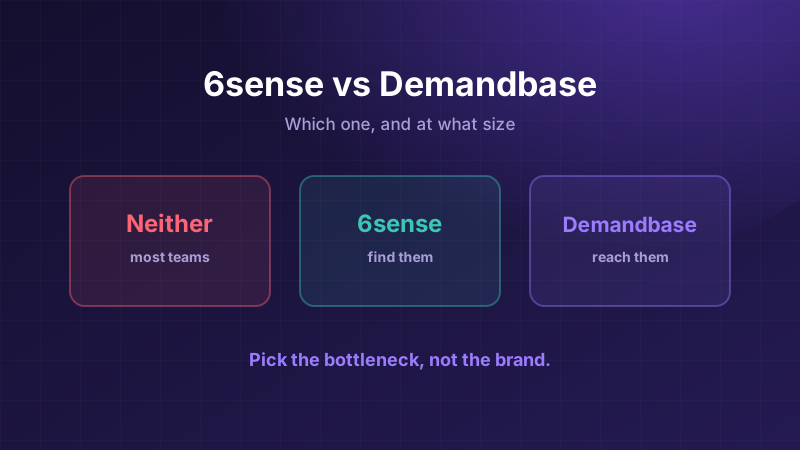
If those two are your shortlist, we compare them head to head in 6sense vs Demandbase, including the size at which each one starts to earn its keep and the gate most teams fail before the comparison even applies.
ZoomInfo Marketing
- Best at: Data depth. Its edge is contact coverage at scale plus conversation intelligence, a signal layer the pure-play ABM vendors do not have.
- Fits: Teams whose primary pain is contact data quality and coverage, with ABM as a secondary motion layered on top.
- Real cost: Quote-based, and typically bundled with data seats. Ask for the ABM module priced separately.
- Do not buy it if: Your data is already clean and your problem is campaign orchestration.
Tier B: mid-market
RollWorks
- Best at: Lightweight account identification and advertising activation, using IP and cookie-based targeting with third-party intent partners.
- Fits: Mid-market teams running traditional ABM advertising who want targeting without enterprise implementation.
- Real cost: RollWorks publishes no pricing. It is the most accessible of the established platforms in the quotes we have seen.
- Do not buy it if: You need deep predictive scoring or sophisticated multi-channel orchestration.
DemandScience (formerly Terminus)
- Best at: Content syndication and managed demand generation, with account-based activation attached.
- Fits: Teams who want outsourced demand generation, syndication, qualified leads and managed advertising, more than they want software to operate themselves.
- Real cost: Vendr's benchmark puts the median contract at $68,000 a year, with deals from $29,600 to $240,000 depending on services attached.
- Do not buy it if: You are expecting the self-serve Terminus advertising product. The offering is services-led now, and the analyst recognition Terminus earned in 2022 predates the merger and the current architecture.
Influ2
- Best at: Contact-level advertising. Rather than targeting an entire account, it serves ads to named individuals in the buying committee and reports on who engaged.
- Fits: Teams with small, high-value account lists who know exactly which people matter.
- Real cost: Mid-market, quote-based, meaningfully below the enterprise suites.
- Do not buy it if: You need broad account discovery. This tool assumes you already know your targets.
Tier C: AI-native signal and orchestration
Clay
- Best at: Waterfall enrichment and programmatic list building. It queries data providers in sequence and only pays for successful matches, and its research agent handles company investigation and message personalisation across a large provider network.
- Fits: Teams with an in-house operator who will actually build workflows.
- Real cost: Credit-based, starting free, scaling with usage. Genuinely accessible at the low end.
- Do not buy it if: Nobody on your team will own it. Clay is a power-user tool, and teams that buy it without an operator consistently under-use it.
Common Room
- Best at: Signals that traditional intent providers miss, such as community activity, social engagement, product usage and developer platforms.
- Fits: Product-led and community-led B2B companies where buyers congregate somewhere other than review sites.
- Real cost: Quote-based, mid-market positioning.
- Do not buy it if: Your buyers are not visible in communities. For a traditional enterprise sales motion, this replaces nothing.
Warmly
- Best at: Website visitor de-anonymisation and immediate follow-up.
- Fits: Teams whose warmest available signal is site traffic they currently cannot identify.
- Real cost: The most affordable entry point in this tier.
- Do not buy it if: Your site traffic is thin. De-anonymising 40 visitors a month is not a programme.
Unify
- Best at: Combining signal, AI research and sequencing into a single outbound motion without a full ABM suite.
- Fits: Signal-led outbound teams who want one system rather than four.
- Real cost: Quote-based, positioned well below enterprise ABM.
- Do not buy it if: You need advertising activation or account-level attribution.
Tier D: CRM-native
HubSpot Breeze and Salesforce Agentforce both now ship AI capability directly on the CRM record. Breeze Copilot is included in Hub subscriptions, with intelligence sold as credits and agents priced on outcomes.
- Fits: Teams whose stack already runs on one of these and who want ABM capability without a new vendor relationship.
- Do not buy more if: You have not exhausted what you are already paying for. This is the most commonly skipped step in the entire evaluation process, and it is free to check.
Comparison at a glance
| Platform | Best for | Realistic annual minimum | Time to live (our estimate) | Needs dedicated admin | Skip if |
|---|---|---|---|---|---|
| 6sense | Predictive intent | about $50,000 | 6 to 10 weeks | Yes | Orchestration is your gap |
| Demandbase | ABM advertising | about $50,000 plus implementation | 5 to 8 weeks | Yes | No ad budget |
| ZoomInfo | Contact data depth | Quote-based | 4 to 6 weeks | Yes | Data already clean |
| RollWorks | Mid-market ads | Quote-based | 3 to 5 weeks | Part-time | Need predictive scoring |
| DemandScience | Managed demand gen | about $30,000 | Services-led | No | Want self-serve software |
| Influ2 | Contact-level ads | Mid-market | 2 to 4 weeks | Part-time | Need discovery |
| Clay | Enrichment, list building | From free | Days | Operator required | No in-house operator |
| Common Room | Community signals | Quote-based | 2 to 4 weeks | Part-time | Buyers are not in communities |
| Warmly | Visitor identification | Low four figures | Days | No | Low site traffic |
| HubSpot Breeze | Already on HubSpot | Included or credits | Immediate | No | Not on HubSpot |
Prices here come from Vendr's transaction data and the vendors' own pricing pages, checked in September 2026. Time to live is our own estimate, not a vendor commitment. This category re-prices constantly, so treat every figure as a starting point and re-check before you commit.
The buy-nothing stack
Here is the option no vendor-sponsored roundup will give you: for a large share of teams evaluating ABM software in 2026, the correct purchase is nothing.
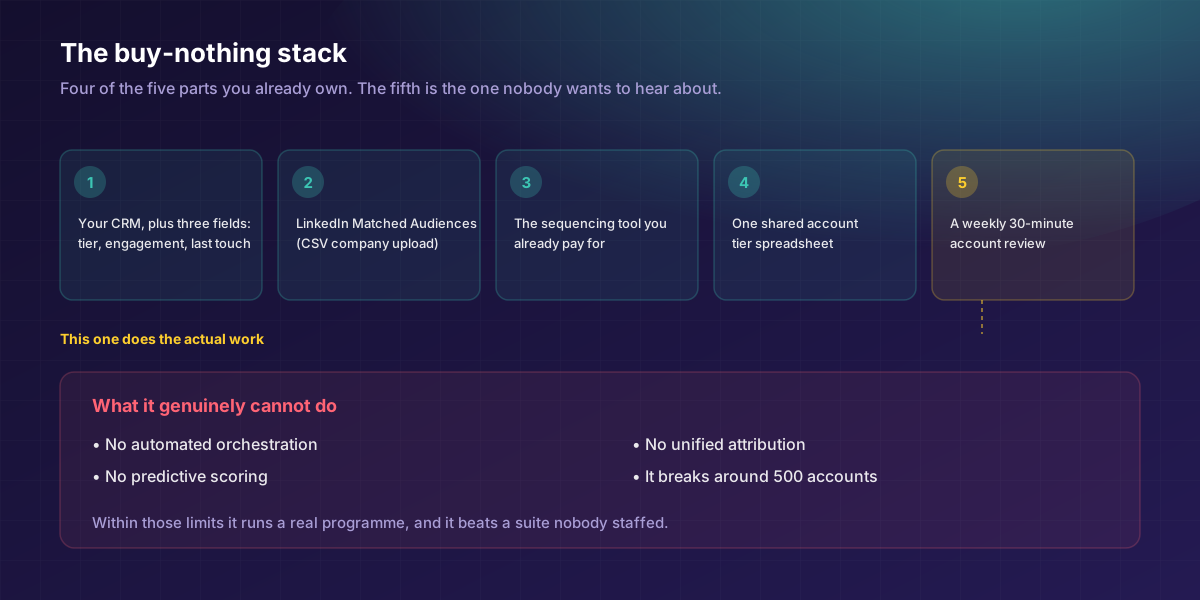
What the stack is. Five components, four of which you probably already own.
- Your existing CRM, with three custom fields added: account tier, engagement score, and last meaningful touch.
- LinkedIn Matched Audiences, using a CSV company-list upload of up to 300,000 companies, which needs at least 300 rows to upload and an audience of at least 300 LinkedIn members before a campaign can run. LinkedIn matches those companies to its own Pages, and lets you serve ads to employees at them filtered by seniority and function. For most B2B buying committees, it is the most precise targeting most teams can reach without a platform.
- A sequencing tool you likely already pay for, handling the email touches in your cadence.
- One shared account tier spreadsheet, tier 1 for named high-touch accounts, tier 2 for programmatic ICP scaling, tier 3 for sector-level awareness.
- A weekly 30-minute account review between marketing and sales, working from the same list. This is the component that actually does the work, and it is the one nobody wants to hear about.
What it costs. Nothing in licence fees beyond what you already spend, plus your LinkedIn ad budget. What it costs is discipline: someone must run the review every week, update the tiers, and act on what the review surfaces. That is a real cost, and it is the reason most teams would rather buy software, or hand the list and the scoring to an agency at our published prices.
What it genuinely cannot do. We are not going to pretend this stack is equivalent to a platform. Be clear-eyed about the ceiling:
- No automated orchestration. Every cross-channel touch is coordinated by a human following a documented pattern.
- No unified attribution. You will assemble reporting manually from LinkedIn, your CRM and your sequencing tool. Without a platform connecting them, you will not get a clean single view of which accounts are progressing.
- No predictive scoring. You prioritise on firmographic fit and observed engagement, not on modelled buying stage.
- It breaks around 500 accounts. Past that, the manual coordination burden exceeds what a weekly meeting can carry.
Within those limits, this stack runs a real account-based programme. Plenty of teams running it outperform teams who bought a suite and never staffed it. If you want the full argument with the replication costs line by line, we costed it out in do you need ABM software.
When you have genuinely outgrown buying nothing
Four thresholds. When two or more are true, start evaluating properly.
- Your named account list passes 500 and the spreadsheet has stopped being maintained.
- Your account-targeted ad spend passes roughly $50,000 a year. At that level, targeting precision and audience management start to pay for platform fees.
- You have hired a RevOps owner with capacity to administer a platform.
- You are being asked to prove pipeline influence in a format the manual stack cannot produce.
Also worth noting on timelines: ABM does not produce visible top-of-funnel volume in the first 60 to 90 days, regardless of what you buy. If you need pipeline this quarter, software will not deliver it. The 90-day roadmap sets out what a realistic first quarter actually looks like.
What the quote does not include
Every enterprise ABM quote understates total cost. Budget for all of these:
- Implementation. Frequently $25,000 to $35,000, separately invoiced.
- Credit overages. Credit-metered platforms charge for consumption beyond your contracted pool, and those charges land mid-year when you have no budget line for them.
- Administration. Roughly half a RevOps salary, ongoing.
- Multi-year lock-in. Two-year commitments are standard at the enterprise tier, and pressure toward them is common in negotiation.
- Minimum ad spend. Advertising-led platforms may require committed media budget on top of the licence.
Two things worth knowing before you negotiate. First, pricing at this tier is genuinely negotiable, and prepared buyers consistently do better than those who accept the opening quote, with the largest reported discounts on deals that close in the final weeks of a fiscal quarter. Second, quotes vary enormously for comparable scope: buyers comparing the same two vendors have reported spreads of tens of thousands of dollars between them. Get both quotes. Show each vendor the other.
A 90-day evaluation process that works
- Weeks 1 to 2: define the question. Write down the single pipeline problem you are buying software to solve, in one sentence, with a number attached. If you cannot, stop here.
- Weeks 3 to 6: build the manual version first. Run the buy-nothing stack against 50 tier-1 accounts, adding tier-2 accounts to the LinkedIn upload to reach its 300-row minimum. This is not a delay tactic. It tells you what your real constraint is, and it makes every subsequent demo sharper.
- Weeks 7 to 8: shortlist two vendors, not five. Choose based on the constraint your pilot exposed. Demo against your actual account list, never against the vendor's sample data.
- Week 9: demand a line-item quote. Base tier versus add-ons, credit pool size, overage rates, implementation, and what happens at renewal.
- Weeks 10 to 11: negotiate, ideally into a quarter-end. Bring the competing quote.
- Week 12: agree your kill criterion in writing before you sign. What number, by what date, means this did not work? A vendor unwilling to discuss that is telling you something.
Where we land
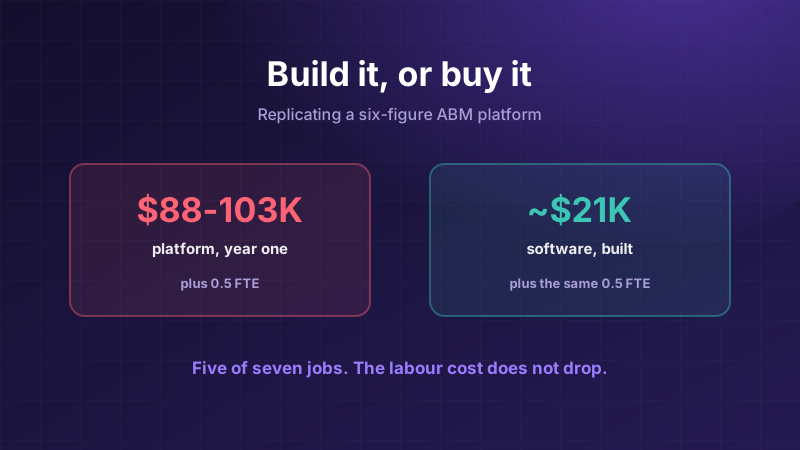
Most teams evaluating ABM software in 2026 are trying to buy their way out of a discipline problem. The platforms are good. Several are excellent. But an unstaffed enterprise suite loses to a spreadsheet somebody actually updates every Monday, every time. If you have the discipline and want to know what the maintained alternative costs, we priced it in replicating a six-figure ABM platform with n8n and intent data.
Build the motion first. Run it manually against 50 accounts. When the manual version starts breaking under its own weight, you will know exactly which platform to buy and exactly why, and you will negotiate a much better deal, because you will be buying a specific capability rather than a solution to a problem you have not defined.
At Omnitics we build the buy-nothing stack, run it, and tell you when it is time to buy something. That is what our account-based marketing practice actually does.
Name three target accounts and we will sketch the plays we would run for each, free: the trigger worth acting on, the buying-committee roles to reach, the angle and the first three touches, plus a short note on whether a platform would earn its keep at your size. If the honest answer is buy nothing, we will say that.
Frequently asked questions
There is no single best platform. 6sense leads on predictive intent, Demandbase on account-based advertising, RollWorks on mid-market accessibility, and Clay or Common Room on signal-led motions. The right choice depends on account list size, budget and whether your constraint is finding accounts or reaching them.
Enterprise platforms typically run $50,000 to $300,000 per year, with median contracts for 6sense and Demandbase reported around $58,000 and $66,000 respectively. Mid-market options are quote-based. Implementation commonly adds $25,000 to $35,000.
Yes. A CRM, LinkedIn Matched Audiences with CSV company targeting, a sequencing tool and a weekly account review will run a functional account-based programme. It works well up to roughly 500 accounts, but offers no automated orchestration and no unified attribution.
6sense is stronger on predictive buying-stage modelling. Demandbase is stronger on account-based advertising through its B2B demand-side platform and on website personalisation. Choose 6sense if your gap is identifying in-market accounts, Demandbase if it is reaching accounts you have already identified.
Terminus merged into DemandScience in November 2024 and the brand was folded into the parent company. The current offering is services-led rather than the self-serve advertising platform mid-market teams originally bought.
Roughly 500 named accounts. Below that, a spreadsheet and CRM handle coordination adequately and platform fees are hard to justify.
Not yet. Agents from Demandbase, HubSpot and Salesforce automate research, personalisation and data hygiene inside existing platforms rather than replacing them. Agent quality depends entirely on the underlying data.
ABM does not produce visible top-of-funnel volume in the first 60 to 90 days, regardless of what you buy. Expect meaningful pipeline signal at three to six months.