Most B2B teams already have the diagram.
You have probably seen it, or drawn it. A Whimsical board with tidy boxes and colour-coded arrows. Cold accounts on the left. Account scoring in the middle. AI-SDR, webinars, roundtables, deanonymization, a nurture loop that folds back on itself. It looks like a system. It reads like a system. Leadership nodded at it in the QBR.
Then you go looking for where the system actually lives, and you find it running on people. A BDR with 40 browser tabs open, checking one company URL at a time to decide whether it fits the ICP. A marketer manually exporting a webinar list and pasting it into a sequence tool. Account scores that live in someone's head, or in a spreadsheet nobody has touched since the last reorg. Website traffic pouring in and leaking straight back out, anonymous, because the deanonymization tool fires a Slack alert that scrolls past at 2pm on a Tuesday and nobody acts on it.
The diagram is the aspiration. The reality is a relay race where the baton gets dropped between every leg.
The gap between the two is not strategy. It is orchestration, and most of the delay lives in routing rather than detection, which is the latency problem behind signal-based selling. And orchestration is exactly the thing n8n was built to handle.
This is a walkthrough of two real demand gen flows built as n8n workflows, followed by a set of additional use cases you can wire up the same way. It is written for operators who are tired of buying another point tool and want the connective tissue instead.
Why n8n, and why not just Zapier
Quick grounding, because the "which tool" question comes up first and it matters.
n8n is a fair-code (source-available) workflow automation platform. You build workflows on a node-based canvas: a trigger fires (a webhook, a schedule, a new form submission), and then data flows through a chain of nodes that fetch, transform, decide, and act. It ships with a large library of pre-built integrations, and where an integration does not exist, the HTTP Request node lets you call any API directly. That last part matters more than it sounds, because it means you are never blocked waiting for a vendor to build a connector.
Three things separate it from the Zapier and Make tier for demand gen work specifically.
First, the AI Agent node. Since version 1.19, when its LangChain AI nodes reached general availability, n8n has shipped a native agent node that wraps a language model with tools and memory. Give it a set of tools (a web search, an HTTP call, a database query, a sub-workflow) and it decides which to call and in what order until the task is done. This is the difference between "call GPT once and get a string back" and "have an agent research an account, read three pages, and return a structured verdict." For qualifying accounts and researching prospects, that distinction is the whole game.
Second, persistent state. An n8n workflow can remember what it did on the last run. It knows which accounts it already scored, which contacts are already in a sequence, what the last outcome was. First-generation automations are often built without state, treating every run as a blank slate, which is how you end up double-enrolling people and re-engaging accounts that churned. State is what turns a set of triggers into an actual system.
Third, ownership. n8n can be self-hosted on your own infrastructure. Your workflows, your credentials, your data, running in your environment, priced against your server rather than per contact processed. For anyone running enrichment at volume, per-contact pricing is the thing that quietly eats the budget. And for teams that care about owning what they build rather than renting it, self-hosting means the engine is yours to keep.
That is the "why." Now the "how."
Workflow one: the agentic ICP engine (the front of your funnel)
Here is a scheduling decision worth flagging up front. Of the two flows, the human-in-the-loop AI SDR is really the front of the funnel. It builds the account and contact list that everything downstream depends on. So we build it first.
The problem it solves is the URL-by-URL problem. Finding the right accounts is the single most important thing in outbound, and doing it manually is brutally slow. A market research exec checking company websites one at a time to confirm ICP fit can burn weeks, sometimes months, on a single territory. That same person then spends their mornings on prospecting research instead of talking to prospects. Both of those are agentic-shaped problems.
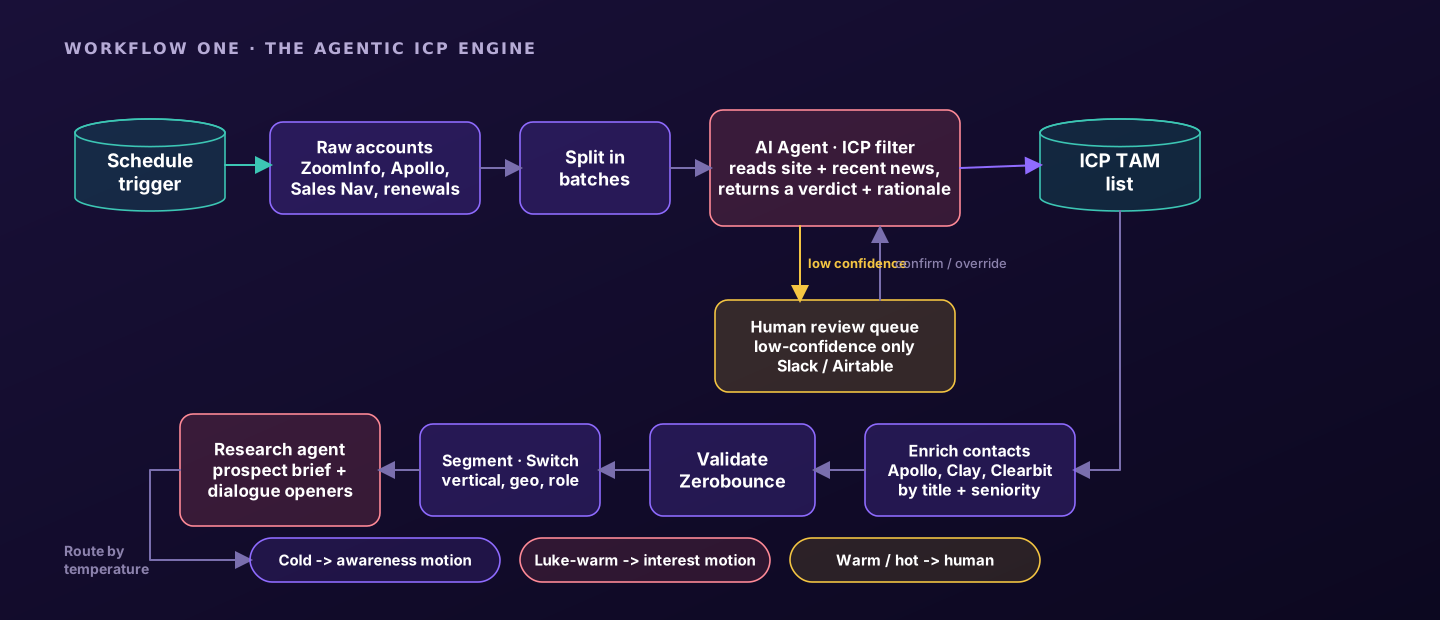
Here is the build, node by node.
The trigger and the sources. A Schedule Trigger runs the workflow daily or weekly. It pulls raw accounts from your sources: a ZoomInfo or Apollo export, a scraped list of a competitor's customers who are nearing renewal, a saved LinkedIn Sales Navigator search. Each source lands as a batch of raw company records.
Data-mining and ICP filtering. This is where the first agent earns its keep. A Split In Batches node feeds one account at a time into an AI Agent node. The agent has your ICP definition loaded as its system prompt (industry, size band, geo, tech stack, the disqualifiers), and it has tools: an HTTP Request tool to read the company website, a web search tool to pull recent news and funding. It reads, reasons, and returns a structured verdict. Not just a yes or no, but a rationale: "Mid-market logistics SaaS, 180 employees, EU-based, no automation tooling detected, strong fit." A rationale is what a rep can act on. A bare score is not.
One honest caveat here, and it is the human-in-the-loop part. The agent is fast and consistent, but it is not infallible. So you route low-confidence verdicts to a review queue: a Slack message or an Airtable view where a human confirms or overrides. High-confidence fits flow straight through. Over time the edge cases teach you how to tighten the ICP prompt. You are not removing the human, you are removing the human from the obvious cases and reserving them for the genuinely ambiguous ones.
Building the TAM and finding contacts. Accounts that pass filtering write to a table (Airtable, Google Sheets, or straight into the CRM) as your ICP TAM list. A second stage finds the relevant people at each account: decision makers, influencers, and managers. Here you call an enrichment API (Apollo, Clay, Clearbit, or People Data Labs) via its node or the HTTP Request node to pull contacts by title and seniority.
Validation. Before a single email address touches a sequence, it goes through validation. A Zerobounce node (or an HTTP call to their API) checks deliverability. This is not housekeeping, it is sender-reputation protection. Validating after qualification rather than before also saves credits, because you are only verifying people you actually intend to contact.
Segmentation into clusters. The verified contacts get bucketed. This is the ABM clustering step: verticals, geographies, interests, job roles, pain points. In n8n this is a Switch node routing records into the right segment based on their enriched attributes. Clean clusters are what make the messaging downstream feel written for the reader rather than blasted at them.
Prospect research and dialogue openers. For the accounts that warrant it, a research agent assembles a prospect brief: their context, the pain points specific to their persona, their interests, their role in the buying committee, a summary of talking points, and a set of hyper-personalized dialogue openers. This is the work that used to eat a BDR's morning. The agent does it in the background and drops a ready-to-use brief next to each contact.
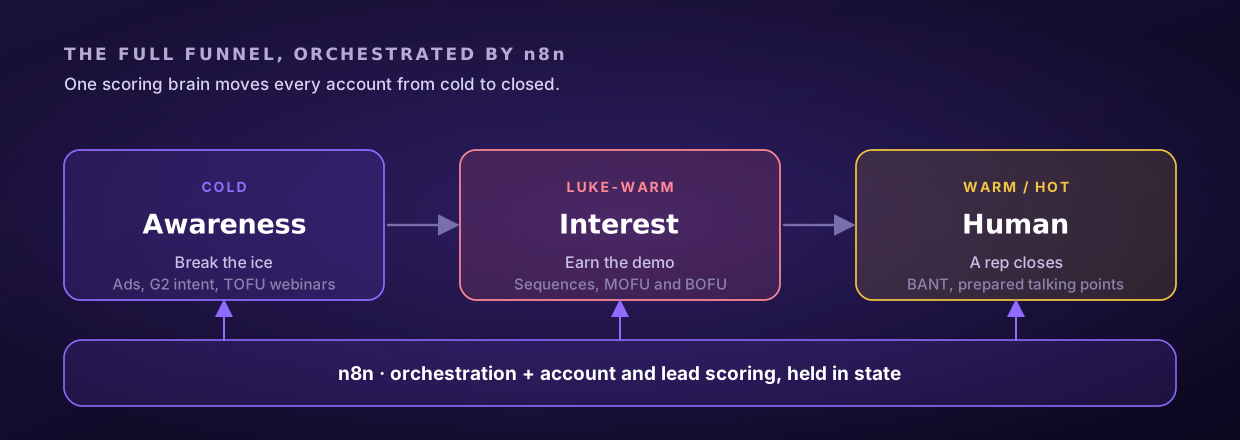
Temperature routing. Finally, accounts route by readiness, and the goal changes with the temperature.
Cold accounts get an awareness motion, and the goal is to break the ice. Targeted ads across LinkedIn and programmatic, G2 buyer-intent targeting, TOFU webinars, targeted content, and a specific ABM program. n8n does not run the ads, but it manages the lists, syncs audiences, and triggers the enrolments.
Luke-warm accounts, once they cross a specific score, get an interest motion, and the goal is a demo or an exploratory call. Success-story ads, MOFU and BOFU webinars and content, and automated SDR-style sequences on email and LinkedIn only, no calling yet.
Warm and hot accounts, on demo intent or a high score, get handed to a human. The goal is BANT qualification and a close. This is the one place you deliberately take automation out of the loop, because at the bottom of the funnel a real person outperforms any sequence.
The whole thing runs on a schedule, feeds itself, and turns weeks of manual list building into a pipeline that refills overnight. Your BDRs stop being researchers and go back to being closers.
Workflow two: the programmatic ABM and scoring orchestration
This is the bigger machine. It is the full-funnel ABM engine, and it has two sides that meet in the middle at a single scoring node. One side is what you control. The other side is what you catch.
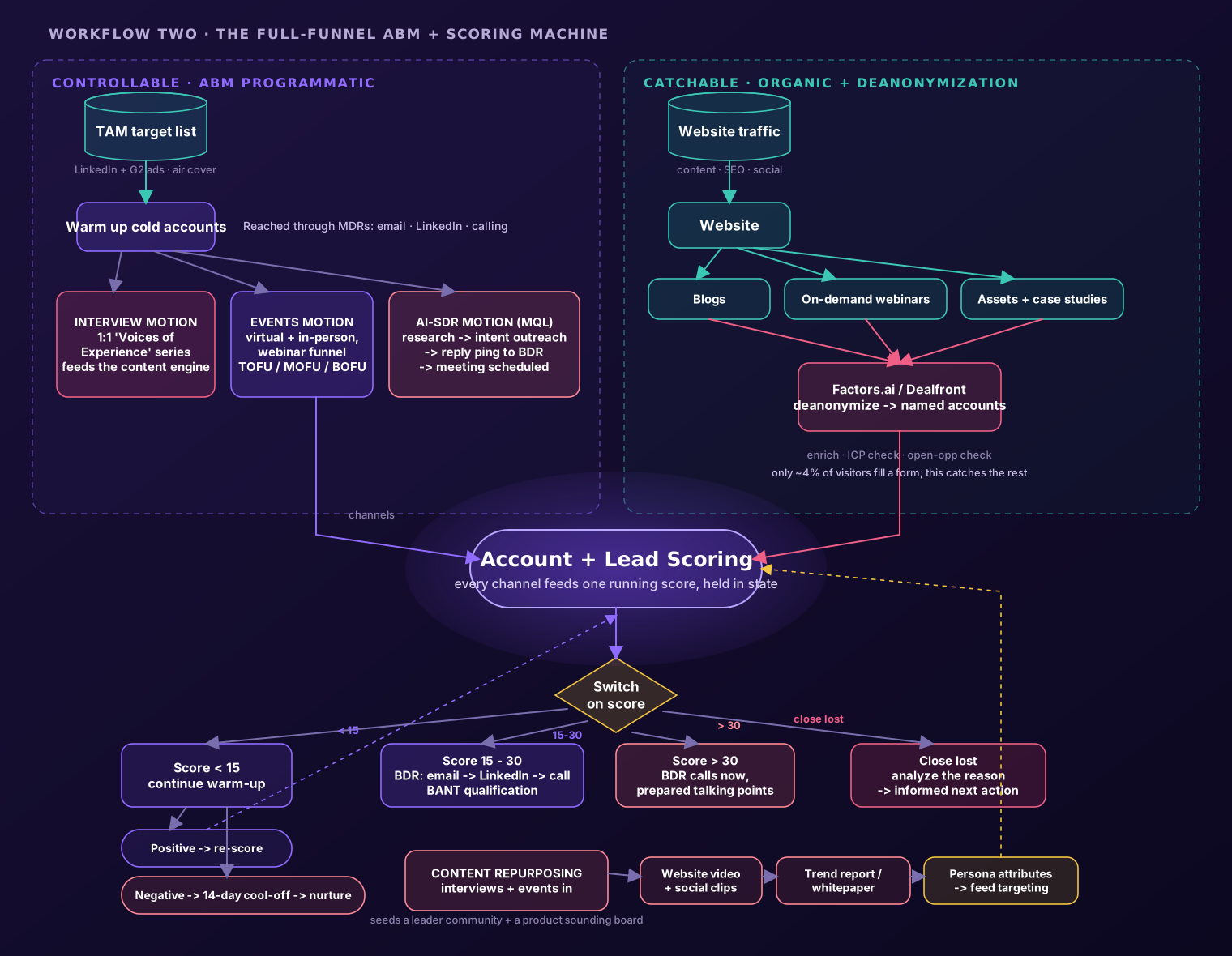
The controllable side: ABM programmatic
This runs against your enterprise target list. It starts with a TAM target list feeding paid air cover: LinkedIn and G2 ads warming up cold accounts so that when outreach lands, the name is not a total stranger. From there, three parallel motions run against the warmed accounts, all of them targeted through your MDRs on email, LinkedIn, and calling.
The interview motion. For top-tier accounts, you invite decision makers and influencers into a 1:1 interview series. Call it a Voices of Experience programme. It is not disguised selling, it is genuine conversation, and it does two things at once: it builds a relationship with a hard-to-reach buyer, and it produces raw material. n8n handles the coordination around it, the scheduling, the reminders, and the handoff of each recording into the content engine.
The events motion. Virtual events (focused group discussions, virtual roundtables, guest speaker slots on your webinars) and in-person events (co-partnered events, roundtables, experiential meetups) chosen by account score or by where the prospects physically are. Layered underneath is a webinar funnel running TOFU, MOFU, and BOFU. Every registration, attendance, and no-show becomes a signal.
The AI-SDR motion. For the MQL layer, an AI-SDR sub-workflow runs the sequence: it triggers prospect research, then intent-based outreach, then a reply-intimation step that pings the BDR the moment a prospect responds, then meeting scheduled. In n8n this is an AI Agent for the research and drafting, an outreach tool (Instantly or Smartlead) for delivery, and an AI classification node that reads the reply and decides whether it is positive, negative, or a question before it wakes a human.
The catchable side: organic and deanonymization
This is the side most teams leave on the table. You spend real money driving traffic to your site through content, SEO, and social. In 6sense's 2022 survey of B2B marketers, respondents put form fills at 3% to 3.5% of unique website visitors. The rest browse your pricing page, read a case study, and leave without a trace. That is not a traffic problem. That is an identification problem.
The fix is a deanonymization layer. Traffic hits the website (blogs, on-demand webinars, other assets and case studies), and a tool like Factors.ai or Dealfront resolves anonymous visits into named accounts. A quick operator's note on the tooling, because the vendors blur it: account-level identification (Factors, Dealfront, Leadfeeder) resolves the company and works globally across regions. Person-level identification (RB2B, and Factors via its RB2B integration) resolves the actual individual, but it is largely US-only and carries heavier privacy obligations, so if you have meaningful EU traffic, treat person-level with care and keep it account-level there. Pick the layer that matches your traffic and your compliance posture, not the one with the loudest homepage.
Here is where n8n turns a passive alert into pipeline. The deanonymization tool fires a webhook on every identified visit. That webhook is an n8n trigger. The workflow then enriches the account (Apollo or Clearbit for firmographics), checks it against your ICP and against whether it is already an open opportunity, scores it, and routes it. The identified visit does not scroll past in Slack anymore. It gets scored and acted on within minutes, which is the entire point of catching intent while it is still warm.
The middle: one scoring brain
Both sides converge on a single Account plus Lead Scoring node. This is the nervous system of the whole flow. Every channel feeds it: ad engagement, webinar attendance, interview participation, AI-SDR replies, deanonymized page views, content downloads. n8n aggregates the signals per account into one running score, held in state so it accumulates across runs rather than resetting.
Then a Switch node routes on the score, and this is where the diagram becomes a decision engine.
Score below 15: continue the warm-up. Keep nurturing, keep building familiarity, do not burn a rep on someone who is not ready. If a warm-up touch gets a positive response, the score moves. If it gets a negative one, the account goes into a 14-day cool-off and then into a longer nurture sequence rather than getting dropped. Nobody gets thrown away, they just get put on a slower timer.
Score between 15 and 30: assign to a BDR with an email-first cadence, email then LinkedIn then call. This is the band where you start BANT qualification.
Score above 30: assign to a BDR to call directly, using the talking points the research agent already prepared. High intent gets a human on the phone fast.
Close lost: route to an analysis step that captures the reason, so the next action is informed rather than a guess. Loss reasons are demand gen's most underused dataset.
The loop: content repurposing
The last piece is what makes the engine compound instead of just run. Everything the top of the funnel produces, especially those interviews, flows into a content repurposing branch: the full video goes on the website, promotional clips go to social, the themes become a trend report or whitepaper, and the behavioural attributes you learn about each persona feed back into your targeting. That output seeds a community of leaders and influencers and doubles as a product feedback and sounding board.
n8n runs this loop on triggers. A new interview recording lands, and the workflow kicks off transcription, sends the transcript to an agent that drafts the clips and the whitepaper outline, and files the persona insights back into the ICP model that Workflow One uses. The funnel feeds the content engine, the content engine feeds the funnel, and the whole thing gets smarter every cycle.
More demand gen use cases you can build the same way
The two flows above are the backbone. Here are additional workflows that plug into the same n8n stack, in rough order of how quickly they pay off.
Real-time intent routing. The single highest-ROI workflow to build first. Deanonymization webhook fires, n8n enriches and scores the visit, and if a target-account decision maker just hit a high-intent page, it routes an enriched alert (name, title, LinkedIn, work email, the page they viewed) to the owning rep in Slack, and drafts the first-touch message. The visit-to-outreach window shrinks from days to minutes. Plenty of teams already own the deanonymization tool. What they are missing is this activation layer.
Reply classification and routing. Inbound replies are where automated sequences usually fall apart, because a human has to read every one. An AI classification node reads each reply, tags it (interested, not now, wrong person, unsubscribe, question), and routes accordingly: interested replies wake the rep, "wrong person" triggers a referral ask, "not now" drops into a dated re-engagement queue. Your reps only see the replies worth their attention.
Webinar and event follow-up. The follow-up window after an event is short and almost always fumbled. A workflow syncs registrations and attendance from your webinar platform, splits attendees from no-shows, and fires a different sequence to each within the hour, while the memory of the session is still fresh. No manual export, no next-day delay.
Unified lead scoring. If you build nothing else, build the scoring brain from Workflow Two as a standalone service. A single n8n workflow that every channel writes signals into, holds one running score per account, and exposes it to your CRM. It ends the argument about whose lead it is and what counts as qualified, because there is one number and everyone can see how it was built.
CRM hygiene on write. Enrichment and deduplication that fire the moment a record is created, so nothing enters the CRM half-empty or duplicated. Quiet, unglamorous, and it is the difference between clean scoring and garbage in, garbage out.
Trigger-based outreach on competitor renewals. Monitor for signals that a competitor's customer is approaching renewal (job changes, funding, review activity), and when one trips, enrich the account and drop it into the front of Workflow One automatically. Timing is most of the win in a switch conversation.
Signal-decay re-engagement. Intent has a half-life. An account that visited your pricing page three weeks ago is not the same lead it was on day one, and treating it like it is wastes the touch. A workflow that tracks how recently each signal fired and adjusts priority as signals age keeps your reps working the freshest intent instead of a stale list sorted by nothing in particular.
AEO and GEO monitoring. As buyers start their research inside AI assistants rather than search boxes, whether your brand shows up in those answers becomes a demand gen metric. A scheduled workflow that queries the major AI engines for your category questions, logs whether and how you were cited, and alerts you when a competitor starts appearing where you do not. Early, but the teams building this now will own the citation real estate later.
The honest part
None of this is magic, and anyone selling it as magic should worry you. Agentic workflows need real engineering: clear ICP definitions, error handling for when an enrichment API returns half a record, guardrails for when the agent reasons its way somewhere strange, and observability so you actually know what the system is and is not doing. An agentic system with no observability fails the same way a manual one does. You just find out later.
But the payoff is real, and it is specific. You stop paying your most expensive people to do your cheapest work. The baton stops getting dropped between marketing and sales. The diagram on the Whimsical board stops being aspiration and starts being the thing that runs while you sleep.
The diagram was never the hard part. Wiring it together was. That is the part worth getting right.
That gap between the board and the running machine is the exact thing we close. Send us one process from that diagram, the tools it touches and roughly how often it runs. In a free Workflow Teardown you get a diagram of how we would build it in n8n, build notes and a fixed quote.
Frequently asked questions
n8n is a workflow automation platform that connects your apps, APIs, databases, and AI models through visual workflows. For demand gen it acts as the connective tissue between enrichment, scoring, CRM, and outbound, so your plays run as one system instead of a stack of disconnected point tools.
Basic logic and API concepts help, but you do not need to be a developer for most GTM workflows. The visual editor handles the flow, and code nodes are there when you need them.
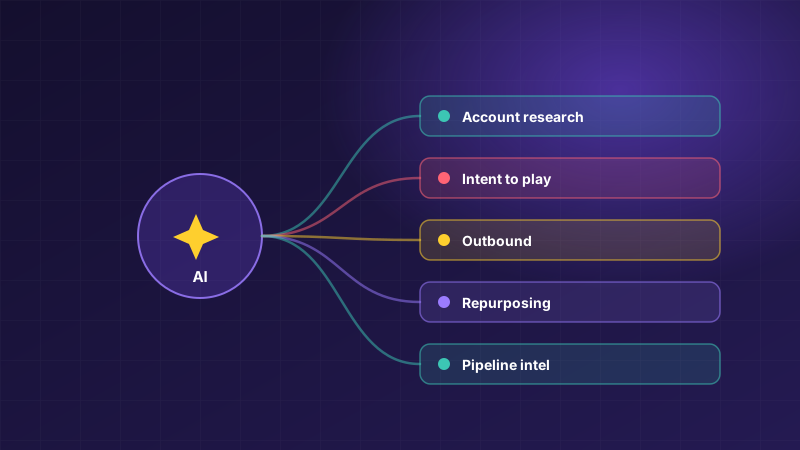
Common ones include account research and ICP scoring, intent-to-play triggers, multichannel outbound sequencing, lead enrichment waterfalls, and pipeline intelligence. Each turns a manual, repetitive process into a repeatable automation.
Zapier is fastest for simple trigger-and-action tasks. n8n wins on complex logic, nested data, native AI nodes, and self-hosting, and it decouples cost from execution volume, which matters as workflows scale. Plenty of teams run both.
Self-hosting gives you control over where data lives, and n8n supports self-hosted and air-gapped deployments for teams with strict compliance requirements. Execution data stays on your own infrastructure, apart from whatever a workflow itself sends to an outside service, and n8n's usage telemetry can be switched off.