Search for whether AI works in account-based marketing and you will find two sets of numbers that cannot both be true.
One set: Woodpecker's cold email data puts advanced personalisation at 17 to 18% replies against 7 to 9% for basic or unpersonalised email.
The other set, from a paired test: AI-generated cold emails replied slightly worse than human-written ones, 4.1% against 5.2%, and were flagged as spam nearly three times as often.
Both are real numbers. The difference is not the underlying reality, it is the study design, and understanding that difference is most of what you need to evaluate any AI claim in this category.
The evidence standard this piece uses
| Tier | Type of evidence | How to treat it |
|---|---|---|
| 1 | Paired or controlled test, same list, same offer, published methodology | Decisive |
| 2 | Independent multi-vendor study with a stated method | Strong, weight by sample size |
| 3 | Analyst research from a firm not selling the category | Useful for direction, not magnitude |
| 4 | Vendor-published aggregate benchmark across their own customers | Directional at best, survivorship-biased by construction |
| 5 | Vendor case study or customer quote | Marketing |
Most of what is written about AI in ABM sits at tiers 4 and 5. Almost every verdict below rests on tiers 1 to 3, and where it does not, this piece says so.
One structural fact worth holding while reading: Gartner estimates only about 130 of the thousands of agentic AI vendors are real, and says many vendors engage in "agent washing", the rebranding of existing products such as AI assistants, robotic process automation and chatbots without substantial agentic capability.
Why the numbers contradict each other
This is the highest-value thing in the article, so it goes before the verdicts.
The first set compares advanced personalisation against basic or unpersonalised email, and it is not about AI writing at all. That is a comparison against the worst possible alternative, and it says nothing about whether AI should write your emails.
The second compares AI-written against human-written on the same list. That is the comparison that informs a decision. The paired analysis ran 50,000 AI-generated emails against 50,000 human-written ones, matched on persona, ICP firmographic, sequence stage and sender-domain age. AI replied at 4.1% against 5.2%, and was flagged as spam at 8% against 3%, with the spam gap widening over time rather than closing.
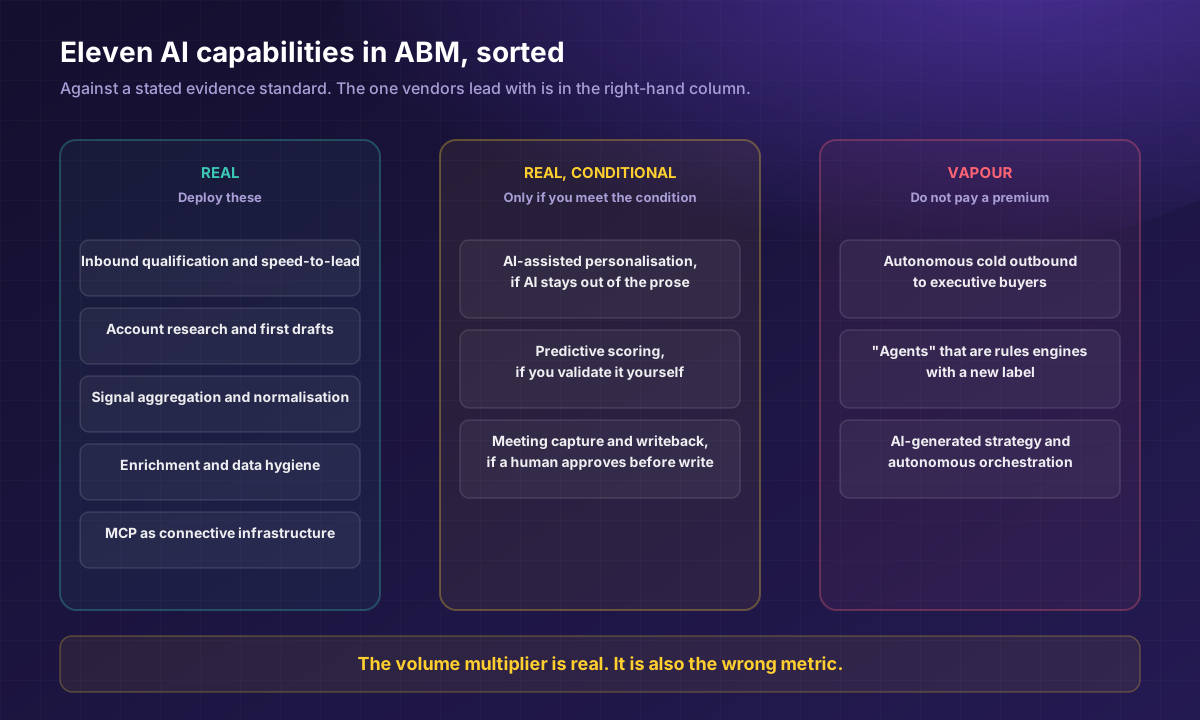
What's real
Inbound qualification and speed-to-lead. The clearest win in the category and it is not close. AI responds to an enquiry in seconds at any hour, which no human team can match, and inbound leads arrive pre-qualified by the act of raising a hand. Published results are strong, though the best-known figures, SaaStr reporting $1 million closed in 90 days from its AI inbound agent and 71% of one month's sponsorship deals from AI-qualified inbound, are single-company and self-reported. That is tier 4 evidence. Weight it accordingly. It is consistent with the mechanism, and the mechanism is sound.
Account research and first-draft synthesis. Reading filings, hiring pages, changelogs, news and social activity, then producing a structured brief, is something AI does faster and more consistently than a rep working a list. The pattern we have settled on is hybrid: AI on research, enrichment and first drafts, humans on the conversation, the disqualification call and the relationship. SaaStr, six months into running five AI SDRs, reports that performance tracks the human attention paid to them. Real, with the boundary at the draft.
Signal aggregation and normalisation. Pulling the buying signals that matter from a dozen sources into a common schema, resolving entities, deduplicating and classifying. Unglamorous data work, and the single highest-leverage thing AI does in ABM, because everything downstream depends on it. It barely registers in vendor marketing because it does not demo well, which is a reason to trust it rather than discount it. This is exactly the W1 layer in the DIY ABM build.
Enrichment and data hygiene. Waterfall enrichment, duplicate resolution, title normalisation, domain-alias mapping, contact verification. A commodity by 2026 and reliably automated. Verify against a held-out sample quarterly rather than trusting a vendor's stated accuracy.
MCP as connective infrastructure. Model Context Protocol went from release in November 2024 to more than 97 million monthly SDK downloads by December 2025, with ChatGPT, Gemini and Microsoft Copilot among the products that shipped support inside 13 months. Gartner expects 33% of enterprise software applications to include agentic AI by 2028, up from less than 1% in 2024.
The caveat the enthusiastic coverage skips: marketing-stack MCP is promising but under-measured, with public servers and clear CRM and messaging use cases but no verifiable public deployment counts for the major marketing platforms. Real as infrastructure, unproven as a marketing outcome. Ask a vendor citing MCP support what it lets you do that their API did not. If there is no answer, it is a checkbox.
What's real, but conditional
AI-assisted personalisation, conditional on AI staying out of the prose.
The paired evidence says AI writing the whole message loses. Reader-perception research points at why, though it needs stating carefully. A study of 1,100 professionals in the International Journal of Business Communication, by researchers at the University of Florida and the University of Southern California, found that medium and high levels of AI involvement in a message led readers to question the sender's sincerity, caring and competence, while light AI assistance was generally acceptable. The limitation worth naming, since this article is about evidence standards: that study examined managers emailing their own employees, not cold outreach to buyers. The mechanism is plausibly similar and it has not been demonstrated in a sales context.
What is demonstrated in a sales context is that signal-grounded personalisation works, and that is a different thing from AI-written prose. Sending a LinkedIn message alongside a profile visit lifted replies to 11.87% against 4.88% for the message alone, because the profile visit is a small signal of real attention.
One related finding that appears to contradict standard ABM advice, including ours, and does not once you look at the direction of causation. Reply rates are higher when you contact one or two people at a company, around 7.8%, than when you contact ten or more, around 3.8%. That is an argument against blanketing an account with simultaneous cold emails. It is not an argument against multi-threading. The committee breadth multiplier in our account scoring model raises an account's priority when several people there are already researching you, which is the opposite direction from sending ten emails and hoping. Sequence the committee, do not blanket it.
Predictive account scoring, conditional on your own validation loop. The models work. The problem is that you cannot see inside them and most teams never check. The recurring complaint from users of vendor scoring is that there is no easy way to see what drove a score, and limited ability to drill into the underlying signals when a rep questions an alert. That opacity compounds: a scoring model that has not been recalibrated against actual outcomes in twelve months is not necessarily wrong, but it is not validated either.
The condition is that you must be able to measure whether it predicted anything. Stamp the score and tier onto every opportunity at first touch, then compare win rates by tier after two quarters. If the top tier does not win more than the middle tier, the model is decoration regardless of what it cost.
Meeting capture and CRM writeback, conditional on an approval gate. Transcription, summarisation and structured field extraction from calls are genuinely good and genuinely time-saving, and low-risk because a human reviews the output before it matters. Auto-writing extracted fields into a CRM without approval propagates errors into the dataset every downstream model depends on. The conservative pattern across agent deployments is the same: start read-only, add write actions later, require human approval for CRM updates and customer-facing sends.
What's vapour
Fully autonomous cold outbound to executive buyers. This is the pitch the category was built on and the evidence against it is now substantial. AI SDR agents multiply per-rep outbound volume, but the paired testing above shows AI-written email earning fewer positive replies and more spam flags. The downstream cost shows up as account executives sitting in meetings with people who do not fit the ICP, do not have budget, and did not fully understand what they agreed to.
The volume multiplier is real and vendors do not lie about it. The problem is that it is the wrong metric. Multiplying output while cutting positive reply rate and downstream quality is a machine for generating work, not pipeline. The same technology is legitimately good at inbound response and re-engaging dormant accounts, where the downside is bounded. It is not good at the cold conversation with a VP who has never heard of you. We went through the build-versus-buy version of that trade in AI SDR tools versus building your own.
"Agents" that are rules engines with a new label. Gartner's assessment is blunt: most agentic propositions lack significant value or return, because current models do not have the maturity and agency to autonomously achieve complex business goals or follow nuanced instructions over time, and many use cases positioned as agentic do not require agentic implementations. The ABM category is not exempt. The agent lines the major platforms launched are, as of 2026, closer to intelligent assistants than to autonomous agents.
An assistant is a perfectly good product. The vapour is the pricing and the roadmap promises attached to the word.
AI-generated ABM strategy and autonomous campaign orchestration. The pitch is that you describe your ICP in natural language and the system builds the account list, the segmentation, the messaging, the channel plan and the calendar, then runs it. Every part of that is a judgement call depending on information the system does not have. Which accounts your sales team will actually work. What your last three losses had in common. Which competitor is undercutting you this quarter. Gartner's framing of why agentic projects fail points at exactly this: the core problem is governance, undefined business value and operational discipline, with pilots faltering in production over integration, data access and accountability rather than model capability.
Five questions that separate an agent from agent washing
Ask these in the demo. They sort real from rebranded faster than any feature comparison.
- What decision does it make without a human? If the answer is "it recommends and a human approves", it is an assistant. That is fine. Do not pay agent pricing.
- What happens when it is wrong? A real agent has a defined failure mode, a rollback and an audit trail. A rebranded workflow has an error log.
- Can it change its own plan mid-task? Adapting when the first attempt fails is the actual dividing line. Executing a fixed sequence, however sophisticated, is automation.
- Show me the reasoning for one specific decision it made last week. If nobody can produce it, you cannot govern it, which means you cannot deploy it anywhere consequential.
- What did this replace, and what is the measured before and after? The absence of a before-and-after after a year in market is the answer.
Run your own paired test
Every number in this article, including the ones supporting the positive verdicts, is somebody else's. Here is the protocol to generate your own. It takes about six weeks.
Setup. One segment, minimum 2,000 contacts, split randomly into two arms. Same offer, same sending infrastructure, same sequence length, same send windows. The only variable is the treatment. Arm A is your current human-written approach. Arm B is the AI treatment you are evaluating.
Measure, in this order: spam placement rate, delivery rate, positive reply rate, meetings held, meetings that pass qualification. Not open rate, which Apple Mail Privacy Protection made unreliable. Not total reply rate, which counts "remove me".
The trap to avoid: do not run Arm B against a generic template baseline. That is the comparison that produces the biggest-looking numbers and it tells you nothing.
Read the spam number first. In the paired study above, the reply difference was modest and the spam difference was nearly threefold. Deliverability damage compounds across every future campaign, so a treatment that wins slightly on replies and loses badly on spam placement is a net loss you will pay for over quarters. The infrastructure that protects against that is in the multi-domain cold email setup.
What this changes about buying decisions
Do not pay a premium for the word "agent". Gartner predicts over 40% of agentic AI projects will be cancelled by the end of 2027 on escalating costs, unclear business value or inadequate risk controls. Buy the capability, priced as the capability, on a contract you can exit.
Deploy AI where the downside is bounded. Inbound response, research, enrichment and summarisation all have a human between the AI and the buyer. Cold outbound to a named executive does not, which is exactly where the measured results are worst.
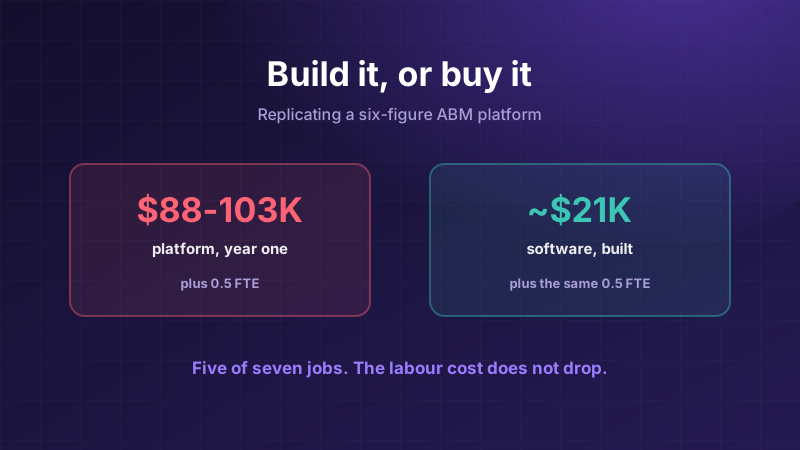
Adoption is not evidence. Salesforce's 2024 State of Sales found 81% of sales teams experimenting with or fully using AI. That tells you what your competitors bought. It tells you nothing about what worked, and buying because everyone else did is how the cancellation figure gets filled. If you are weighing a platform against building the capability yourself, the seven jobs teardown prices both.
The thing nobody is selling you
There is a use of AI in the account-based motion that no vendor is pitching, because there is no product to sell alongside it.
Your buyers are using AI assistants to build vendor shortlists. That process runs before any signal reaches your stack, produces no site visit, no form fill and no third-party intent surge, and it frequently sets the consideration set before you know an evaluation exists. No ABM platform sees it. No AI SDR influences it. It is a content and visibility problem, and it is the single most consequential way AI has changed B2B buying.
Every capability in this article operates downstream of that moment. We wrote up the mechanics in winning the answer box, People Also Ask and voice and the shortlist half in generative engine optimisation. Worth weighing when the AI budget gets allocated.
Where we land
The technology is real and the category around it is noisy. Five capabilities deserve budget today, three deserve budget with a condition attached, and three deserve scepticism in proportion to the premium being charged.
The useful habit is not memorising which is which, because that will change. It is asking what any given number was measured against, and whether a human sits between the model and the buyer. Those two questions sort most of the category on their own.
At Omnitics we run the parts that measure well and say so when the honest answer is that a deliverable is not worth building. That is what our SEO, AEO and GEO practice and our ABM practice actually do.
Get a second opinion before you sign. Name three target accounts and we will sketch the plays we would run for each, free: the trigger worth acting on, the buying-committee roles to reach, the angle and the first three touches. Then put the tool's output for the same three accounts beside it.
Frequently asked questions
Not when AI writes the whole message. A paired analysis of 100,000 emails, 50,000 AI-generated against 50,000 human-written and matched on persona, firmographic, sequence stage and sender-domain age, found AI replying at 4.1% against 5.2% while being flagged as spam at 8% against 3%. AI works well for finding the specific fact worth referencing. A human should write the sentence around it.
Because of the baseline. Studies reporting 17 to 18% reply rates compare advanced personalisation against basic or unpersonalised email. That is not about AI writing at all, and it is the weakest possible comparison, not the choice anyone actually faces. Paired studies comparing AI-written against human-written on the same list find AI slightly behind. Check what the treatment was measured against before you check the headline number.
For inbound response and dormant-account re-engagement, yes, because the buyer has already raised a hand and the downside is bounded. For cold outbound to executive buyers the 2026 deployment data is unfavourable: roughly 15% meeting-to-qualified-opportunity conversion against 25% for human SDRs, alongside a large increase in send volume paired with a fall in positive reply rate.
Agent washing is Gartner's term for vendors rebranding existing products such as chatbots, AI assistants and robotic process automation as agentic AI without substantial agentic capability. Gartner estimates only around 130 of the thousands of vendors claiming agentic capability are genuine. The practical test is whether the system makes a decision without a human and whether it can change its own plan mid-task.
As infrastructure, yes. Model Context Protocol went from release in November 2024 to more than 97 million monthly SDK downloads by December 2025, with ChatGPT, Gemini and Microsoft Copilot among the products that shipped support inside 13 months. As a marketing outcome it remains under-measured. Ask any vendor citing MCP support what it enables that their existing API did not.
Trust it conditionally and validate it independently. The models are capable but closed, and the recurring user complaint is that there is no way to see what drove a particular score. Stamp the score and tier onto every opportunity at first touch, then compare win rates by tier after two quarters. If the top tier does not outperform the middle tier, the model is not earning its cost.
Run a paired test. Take one segment of at least 2,000 contacts, split it randomly, and hold the offer, sending infrastructure, sequence length and send windows constant so the AI treatment is the only variable. Measure spam placement, delivery, positive reply rate, meetings held and meetings that pass qualification. Do not benchmark against a generic template, and read the spam number first, because deliverability damage compounds across every future campaign.
Both, in the right order. Reply-rate data shows contacting one or two people per company outperforms contacting ten or more, at roughly 7.8% against 3.8%. That is an argument against blanketing an account with simultaneous cold emails, not against multi-threading. Sequence the committee over time, and let evidence that several people are already researching raise the account's priority rather than trigger ten emails at once.