Let's begin with something that might sting a little but is almost always true. If you tried account-based marketing before and it quietly fizzled, the framework was probably fine. The problem lived upstream of the framework, in the part nobody photographs for the case study.
We have watched a lot of ABM programs stall, and they rarely die because someone chose the wrong tier model or the wrong intent vendor. They die because the team launched ABM as a campaign when it is actually an operating model, and an operating model has prerequisites a campaign politely ignores. The industry data tells the same story with a straight face. Around 80% of B2B companies say they "do ABM," 6sense reports, yet Momentum ITSMA finds only 17% have it genuinely wired into how the business runs, and only about 30% would call their program mature. That gap, adoption without maturity, is where nearly everyone gets stranded. It is also the most expensive misunderstanding in B2B go-to-market today, and it hides in plain sight because everyone is too busy reporting on it to fix it.
This guide is the framework we actually use, the readiness checklist we run before anyone spends a dollar, and the 90-day roadmap we follow to stand a program up. It is deliberately unglamorous. ABM that works usually is.
What ABM actually is (and the definition that trips people up)
Account-based marketing is a go-to-market model in which marketing and sales agree on a finite set of accounts worth winning, then concentrate coordinated effort on those accounts as the unit of work. Not leads. Not contacts. Accounts.
The word that does the quiet damage in that sentence is "coordinated." Most failed programs got the targeting right and the coordination wrong. They built a beautiful target list and then ran the same disconnected plays they always ran: marketing manufactured "engagement," sales worked its own list, and the two never actually arrived at the same account, at the same moment, with the same message. That is not ABM. That is demand generation with a smaller audience and a bigger tech invoice.
Real ABM carries three structural commitments in its bones:
- The account is the unit of measurement. You stop counting leads and start counting account progression. A B2B buying decision now involves a committee of 5 to 16 people across as many as four functions, on Gartner's 2025 survey, so a single "lead" tells you about as much as one juror tells you about a verdict.
- Sales and marketing share one definition of success and one list. Not two lists that "overlap." One. Companies with tightly aligned revenue teams grow meaningfully faster (SiriusDecisions research puts it at 19% faster revenue growth where sales, marketing and product align), and ABM is, at heart, a mechanism for forcing that alignment to become concrete instead of aspirational.
The list itself has to survive contact with a quota, which is a separate discipline from picking the accounts.
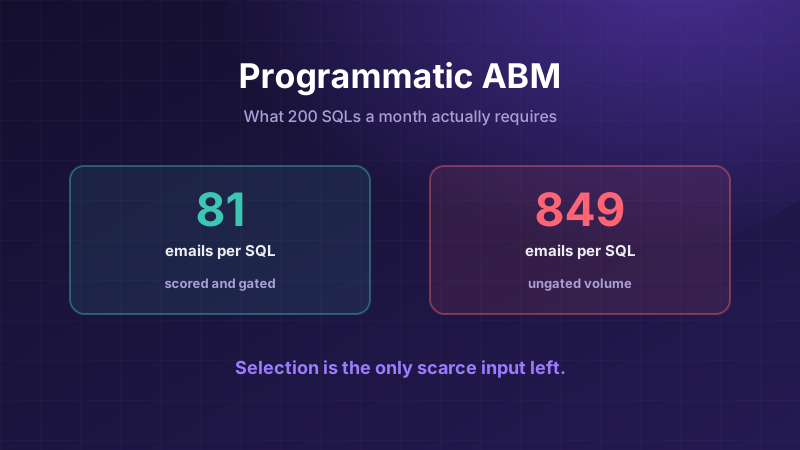
- Effort scales with account value. You spend differently on a marquee strategic account than on the 200th name in a programmatic tier. That is the tiering model, and it is where the framework formally begins. The programmatic tier is the one that needs a scoring model underneath it, because human triage stops working past a few hundred accounts: here is the arithmetic that tier runs on.
The framework: three tiers, three motions
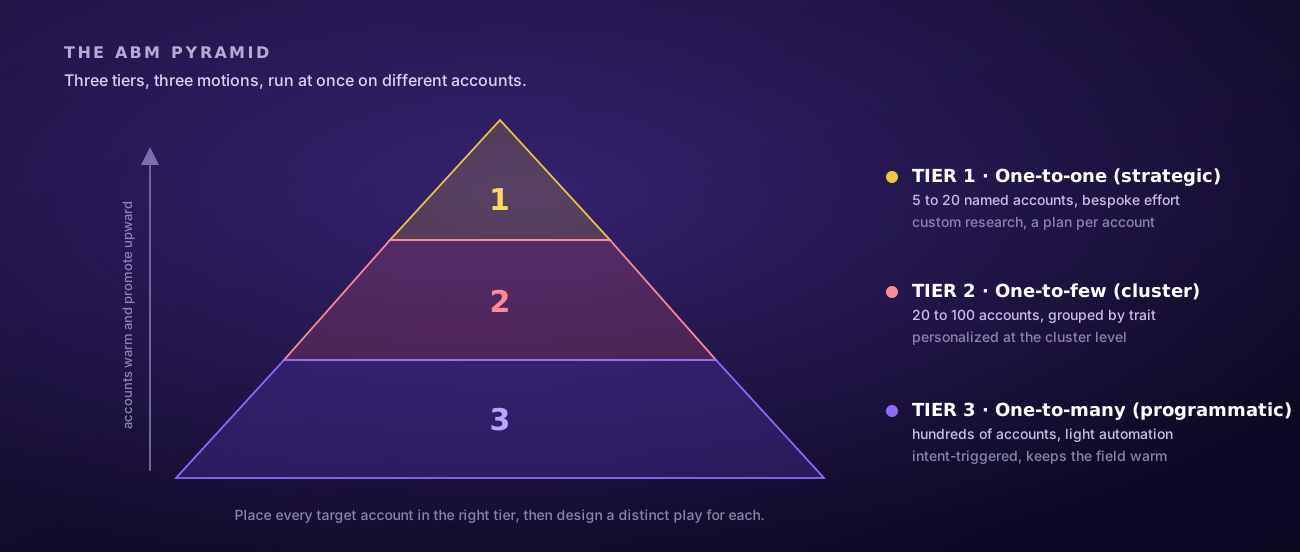
There is no single "ABM." There are three motions, and mature programs run all three at once, on different segments of the list. The State of ABM 2026-2027 report breaks down how those motions shifted this year.
Tier 1, one-to-one (strategic). A small set of named accounts, typically five to twenty, that justify bespoke effort: custom research, custom content, executive-to-executive relationships, a dedicated plan per account. Highest cost per account, and, when the account is genuinely strategic, the highest return. The classic error is overcrowding this tier out of optimism. If you cannot write a genuinely customized plan for an account, it does not belong here, no matter how good the logo would look on a slide.
Tier 2, one-to-few (cluster). Accounts grouped by a shared trait: same industry, same use case, same trigger event, same tech-stack headache. Perhaps 20 to 100 accounts in clusters of five to fifteen. Content is personalized at the cluster level, not the account level, so you build a play for "mid-market fintechs ripping out a legacy billing system" rather than for one named company. This tier tends to deliver the best ratio of effort to impact, and it is the one most teams skip, because it demands actual segmentation discipline rather than enthusiasm.
Tier 3, one-to-many (programmatic). Hundreds of accounts handled with light, automated, account-aware personalization: dynamic ads, intent-triggered sequences, account-level web personalization. Low cost per account, lower per-account return, but it keeps a wide field warm and feeds accounts upward into Tier 2 and Tier 1 as they start showing signals.
The framework is not "pick a tier." It is "place every target account in the right tier, then design a distinct play for each." A healthy program looks like a pyramid: a few Tier 1 accounts getting the white-glove treatment, a substantial Tier 2 middle, and a broad Tier 3 base that quietly and continuously surfaces accounts worth promoting.
The readiness checklist (run this before you spend anything)
We do not let a team launch ABM until it can honestly tick every box below. When programs fall over in month four, it is almost always because a box went unticked in month zero. Treat any blank as a project to finish before launch, not a detail to patch later.
Strategic foundation
- Leadership has agreed, in writing, that ABM is an operating model and not a Q3 campaign, and has committed at least three to four quarters before passing judgment.
- You can say, in one sentence, why these accounts and not others. If the honest answer is "they're big," you are not ready (see our separate guide on building an ICP scoring model).
- You have a documented Ideal Customer Profile derived from your actual closed-won data rather than from a whiteboard full of ambition.
Sales and marketing alignment
- Sales and marketing co-built and co-signed the target account list. Sales did not "receive" it like a package left on the porch.
- There is one shared definition of an engaged account and a qualified account opportunity.
- There is a standing weekly cadence where sales and marketing review the same accounts together. This meeting is the program. If it does not exist, nothing else will hold, and everything below becomes theater.
- Service-level agreements exist in both directions. Marketing commits to what it delivers; sales commits to follow-up timing on flagged accounts.
Data and tooling
- Your CRM has clean account and contact records, and target accounts are tagged so you can report on them as a cohort.
- You can measure target-account pipeline separately from everything else. If you cannot isolate the cohort, you cannot prove ABM worked, which means you cannot keep funding it.
- You have buying-committee coverage data. You know who the likely economic buyer, champion, and technical evaluator are at each account. Thin coverage of the committee is a known blind spot, and it is usually the stakeholder you never met who kills the deal.
Measurement
- You have explicitly agreed to stop judging the program on MQL volume, cost per lead, and email open rates. This is the box everyone wants to skip. Measuring ABM with demand-gen metrics will make a working program look like a failure and a failing program look admirably busy.
- You have chosen account-level metrics instead: account engagement, buying-committee coverage, target-account pipeline, win rate on target versus non-target accounts, and sales-cycle velocity.
If you read that last section and felt a small twinge of recognition, yes. That is usually the part that went wrong last time. The same 6sense survey found that only 29% of ABM teams are measured solely on ABM-aligned metrics, and a slightly heartbreaking 13% actually report closed-won revenue from target accounts to the board. The measurement gap is not a reporting nicety. It is the reason good programs get quietly defunded by executives who were never shown the number that mattered.
The 90-day implementation roadmap
You do not roll out ABM company-wide and hope. You run a contained 90-day pilot on a single tier, prove the motion, then expand. Here is the sequence we run.
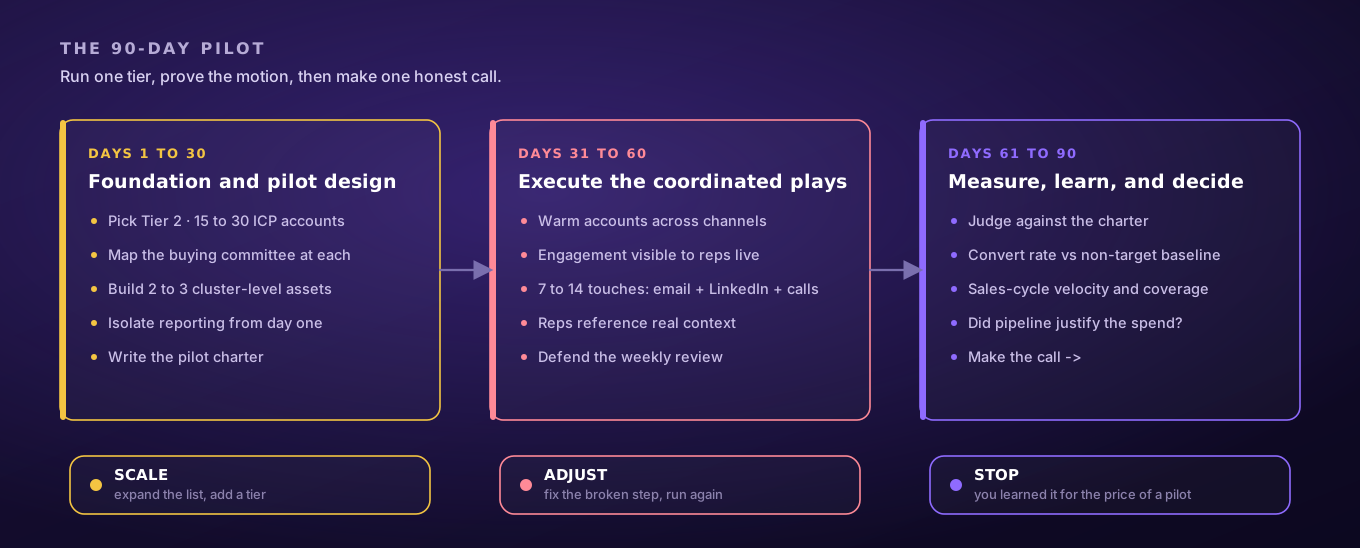
Days 1 to 30: foundation and pilot design. Pick one tier to pilot. For most companies starting out, Tier 2 (one-to-few) is the sweet spot, concrete enough to measure and broad enough to generate signal inside a quarter. Select 15 to 30 accounts that fit your ICP and show at least one buying signal. Resist the romance of starting with Tier 1; bespoke programs are hard to learn from precisely because the sample is tiny. In this window: finalize the account list with sales physically in the room, map the likely buying committee at each account, build or adapt cluster-level content (two or three genuinely useful assets, so an account gets more than one relevant touch), and set up reporting so the cohort is isolated from day one. Define what "success" means before you launch, in numbers, and write it down where you cannot later renegotiate it with yourself. That document is your pilot charter.
Days 31 to 60: execute the coordinated plays. Now you run the motion, and the operative word remains coordinated. A working play looks like this: marketing warms an account across channels (account-aware advertising, relevant content, an executive's LinkedIn presence), the account begins to engage, that engagement is visible to the rep in real time, and the rep reaches out referencing the actual context rather than firing a generic sequence into the void. Multi-touch ABM sequences usually run many touches before anything converts, blended across email, LinkedIn, and an actual human voice. The sequence that works most often for us is unglamorously simple: email plus LinkedIn plus SDR calling, all aimed at the same named people. The thing to defend in this window is the weekly sales-and-marketing review. Every week, you examine the pilot accounts together and ask which moved, which stalled, and why. When an account shows high engagement but no meeting, that is not a marketing win waiting to be claimed. It is a handoff failure to fix that week, before it calcifies into a habit.
Days 61 to 90: measure, learn, and decide. In the final window you judge the program against the charter you wrote on day one. The right questions are plain. Did target accounts convert to opportunities at a higher rate than your non-target baseline? Did they move faster? Is buying-committee coverage climbing? Did pipeline from the cohort justify the spend?
Then you make one of three honest calls. Scale: the motion works, so expand the list and add a tier. Adjust: the motion is directionally right but a specific step is broken, so fix it and run another cycle. Stop: the accounts, the offer, or the timing were wrong, and you learned that for the price of a pilot instead of an annual budget and a reorg. All three are good outcomes. The only bad outcome is designing a pilot that cannot produce a clear answer, which is just an expensive way to stay confused.
Where this breaks, and how to keep it standing
A few failure modes recur often enough that we plan around them from the first meeting.
The list is too big. Enthusiasm produces 500-account "pilots." A 500-account list is not ABM; it is demand generation in a rented tuxedo. Start small enough that you could, in principle, say something specific about every account on it.
The content is personalized in name only. Dropping a logo into a generic asset is not personalization, and buyers clock it instantly, the way you clock an email that opens "Dear [First Name]." Personalization means the content speaks to a problem that cluster actually has. If you cannot name that problem, do more research before you make more content.
Sales never truly bought in. If the list was handed to sales rather than built with them, reps will work their own pipeline and the program dies of neglect, unmourned. The fix is structural, not motivational: sales co-owns the list and shares the scoreboard.
Leadership expects a lead-gen timeline. ABM compounds; it does not spike. Relationships at target accounts often take a year or more to develop. If leadership is grading you on monthly MQLs, renegotiate the scorecard before you launch, or do not launch and save everyone the disappointment.
The one-page version
Account-based marketing is an operating model, not a campaign. It works when marketing and sales share one list and one scorecard, when effort is tiered to account value, when plays are genuinely coordinated on the same accounts at the same time, and when you measure account progression instead of lead volume. The framework is three tiers: one-to-one, one-to-few, one-to-many. The prerequisite is the readiness checklist. The way in is a contained 90-day pilot built to give you a clear yes or no.
Do those things and ABM stops being the thing you tried once and mention with a sigh. It becomes the way your best accounts get won.
Start small enough to say something specific about every account. Name three target accounts and we will sketch the plays we would run for each, free: the trigger worth acting on, the buying-committee roles to reach, the angle and the first three touches. You keep it whether you hire us or not.