This is for teams with 1,000 to 5,000 fit-qualified accounts, an owner who will actually build and maintain workflows, and a CRM already clean enough to trust.
If you do not have that owner, stop reading and buy the platform. An unmaintained homegrown stack is worse than an unused licence, because an unused licence at least does not route your reps to the wrong accounts.
It is also not for teams under 500 accounts. At that size you have a research problem rather than an orchestration problem, and neither route is the answer. Scoring a list that size, researching its Tier 1 accounts and designing the plays is what our ABM programme for up to 500 accounts is built for.
What "six figures" actually means
The licence is not the number.
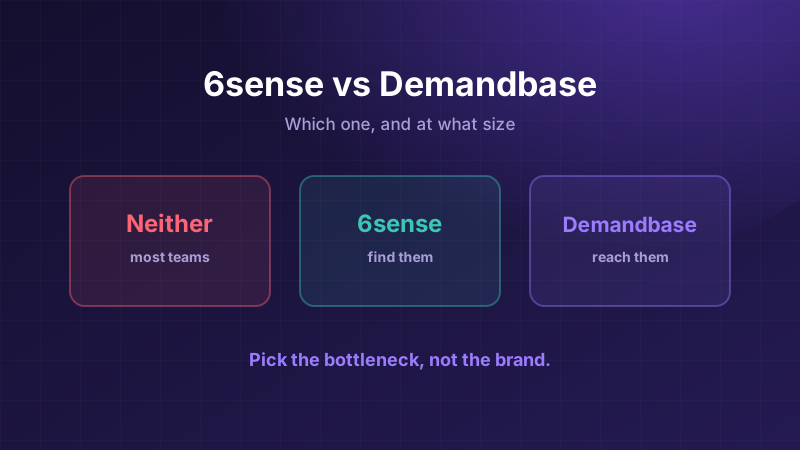
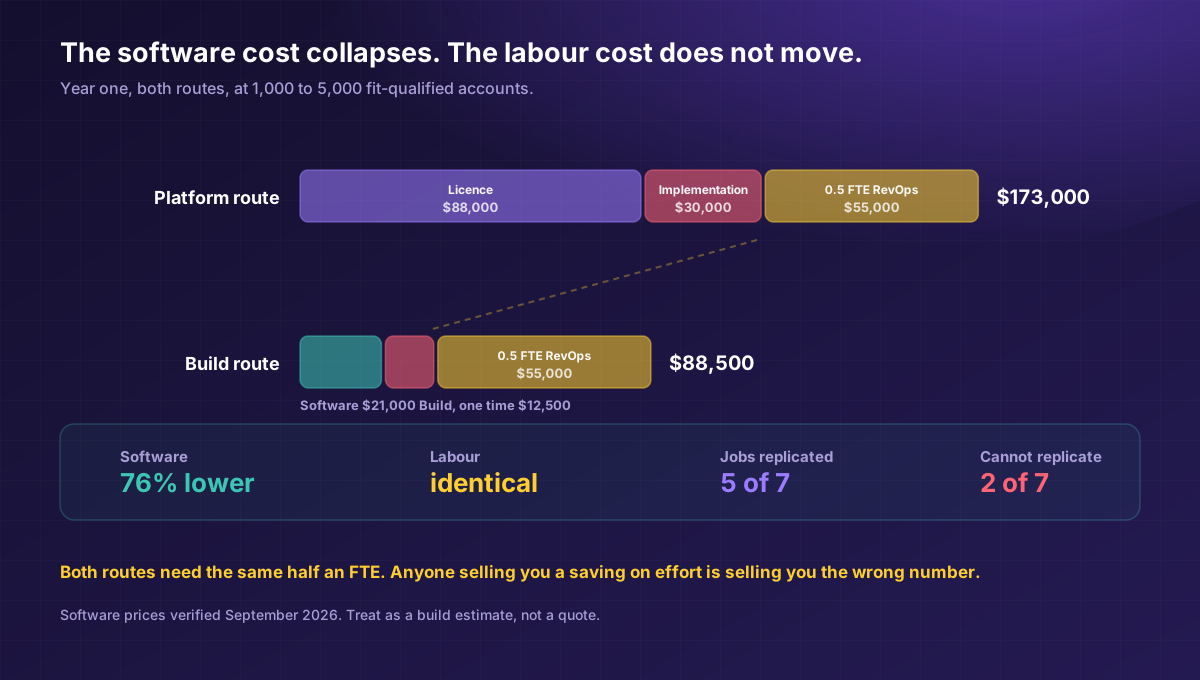
Vendr marketplace data puts median ABM platform contracts in the high $50,000s to high $60,000s a year, and it is worth knowing that those medians drift: they are live marketplace figures that move as purchases accumulate, which is why you will see slightly different numbers quoted at different times, including across our own posts. We broke the two market leaders down in detail in 6sense versus Demandbase. Real annual spend across both lands between $60,000 and $150,000 in the deals we have seen, once seats, ad budget and data volume are counted, and implementation is invoiced separately at another $25,000 to $35,000.
Add half an FTE of RevOps administration, which we load at roughly $55,000, and year one clears $140,000. That is the number this article is measured against.
The seven jobs a platform does
Strip the marketing away and an enterprise ABM platform performs seven distinct jobs. Pricing the replacement means pricing each one separately, because they are not equally hard to reproduce.
| Job | Replicable? | Honest note |
|---|---|---|
| Account identification | Yes, at parity | Same underlying providers, similar match rates |
| Third-party intent | Yes, at reduced breadth | You buy one or two feeds instead of an aggregated network |
| Enrichment | Yes, at parity or better | Waterfall enrichment is a commodity in 2026 |
| Scoring and prioritisation | Yes, and better | This is the one you win |
| Orchestration and routing | Yes, with real build effort | Where your 100 hours go |
| Account-based advertising | No | You get matched audiences, not a native B2B demand-side platform |
| Attribution and reporting | Partially | Assembled manually, and less defensible in a board deck |
Two hard noes and one partial. Be clear-eyed about them before starting.
Why advertising is a genuine no. Demandbase's B2B demand-side platform is its oldest asset and there is no assembling an equivalent from parts. You can sync identified accounts into LinkedIn company-list audiences, and the contacts at those accounts into Google Customer Match and Meta custom audiences, which covers a meaningful share of the use case. What you cannot do is run programmatic display against a 3,000-account list with account-level frequency capping and reach reporting. If media-led ABM is your motion, buy the platform. This article does not apply to you.
Why attribution is a partial. You can write tier-at-time-of-touch onto opportunities and produce a defensible influence report. You cannot produce the multi-touch model a platform ships. In practice the simpler measure is more honest, and it is harder to defend to a CFO who has seen a vendor demo.
The one job you will do better than the platform
Scoring. The reason is not cleverness, it is visibility.
The recurring complaint about vendor predictive scoring is that it is powerful and closed: when a rep questions an alert there is limited ability to drill into what drove the score. That is not a bug, it is the necessary consequence of a proprietary model: how a score is built stays closed.
A model you build is auditable by construction. Every score decomposes into its inputs. When a rep says "this account is nowhere near buying", you can open the record, see which four signals fired, and either fix the account or fix the weights. Over eighteen months that feedback loop is worth more than the extra predictive power of a black box, because a model reps trust gets worked and a model they do not trust gets ignored.
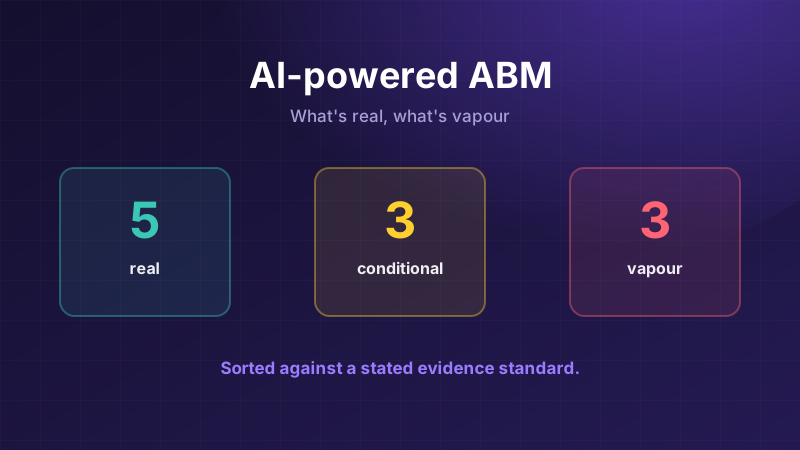
You also get to encode judgement a general model cannot. If accounts that just hired a Head of RevOps close at twice your average rate, you weight that. No vendor model knows that about your business. Vendor scoring is one of three AI capabilities we rate as real but conditional, and the condition is that you validate it yourself: the full sort is in what is real and what is vapour.
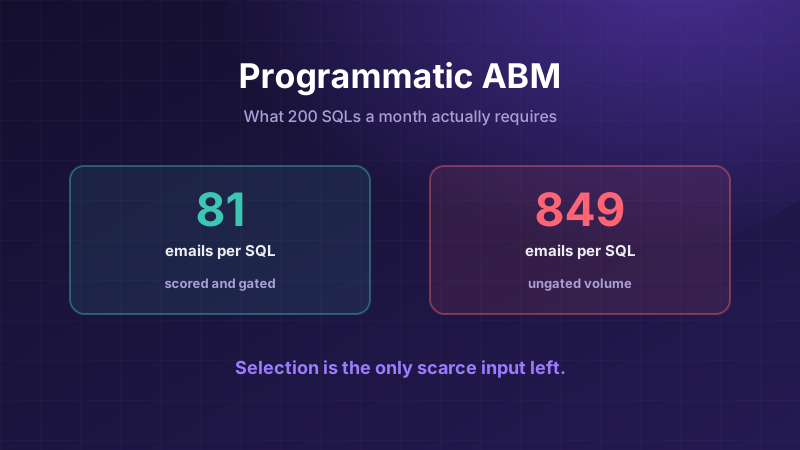
The obvious cost: your model only trains on your own outcome history. If you close twenty deals a year you do not have a training set, and a rules-based model is the honest ceiling. That is fine. Most rules-based models outperform the platform in year one anyway, because they actually get maintained. The scoring architecture we run is set out in programmatic ABM and what 200 SQLs a month actually requires, and the full tables are in the RFE Account Scoring Playbook.
The stack, priced
Realistic 2026 pricing, with the vendor list prices checked in September 2026 and the rest our own build costs. This is the stack we actually run, not a hypothetical. Treat the figures as a build estimate rather than a quote; our own starting prices are published separately.
| Layer | What you use | Annual cost |
|---|---|---|
| Orchestration | n8n Cloud Pro | ~$650 |
| Visitor identification | RB2B Pro+, or a similar tool | $2,400 to $4,800 |
| Third-party intent | G2 Buyer Intent, entry tier | ~$10,000 |
| Waterfall enrichment | Clay or equivalent, credit-metered | ~$4,200 |
| Verification and monitoring | Email verification, uptime, logging | ~$1,500 |
| CRM | Already owned | $0 incremental |
| Sequencing | Already owned | $0 incremental |
| Software subtotal | ~$21,000 | |
| Build | 80 to 120 hours, one time | $10,000 to $15,000 at agency rates, or internal time |
| Administration | 0.5 FTE, ongoing | Identical to the platform route |
Against the platform route at $88,000 to $103,000 in year one before administration, that is roughly a 76% reduction in software cost and no reduction in labour at all.
n8n Cloud is EUR 20 a month on Starter for 2,500 executions and EUR 50 on Pro for 10,000, both billed annually, with unlimited users, workflows, steps and integrations on every plan. RB2B prices on monthly resolutions, from a free plan to Pro+ from $199 a month. Vector now prices on a flat monthly platform fee plus usage credits, which puts it above this budget. Paid G2 Buyer Intent, at around $10,000 a year in our own quote, is the minimum tier exposing account-level signals useful for outreach; the free data is useful for reporting rather than pipeline. For contrast on why Bombora is not on this list at this budget, it publishes no pricing and the entry quotes we have seen sit well above everything else here.
The self-hosting trap
n8n Community Edition is free and every guide leads with that. The honest accounting is different: on our own numbers a production self-hosted instance costs $130 to $230 a month once you count the server and the person who keeps it running, and at low thousands of executions a day we budget roughly half a day a month in patching, backups and execution-data pruning.
Take Cloud unless you have a compliance requirement or an engineer who wants the server. The EUR 50 saved is not worth a broken upgrade on the morning your scoring model was supposed to run.
The execution-count trap
This one costs people real money and almost nobody flags it. An execution in n8n is one workflow run, no matter how many steps it contains or how much data it moves. So a workflow triggering every five minutes generates 8,640 executions a month on its own, which blows the Starter plan's 2,500 limit in nine days. Billing is execution-based rather than step-based, and every Cloud plan now includes unlimited workflows, users and steps, so execution volume is the only lever on your bill.
There is a second reason to care, and it is not about money. When you hit the Cloud execution cap, every workflow pauses immediately. No warning email, no grace period. That turns execution architecture from a billing question into an uptime question: a badly batched build does not just cost more, it stops scoring accounts mid-month without telling you.
Before you build, confirm with your plan how sub-workflow calls are counted, because that assumption will shape half your architecture.
The six workflows
Four of these are obvious and everyone gets to them. The last two separate a working system from an expensive Slack notification generator.
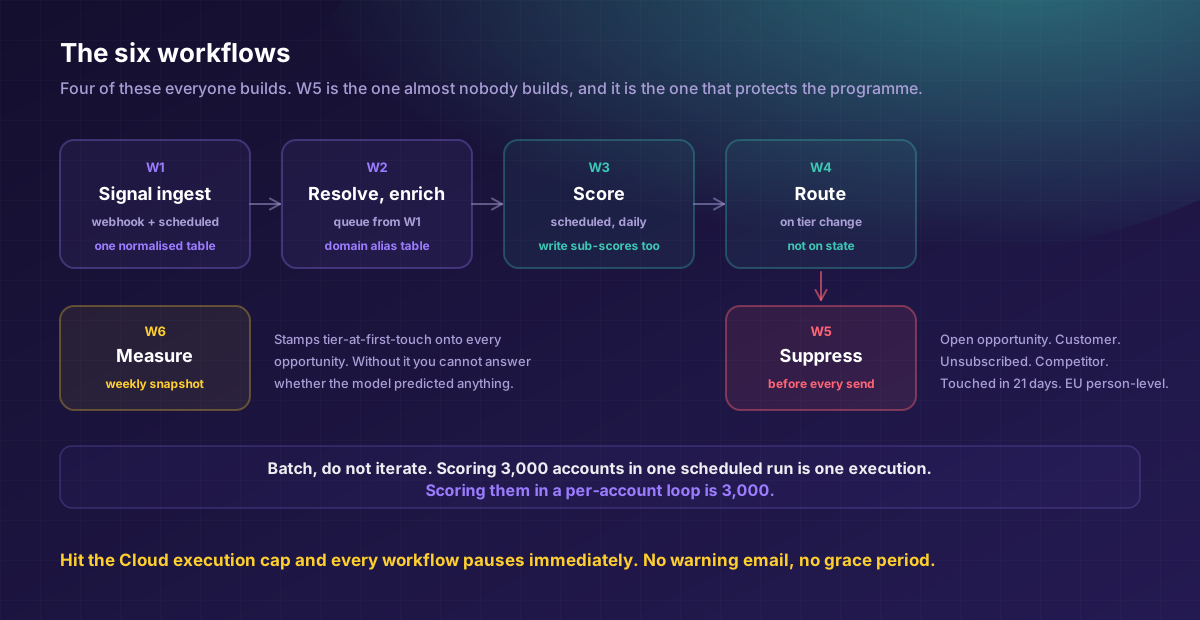
W1. Signal ingest and normalise. Webhook for real-time sources, scheduled for batch pulls. Accepts signals from every source and writes them into one normalised table with a common schema: account domain, signal type, source, timestamp, person identifier where available, raw payload. Every downstream workflow reads from one place. Without this layer you end up with five parallel half-systems and no way to score across them. Sources worth wiring: visitor identification, intent exports, job posting monitors, funding feeds, CRM activity, form fills, review-site activity and email engagement.
W2. Resolve and enrich. Queued from W1. Resolves the signal's domain to a CRM account, creates it if absent and it passes the fit gate, then runs waterfall enrichment. Watch for subsidiary and domain-variant collisions: build a domain alias table early or you will score the same company three times under three records.
W3. Score. Scheduled, daily. Recomputes the score for every account with signal activity in the window, applies decay per signal type, and writes the composite, the tier and the component sub-scores back to the CRM. Write the sub-scores, not just the composite. That decision is what makes the model auditable and it costs nothing. Daily, not weekly: a signal with a three-day half-life routed on day six was not routed. Which signals deserve which decay is its own question, and we ranked thirty of them in the buying signals that actually predict pipeline.
W4. Route. Fires on tier change. Tier 1 sends a Slack alert to the account owner, creates a CRM task with an SLA timestamp, and posts the sub-scores in the alert so the rep can see why. Tier 2 enrols the buying committee into sequencing. Tier 3 syncs to ad audiences only, no outbound touch. Route on change, not on state. Routing on state re-alerts the same account every day until reps mute the channel, which is the most common way these builds die.
W5. Suppress. Called before every outbound action. Blocks the touch if any of these is true: open opportunity, existing customer, unsubscribed or complained, competitor domain, contacted in the last 21 days, person-level identification on a non-US visitor, or account owned by another rep.
This is the workflow everyone skips and the most valuable one in the build. Identification is the easy part; the money is in suppression, routing and message discipline, including not auto-enrolling identified strangers into a cold sequence, which is a deliverability problem nobody selling these tools mentions. The EU rule in that list is not optional caution: company-level identification is generally defensible because a company is not a natural person, whereas person-level identification of EU visitors is much harder to justify, which is why person-level vendors concentrate on US traffic. Gate it in code, not in policy. The wider infrastructure argument sits in the multi-domain cold email setup.
W6. Measure. Scheduled, weekly. Stamps tier-at-time-of-first-touch onto every opportunity created that week, and writes a weekly snapshot of tier distribution to a table you never delete. Without W6 you cannot answer the only question that matters, which is whether the scoring model predicted anything. With it, after two quarters, you can compare win rates by tier at first touch and either defend the model or rebuild it.
The identification layer, honestly
This is where the build route gets unfairly criticised and the platforms get unfairly credited, because both are buying from a similar pool of providers.
Company-level match rates run 30 to 65% depending on traffic source, averaging around 65% for predominantly US traffic and falling hard once international visitors enter the mix. Person-level runs 5 to 20%, averaging around 15%, even using a waterfall of more than twenty data providers. The structural cause is not fixable by anyone: remote work broke the reverse-IP model, and with a majority of workers browsing from home networks, VPNs or mobile connections, those IPs do not map to anything useful.
Treat headline match rates as marketing. Treat any figure of 70% or more as blended or best-case until a vendor proves it on your own traffic.
Accuracy is a separate question from coverage, and it is the one to interrogate. Deterministic matching, where a known identifier ties a visitor to a record, produces materially fewer false positives than probabilistic inference. A tool that confidently returns the wrong person at the wrong company is worse than one that returns nothing, because your rep acts on it.
Where the build breaks
Four failure modes, in the order they usually arrive.
Month 2, data hygiene. Duplicate accounts, domain variants and subsidiary structures. Fix with an alias table in W2 before you scale, not after.
Month 4, alert fatigue. Reps mute the Slack channel. Almost always caused by routing on state rather than change, or a Tier 1 threshold set too low. Recalibrate so Tier 1 produces fewer alerts than your reps can work in a day.
Month 7, silent failure. A provider changes an API response shape, W1 stops writing a signal type, and scores drift downward with nothing visibly broken. Build a canary: a scheduled check that alerts when any signal source writes zero rows in 48 hours. This is the failure mode that quietly kills these builds and the reason people say platforms are more reliable.
Month 12, the owner leaves. The person who built it is the only one who understands it. Document the schema and the weights in a shared doc from week one, and keep workflows in version control if your plan supports it.
When to stop building and buy
Four triggers. When two or more are true, run a platform evaluation properly, and the buyer's guide is the honest version of that comparison.
- Your account universe passes 5,000 and daily batch scoring runs are getting slow enough to matter.
- Account-targeted display spend passes roughly $50,000 a year. At that point the demand-side platform alone is the reason to buy.
- You are being asked for multi-touch attribution in a format your manual reporting cannot produce.
- You have closed enough deals to train a real model and your rules-based scoring has stopped improving.
Note what is not on that list: team size, funding stage, or a competitor buying one. None of those change the arithmetic.
What this does not solve
The stack scores accounts that leave signals your tools can observe. Increasingly, the earliest and most consequential stage of a B2B evaluation leaves no observable signal at all, because it happens inside an AI assistant that produces a shortlist before anyone visits your site. G2's March 2026 survey of B2B software buyers puts AI chatbots ahead of review sites, analyst firms and vendor websites as the top influence on shortlists. No visitor identification tool sees that session. No intent feed captures it. By the time the pricing page visit fires and your model wakes up, the shortlist is set.
That is an answer engine and generative engine visibility problem, and it is a different discipline from anything described here. We wrote it up in winning the answer box, People Also Ask and voice. Worth naming, because a scoring model that only sees accounts already aware of you is working a shorter list than it should be, and no amount of orchestration fixes an absence.
Where we land
The saving is real and it is narrower than the pitch. Software drops about 76%. Labour does not drop at all. Five of seven jobs come across cleanly, one comes across better, and two do not come across.
If media-led ABM is your motion, buy the platform. If you have no owner, buy the platform. If you have 1,000 to 5,000 accounts, a maintainer and a CRM you trust, the build is the better trade, and the reason is not the money. It is that you end up with a model you can open, argue with and improve, instead of a score you have to take on faith.
At Omnitics we run this exact stack, which is why the prices above are ours rather than a survey. That is what our AI workflow and automation practice actually does.
Name three target accounts and we will sketch the plays we would run for each, free: the trigger worth acting on, the buying-committee roles to reach, the angle and the first three touches, plus a short note on whether a platform would earn its keep at your size. If the platform is the right call for your motion, we will say so.
Frequently asked questions
Five of its seven core jobs, yes: account identification, third-party intent, enrichment, scoring and orchestration. Account-based display advertising and full multi-touch attribution cannot be replicated. Software cost drops by roughly 76%, from our own year-one estimate of $88,000 to $103,000 to around $21,000. Administration cost does not drop, because both routes need roughly half a full-time equivalent to run.
Around $21,000 a year in software: n8n Cloud Pro at roughly $650, visitor identification at $2,400 to $4,800 depending on the tool, third-party intent at around $10,000 on our own quote, waterfall enrichment at around $4,200, and $1,500 for verification and monitoring. Add 80 to 120 hours of one-time build and half an FTE of ongoing administration. Vendor list prices checked September 2026.
Cloud, unless there is a compliance requirement or an engineer who wants to own the server. Community Edition is free software, but on our own numbers a production instance costs $130 to $230 a month once the server and the maintainer's time are counted, which exceeds the Cloud plan it replaces. We budget roughly half a day a month in patching, backups and pruning.
It depends on architecture rather than account volume. An execution is one workflow run regardless of how many steps it contains, so a batched scheduled workflow uses one execution whether it processes 30 accounts or 3,000, while a per-record loop uses one per record. A 5-minute polling trigger alone burns 8,640 executions a month. A well-architected build for 3,000 accounts fits inside the Pro tier's 10,000 monthly executions.
Expect 30 to 65% at company level for US-heavy traffic and 5 to 20% at person level. Widely quoted figures of 70 to 80% are company and person blended rather than person-level rates. Remote work broke the reverse-IP model that underpins the category, non-US traffic performs materially worse, and person-level identification of EU visitors is difficult to justify.
Less predictive, more auditable, and more likely to be used. Vendor models are proprietary and closed, and the common complaint is that there is no way to see what drove a particular score. A model whose components can be opened and challenged gets trusted and maintained. A model reps do not trust produces nothing regardless of its accuracy.
Suppression. Most teams build signal ingest, scoring and routing, then skip suppression entirely. A suppression layer that runs before every outbound action blocks contact with existing customers, open opportunities, unsubscribed contacts, competitor domains and recently touched people. It is a credibility safeguard and a deliverability one at the same time.
When two or more of these are true: your account universe passes 5,000 and batch scoring runs are getting slow, account-targeted display spend passes roughly $50,000 a year so the demand-side platform alone justifies the licence, you are being asked for multi-touch attribution your manual reporting cannot produce, or you have closed enough deals to train a genuine predictive model. Team size, funding stage and a competitor buying one are not on that list.