Written by the Omnitics team, three operators who have worked alongside SaaS companies through the exact revenue inflections T2D3 describes. We have seen the model used as a compass, and we have seen it used as a loaded gun pointed at the company's own foot.
T2D3 is one of those frameworks that circulates in boardrooms with the confidence of scripture. It is not a strategy. It is a benchmark, and the distance between those two things is where companies get hurt. Used as a yardstick, T2D3 is genuinely useful. Used as a target to be hit at any cost, it has burned out more good teams and incinerated more cash than almost any other number in SaaS, all while looking excellent on a slide.
So let us do something most write-ups of T2D3 skip on their way to the inspirational bit: explain exactly what it is and where it came from, walk the real math, lay out what each phase actually demands from the people living it, and then say plainly when chasing it is the wrong move. If you have ever quietly felt like a failure for not tripling, part of this guide exists to recalibrate that feeling.
What T2D3 actually is, and where it came from
T2D3 stands for Triple, Triple, Double, Double, Double. It describes a revenue path: a SaaS company triples its annual recurring revenue for two consecutive years, then doubles it for each of the following three.
It was coined in 2015 by Neeraj Agrawal, a General Partner at Battery Ventures, in an essay called "The SaaS Adventure" (first published on TechCrunch). Agrawal had noticed a pattern. A set of companies that went on to become category leaders (Salesforce, Workday, Zendesk, NetSuite, ServiceNow, Marketo, Omniture) had each roughly walked this revenue path on the way to scale. As he put it, venture capitalists are pattern recognizers at heart, and this was the pattern. He framed it as a mountain climb with seven distinct go-to-market phases, each demanding a different operational focus.
Two things about the origin matter and usually go missing in the retelling. First, Agrawal himself called it one sure-fire path, not the path, and openly named companies (Cornerstone, ExactTarget, SuccessFactors) that reached the summit by other routes. Second, it was always a go-to-market model. It describes the revenue curve and the operational sequencing that supports it. It does not describe everything that must be true for a company to be healthy, which is a caveat the framework's fans tend to leave off the slide.
The math (and why it feels impossible)
The model assumes you begin after you have found product-market fit, at roughly $1 to $2 million in ARR. That starting point is the entire game. T2D3 is not a plan for reaching your first million; it is a plan for what happens once you have.
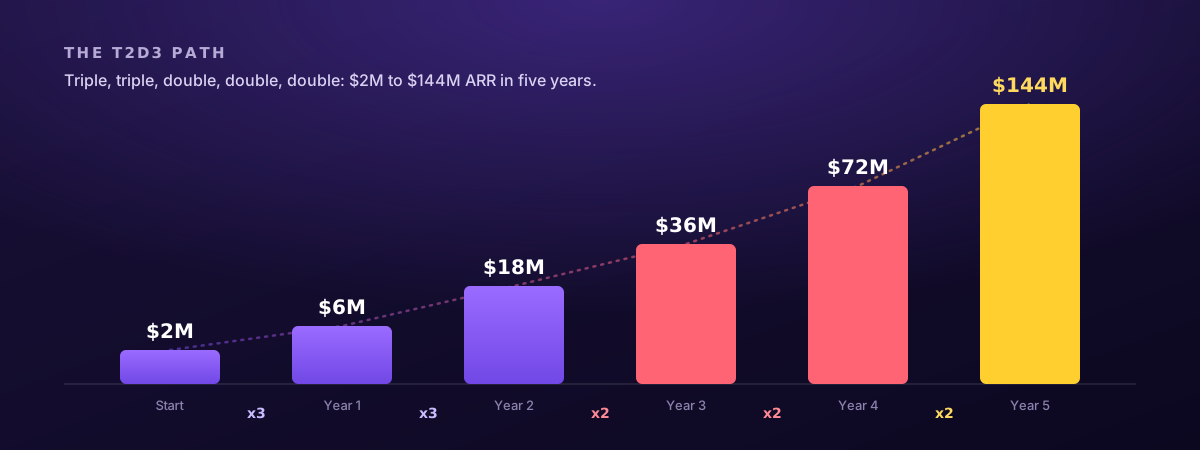
Starting from $2M ARR, the path looks like this:
| Year | Growth | ARR |
|---|---|---|
| Start | base | $2M |
| Year 1 | 3x (triple) | $6M |
| Year 2 | 3x (triple) | $18M |
| Year 3 | 2x (double) | $36M |
| Year 4 | 2x (double) | $72M |
| Year 5 | 2x (double) | $144M |
Two consecutive triples followed by three doubles compound a $1 to $2M company into roughly $100M+ ARR in five to six years, and, historically, into a valuation near the $1 billion "unicorn" mark. (Start from $1M and you land near $72M; start from $2M and you clear $140M. The exact endpoint depends on the base, but the shape is the message.)
Laid out like that, you can feel both why investors adore it and why it is quietly brutal. Tripling revenue once is hard. Tripling it twice in a row and then doubling for three more years requires nearly everything in the company to scale in lockstep, pipeline and hiring and onboarding and support and infrastructure, without a single wheel departing the axle. Many companies that attempt it miss. That is not a personal failing; it is the base rate wearing its everyday clothes.
What each phase actually demands
The revenue numbers are the scoreboard. The real content of T2D3 is what you have to get right operationally at each stage. Agrawal's seven phases compress into a handful of transitions, and those transitions are where companies either level up or come apart.
Before you start: earn the right. T2D3 begins only after genuine product-market fit. The work here is relentless customer discovery, understanding how urgent the problem is and how completely your product solves it. Applying T2D3 acceleration before PMF is how you scale a leaky bucket and reach insolvency ahead of schedule. Do not start the climb until the foundation holds your weight.
The triple years ($2M to $18M): build a repeatable sales engine. The defining task of the first two years is converting founder-driven, artisanal selling into a repeatable, hireable motion. You are hiring reps, and, more importantly, the systems and managers around them. Agrawal describes the moment a deal closes with no founder involvement as "magical," and it is, because it is proof the motion is real and not merely founder charisma in a good suit. If you cannot manufacture that moment on purpose, tripling is not coming, regardless of how much you spend trying to buy it. Before you hire reps to hit a triple, work out what T2D3 demands of your pipeline: turn the revenue target into sales-qualified leads with your own win rate and deal size, then trace each rate back to a scored account list with our worked programmatic ABM model.
The transition to doubling ($18M to $72M): scale the organization and go international. Now the bottleneck moves from "can we sell?" to "can we build the organization?" This is strategic hiring, real sales management, and disciplined geographic expansion. The classic error is entering five countries at once out of ambition; the discipline is to pick two or three (Agrawal's example for EMEA is Germany, the UK, and France), build genuine presence, and expand only then. Each new region needs its own customer profiles, its own sales playbook, and a real local leader, not a flag planted from headquarters and a hopeful email.
The later doubles ($72M to $144M+): operational maturity and the right kind of leverage. At this altitude the questions turn to non-linear growth: channels, partners, resellers. Agrawal's specific, hard-won advice is not to push hard on resellers and channel partners until you are around a $50M run rate, because below that, partners will not prioritize you over their bigger bets, and you will spend a year learning that in real time. Quality over quantity still rules: one or two strong partners beat ten indifferent ones who each assumed the others were handling it.
Where teams actually break (the part the slide deck omits)
We have watched companies stall at every one of these transitions, and the patterns are depressingly consistent.
They scaled before PMF. The most expensive mistake in the catalogue. T2D3 spend applied to a product the market does not urgently want buys a brief revenue bump and a brutal churn cliff to follow. Growth that compounds instead starts with targeting the right accounts, not spending harder against the wrong ones. The triples were purchased, not earned, and purchased triples do not renew.
They hired ahead of the playbook. Tripling pressure pushes teams to hire reps fast, but reps dropped into an undocumented, founder-dependent motion fail, and now you are paying for a sales team that cannot sell and a founder who is still personally closing every deal at 11pm. The motion has to be repeatable before you pour people into it, or you are just adding witnesses.
They confused the benchmark with the strategy. This is the big one. Chasing the T2D3 number leads teams to do unnatural things to hit it: discounting to inflate bookings, selling to anyone with a pulse and a credit card rather than to the ICP, entering markets they are not ready for, and burning capital and people on growth the business cannot sustain. The number is a symptom of a healthy, scaling company. Optimizing the symptom directly while ignoring the underlying health is how you triple your way into a crisis, on schedule.
They underestimated the capital and the human cost. T2D3 is capital-intensive by design. It generally assumes aggressive fundraising to fund the growth, which means that if the targets slip, the company can find itself over-extended on a burn rate it raised against and cannot easily walk back. The human cost is just as real: the model carries genuine burnout risk, because nearly everything has to scale at once and the team is the thing absorbing the strain.
The modern reframe: read T2D3 in today's market
T2D3 was articulated in 2015, in a very different funding climate, and the smart way to use it now has shifted in two ways worth knowing.
The bar at the top has risen. For the most elite, premium-valued startups, some investors now mutter about T3D3, triple, triple, triple, double, double, reflecting that the price of the highest valuations went up as thousands of SaaS unicorns were minted and rarity stopped being rare. You do not need to hit even T2D3 to build a great company, but it is worth knowing the top end moved while you were reading the old blog posts.
Efficient growth replaced growth-at-all-costs. The era of growth at any burn is over, and it is not coming back to apologize. Today, T2D3-style growth is judged alongside capital efficiency, most concretely through the Rule of 40 (your growth rate plus your profit margin should clear 40%). The honest modern reading of T2D3 is this: the trajectory is impressive if, and only if, it is achieved with reasonable efficiency. Tripling while setting money on fire is no longer a flex. It is a risk flag with a bow on it.
So should you chase it?
Use T2D3 the way Agrawal originally intended: as a benchmark to measure against and a sequencing guide for which operational problem to solve next, not as a target to hit at any cost.
It is a reasonable yardstick if you are a venture-backed B2B SaaS company past product-market fit, with a large market, deal economics that support aggressive scaling, and both the capital and the stomach for it. Even then, remember the trajectory is the output of getting the operational phases right, not an input you can summon by wanting it hard enough.
It is the wrong frame if you have not nailed PMF, if your market or model favors efficient and durable growth over a moonshot, or if "hitting the number" would push you to do things that quietly damage the company's health. Plenty of excellent, valuable SaaS companies grow more slowly and win anyway. Slower growth is genuinely harder in some respects, since growth rates tend to decay over time and fast-growers hoover up the talent and customers, but "did not triple" is not a synonym for "failed," no matter how the board meeting felt.
If you have been silently measuring yourself against T2D3 and feeling behind, here is the recalibration. The model describes the rare path of a specific kind of venture-scale company in a specific market window. It is a good map of one mountain. It is not the only mountain, and it is certainly not a verdict on your company.
Growth that compounds starts with the right accounts. Name three accounts you want to win next quarter and we will sketch the plays we would run for each, free: the trigger worth acting on, the buying-committee roles to reach, the angle and the first three touches. You keep it whether you hire us or not.
Frequently asked questions
T2D3 stands for triple, triple, double, double, double: a SaaS revenue path where a company triples ARR for two years, then doubles it for three. It describes the trajectory of some category-leading SaaS companies on the way to roughly $100M ARR.
No. T2D3 is a benchmark, not a strategy. It describes an outcome, and treating the outcome as a plan is where teams get hurt. The real work is in the underlying motion, not the multiplier.
The tripling years usually depend on nailing product-market fit and a repeatable early motion. The doubling years shift the challenge to scaling go-to-market, hiring, and operations without breaking what already worked.
When the growth rate outpaces genuine product-market fit or healthy unit economics, forcing T2D3 burns capital and people. For many companies a slower, durable curve is the healthier target.